Author Archives: Matthew De Abaitua

how to write science fiction

How to Write Science Fiction

Not that I consider myself an expert. A neophyte, still. But I’ve gleaned some ideas from other more experienced writers and put together an article on writing science fiction for Publishing Talk, here.


Here is an extract about robots:

Robots replace workers, and they always have, ever since a sorcerer first summoned a golem to clean up his lair.

Think of all the people in the public service you encounter across the course of your life: midwife, nursery assistant, nanny, primary school teacher, youth worker, fireman, policeman, lawyer, parole officer, prison officer, doctor, surgeon, palliative care nurse, undertaker. Then replace them all with robots, many different mechanical bodies but all guided by one cloud-based intelligence.

In this world, the machine gaze that first greets you when you come into the world will be the same diffident, algorithmic mind which lowers you into the earth.

Angry Robot acquire novels

Giddy with excitement, I can announce that publisher Angry Robot have acquired my next two SF novels: IF THEN, for publication in the UK and US in September 2015, and The Destructives in 2016. The full announcement is on the Angry Robot site.

angry-robot angry robot logo

IF THEN is finished and I’m keen to discover what readers make of it.  For now, I’m just sharing the synopsis. As publication draws nearer, more cat will be allowed out of the bag.

IF THEN

James has a scar in the back of his head. It’s where he was wounded in the Battle of Suvla Bay in August 1915. Or is the scar the mark of his implant that allows the Process to fill his mind with its own reality?

In IF, the people of a small English town cling on after an economic collapse under the protection of the Process. But sometimes people must be evicted from the town. That’s the job of James, the bailiff. While on patrol, James discovers the replica of a soldier from the First World War wandering the South Downs. This strange meeting begins a new cycle of evictions in the town, while out on the rolling downland, the Process is methodically growing the soldiers and building the weapons required to relive a long lost battle.

In THEN, it is August 1915, at the Battle of Suvla Bay in the Dardanelles campaign. Compared to the thousands of allied soldiers landing on this foreign beach, the men of the 32nd Field Ambulance are misfits and cranks of every stripe: a Quaker pacifist, a freethinking padre, a meteorologist, and the private (once a bailiff) known simply as James. Exposed to constant shellfire and haunted by ghostly snipers, the stretcher-bearers work day and night on the long carry of wounded men. One night they stumble across an ancient necropolis, disturbed by an exploding shell. What they discover within this ancient site will make them question the reality of the war and shake their understanding of what it means to be human…


dinner party wars by matthew de abaitua

The Dinner Party Wars

My short story ‘The Dinner Party Wars’ can be read for free and in full at alternative literary site 3:AM. It’s about the highly formalised duelling that goes on between the dinner party set in London. Only vintage weapons are allowed.

I wrote ‘The Dinner Party Wars’ over ten years ago, and published it in The Idler. Fortunately 3:AM fiction editor Joanna Walsh aka @badaude remembered the story, and asked me if they could reprint it. I published a batch of short stories in The Idler in this ilk: comic, media-inspired, riffing pieces. Often I would finish writing on a Thursday then perform the story on a Friday night at the Idler parties in the TARDIS in Clerkenwell. So the voice is broad and comic. Most have dated but I remain fond of The Dinner Party Wars because it sprang fully formed from a dream, and retains a distinct but fitting strangeness.


Still from Ed Atkins' Ribbons

Head Space

In conversation with Ed Atkins for Frieze Magazine, September 2014

Still from Ed Atkins' Ribbons

I meet with Ed Atkins in a side room of Cabinet, a London gallery close to the cluster of tech start-ups around the Old Street roundabout. As a science fiction writer, I’m interested in how technology is changing us, and how art is tracking those changes. Atkins’s video work ‘Ribbons’ (2014) – which, on different screens, formed the heart of his recent untitled solo exhibition at the Serpentine Sackler Gallery in London – follows the self-debasement of a naked, tattooed, computer-generated avatar as it puts away the fags and booze with abandon. It speaks with Atkins’s voice.

The avatar can play the doppelgänger, unleashing the dark self. The troll. The hater. But ‘Ribbons’ also explores how we are in a feedback loop with technology. At the entrance to the Serpentine exhibition, a screen showed a computer-generated head bouncing endlessly down a flight of stairs; it created a grisly punctuation. The loop is a signature of our times, whether in musical beats or GIFS. The loop is repetition, over and over again in the now. It’s very important to be kept in the loop.

Read the conversation at Frieze

Will Self poses with lobster

Self & I at Port Eliot

I’m going to read from Self & I at the  Port Eliot festival, 2014. The festival runs from July 24th to July 27th and is held on the beautiful St Germans Estate. I am performing on Friday 25th of July on the Five Dials stage between 4.45PM and 5.30PM.

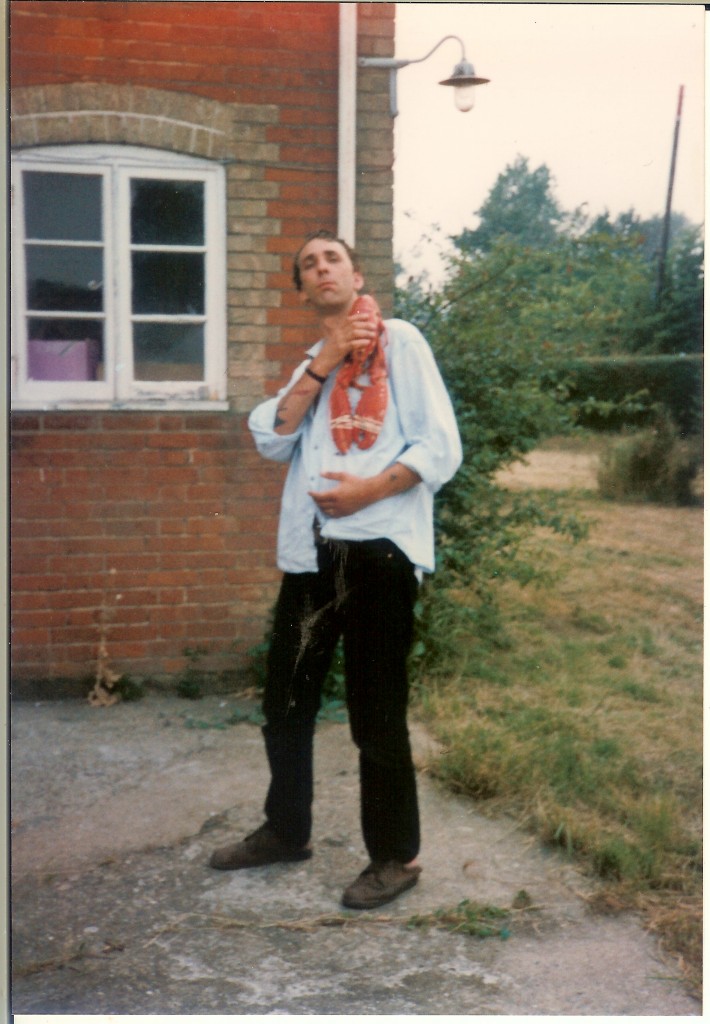
‘Self & I’ is a memoir about the six months I spent working and living with Will Self in a remote Suffolk cottage in the summer of 1994, exactly twenty years ago. I published an essay-length version in Five Dials magazine, and have since worked the material up into a book-length memoir of literary ambition.

Here is an extract of the new material, drawn from when I first arrived at 1 Hall Cottages.
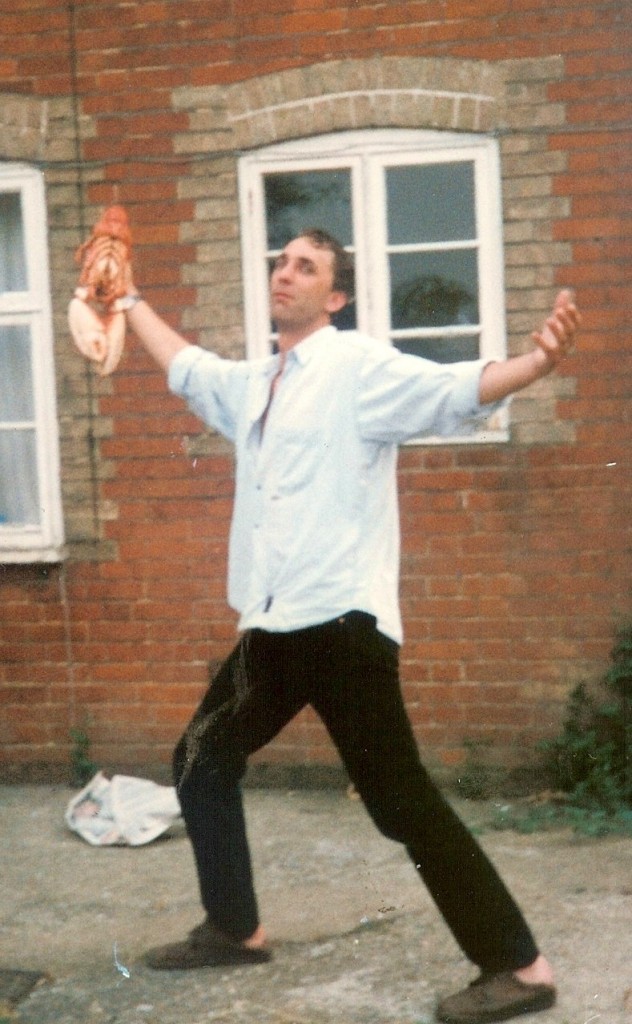
Will Self with lobster


The cottage is one of a semi-detached pair of worker’s cottages, authentically rural in their sparse utility, and in no way bucolic. We park on a rutted path that runs between wide flat fields and ‘a liner-shaped copse’ (as described in Will Self’s short story ‘Flytopia’). The rippling wheatfield is a deep pile of soft, closely-packed fibres. The hedges are frozen bursts of thorn and tangle obscuring a drainage ditch which runs along this lull, this dip, that I am about to call home.
We go through the small gate. The long grass in the back garden is scorched, brittle and ochre. Pushing its way between the flagstone and the neglected turf, a single opium poppy lolls under its own heady weight.
Will crouches down, and dents the pale papery head of opium with his forefinger.
’Fucking ironic,’ he says, walking on.
‘What do you mean?’
He disappears into the house.
The front room is his study. It contains a desk, a selection of adored typewriters in their sheathes, a wheezing Amstrad word processor and printer with the special box of printer paper, a fax, again requiring its own particular stationary, and then the book shelves, one of which is occupied by various editions and translations of his own books: the debut short story collection A Quantity Theory of Insanity, the conjoined novellas of sexual transmogrification *** & Bull, and the debut novel My Idea of Fun, largely represented on this shelf in the scarlet-trimmed, card-covered Atlantic Press edition.


The flock wallpaper is obscured by yellow post-it notes on which he has scrawled gnomic images, observations, commandments, themes, characters. I’ve never seen a work-in-progress exteriorised in this way before: the aide memoires, the prompts, the grit about which the imagination accretes. Post-it notes because their weak glue allows them to be easily reconfigured, for images to agglomerate and overlap.
The living room is small and bare with no television and no furniture. Two dozen coils of flypaper hang down from the ceiling, each riddled with flies. Most are dead, but some flies are still alive and struggle against the gum. The previous winter, the drainage ditch which runs alongside the cottage flooded and sludge seeped into the house, seeding the walls with fly eggs. Now it is summer and the eggs have hatched.
Matthew De Abaitua with lobster
I put down the box containing my stereo and watch a fly hop up a strand of flypaper, using the backs of its gummed comrades as stepping stones. Upon discovering a still-living fly, the liberated one buzzes furiously in an act of rape.
‘No, not rape,’ says Will. ‘Look more closely. Its proboscis is going into the chink between head and thorax. It is feeding.’
‘Fucking ‘em and eating ‘em,’ I whisper.
We stand quietly in the empty fly room.
‘I want you to buy a sofa for here,’ says Will. ‘As cheap as you can find.’
This residence, temporary and rented, will be appointed with masculine functionality, containing all that we need to write, and nothing more. No distraction, no adornment.
He shows me the six binbags containing his possessions, ransacked before taking leave of the family home.
‘I want you to unpack these bags,’ he says.
‘What if I come across anything private?’
‘It’s all private, Matthew. I’m trusting you. I can’t unpack them. It’s too painful. When you’ve left a family like I have.’ He leaves the thought there, and I am too young to know if it is complete or incomplete.
‘Buy a filing cabinet,’ he says. ‘And organise it all. White folder for personal and driving related material. The red folder for work. The folder with the black trim for money.’
The kitchen is a narrow galley. On top of the empty fridge, there are vials of oils in which strange shapes float. Are they miniature Damien Hirsts, or carnival oddities? A twig of rosemary intertwined with oregano floats like a spinal column with attached nervous system: flavoured olive oils bought by his girlfriend Victoria from Selfridges Food Hall. Something feminine.
Will shows me a tub of Lavazza and the coffee pot.
‘Fresh coffee goes in here,’ he holds up the pot.
‘Used grains go in here,’ he holds up an old Lavazza tub.
‘Why do you keep the used grains?’ I ask.
This question rattles at the bottom of a deep well.
Upstairs, he shows me my room.
‘There is no bed. Not yet. I ordered one but it won’t arrive until tomorrow. You can sleep in my bed tonight.’
‘I… I…’
‘I won’t be in the bed, Matthew. I’ll drive to London and sleep there.’
‘I couldn’t possibly. I’ll sleep on the floor’
‘Take the bed. Mi casa, su casa.’
I’ve never heard this phrase before.
He translates for me, ‘My house, your house. I will drive to London, to Victoria’s place, and then bring her back tomorrow. You’ll need some money for a bike and things. Start sourcing what we need. I want bunk beds too, for the kids when they visit. Linen, pillows, and a duvet for yourself. And an axe for chopping wood. There is a long list. We’ll go over it tomorrow.’ He hands me a hundred quid.
‘Get receipts for everything.’
I make us some coffee, storing the used grounds as per instructed. We drink it while admiring the flypaper. And then he is gone, and I am alone with the flies.
Will Self with lobster 2

Arc 2.2 Chromewash

The Destructives in Arc 2.2

My short story The Destructives is published in Arc 2.2, available on tablet, mobile etc. It’s pleasing to be in such august company (M John Harrison, Ned Beauman, Joanna Kavenna, Jane Rogers, Michael Marshall, Simon Ings – and that’s only the authors I have on the SF bookshelf behind me).

Arc 2.2 Chromewash

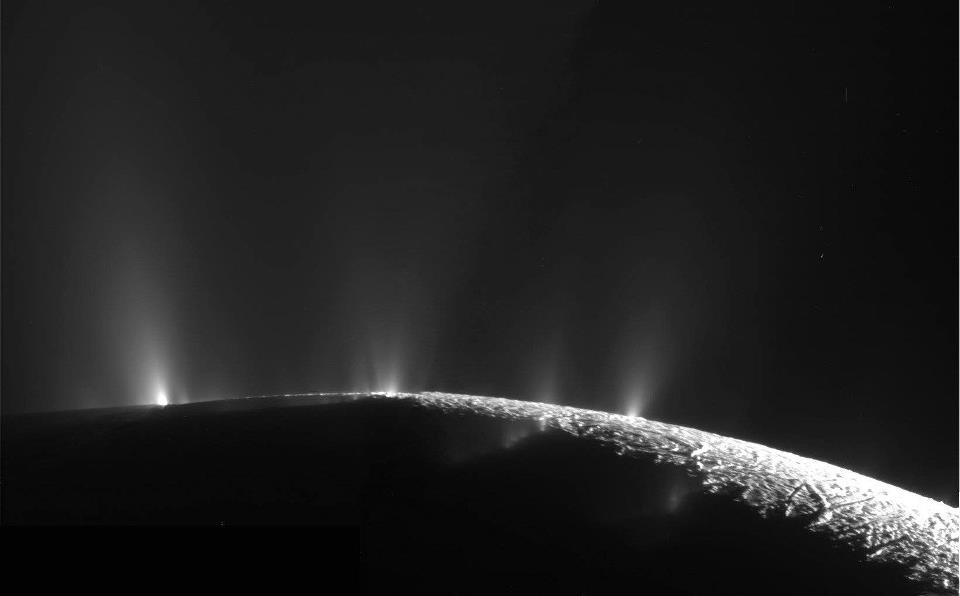
As short stories go, The Destructives is pretty long – about six thousand words. I wrote it in the wake of finishing a novel, from an initial idea of ‘Mad Men in Space’. It’s set under the ice of Europa and so I was able to use the latest discoveries about that intriguing and promising moon.

Here is an extract:

The pod surfaces in a moon pool within the habitat. As the client promised, Alex is met by Petra Elisson, the middle generation of the would-be-dynasty of the Europan Elissons. Petra is in her late thirties, with good skin, her ethnicity somewhere between New York and Tokyo; she is let down by provincial tailoring and a haircut so unfortunate it merits a card of condolence.
Alex corrects the line of her trouser suit and the sweep of her jet-black fringe then steps out onto the landing stage. The air pressure is not quite right and neither is the gravity. Disembarking with dignity requires some concentration.
“Pleasant flight?” asks Petra Elisson.
“Always.”
“The rest of the team not coming?”
Alex points upward in the direction of outer space.
“The destructives remain on board The Significance for now.”
“Then they will miss out on all the fun.”
In response to Petra’s joke, Alex finds a suitable smile.
The walkway is a narrow girder surrounded by illuminated transparent tubing. Outside, a question mark of megafauna swirls through the dark water. Her eyes will have to adjust before she can appreciate the subtle differences of darkness.
“We’re all very excited about your presentation,” says Petra. “It’s an honour to have the creatives who reinvented the flutterby working on our account.”
She wants to correct her: not creatives, the destructives.
The flutterby had been developed as a flying protein snack for hard-partying twentysomethings in lowgrav environments but the novelty of a self-propelled salty treat could not offset cultural aversion to eating anything that resembled an insect. The product trials tanked. The destructives repositioned it as the snack for feliners who really like to play with their food.
The existence of hybrid species such as the feliners and caniners had threatened heresy against market fundamentalism. But the trajectories of the hybrids were plotted, and it was predicted that they would not become a threat to the culture. Indeed, hybrid species opened up new product categories in everything from snack foods to home furnishings, and as hybridisation was accompanied by a drop in intelligence, clients didn’t have to spend so much on media to convert them into customers. It was just a shame she found the hybrids so repulsive. But then, as Bougas said, when he came into her hotel room and opened his robe, revealing a satyr’s gut and an afterthought of genitalia: “Disgust, madam, is a cultural construct.”

The story is complete in itself but it is part of a much larger world, a much bigger story, spanning generations.

Arc is published by the New Scientist and is an inspiring, thought-provoking collection of future shock and other speculations.

Out There, Guide to the Solar System

Out There – the Solar System for Tourists

matthew de abaitua, Out there, Herb Lester, map of the solar system
I’ve long been an admire of the stylish maps and guides produced by Herb Lester. So when they asked me to write a guide to the solar system for any prospective tourists, I was keen to do it. Our understanding of the solar system has changed so much since I was a boy, even within the last decade, and researching this guide brought home its awe-inspiring strangeness. Out There been beautifully designed by Paul Rogers so please buy a copy from Herb Lester for yourself or for the aspiring space tourists in your life.

outthere6

outthere7

Buy Out There: The Solar System for Tourists

Failed Job Interviews of a Novelist

In November 2013, I was invited by LDNIA to speak at their gathering held in the Albion agency in Shoreditch. LDNIA is a network of designers, information architects and writers. To open my talk, I performed an imaginary dialogue based on a couple of failed job interviews I had in the previous decade. Gollancz are running an edited version of that dialogue on their blog.

The geysers of Enceladus

Music To Write Science Fiction By

I’m writing a series of interconnected science fiction stories called ‘The Destructives’. The first will be published in March 2014 by Arc, the longform SF and futuristic tablet publication from the New Scientist. I write to music, using it as a way of cueing in the state of mind required for the story. I put this mixtape together for Australian magazine The Lifted Brow, culled from the three hour-or-so Destructives playlist.

Matthew De Abaitua – A Mix for the Lifted Brow by The Lifted Brow on Mixcloud