Category Archives: Books

Self and I, matthew de abaitua, TLS, review

Self & I reviews

My memoir Self & I has been reviewed widely in the UK. Here is the review in the Times Literary Supplement.

Self and I, matthew de abaitua, TLS, review

Review in The Spectator, Financial Times, The Guardian.

You can also listen to me talking to Janice Forsyth about Self & I to Radio Scotland.

See also the review below from The Oldie.

Where there’s Will…
Self & I By Matthew De Abaitua

Hamish Robinson

Eye Books £14.99

Oldie price £11.31 inc. p&p via Wordery

This book comes very close to being a classic memoir of literary apprenticeship. It’s a rich field – one thinks of De Quincey on Wordsworth, Hazlitt on Coleridge or Richard Kennedy’s A Boy at the Hogarth Press – dominated by one masterpiece, Boswell’s Life of Johnson.

As well as being a full biography, the Life is also a study in passionate discipleship. When Boswell described Johnson attempting to flip the corpse of a drowned cat over a weir with the aid of a long pole, he was clearly aware of the comic opportunities available to the hovering scribe.

Don Quixote and Sancho Panza are the supreme examples of the master/disciple relationship, where the conceit of one can be endlessly entangled in the credulity of the other.

The Quixote to Matthew De Abaitua’s literary Sancho is the novelist Will Self. In 1994, De Abaitua, then a 22-year-old graduate of the UEA Creative Writing MA, found himself being interviewed at a party for a job as an ‘amanuensis’ by the recently separated, 32-year-old Self. At a second interview, conducted at the remote Suffolk cottage where Self lived in retreat, after a ‘special cigarette’ and some preliminary shooting at beer bottles with an air gun, De Abaitua receives his job description:

‘I am to acquaint myself with the oeuvre – not merely his works, but the works he will be writing about. I must read the library of influential literature in the study, and related works concerning drugs, psychoanalysis and anthropology. Secondly, I can bring no Class A drugs into the house, nor am I permitted to drink more than the government-recommended 24 units of alcohol a day. I am to do whatever I am asked. Nothing is beneath me: laundry, transcriptions, fetching and carrying.’

‘The oeuvre’ is authentic Self – nor was there anything deceptive about the job description. An hilarious sequence of episodes follows, including nudity, gasmen, dangerous driving, game birds, crazed phone calls from Brazil, the inevitable lobster à la Nerval and long night walks from pub to pub, all peppered with Selfian pronouncements and bons mots.

Most evocative perhaps is the account of the hungover pair taking ‘the Sizewell cure’, a dip in the warm sea surrounding the offshore pumping station attached to the nuclear power plant a few miles from their cottage, a numinous spot for psychogeographers.

‘We should live here,’ says Self on coming across a house to rent in the lee of the power station overhung with sizzling power lines. As the innocent De Abaitua’s foil, Self is a truly majestic comic creation – ‘We’re like the Ladies of Llangollen out here,’ he remarks to a visiting journalist by way of explaining their ménage as he scrubs potatoes.

One only wishes their partnership had endured longer than six months. Had De Abaitua stuck to Self like Watson to Holmes, we might have come into possession of a literary fiction to stand alongside even ‘the oeuvre’ itself. As with all great comic characters, Self has no sooner left the page than one wishes him back. This sense of loss marks, if not a flaw, then at least a faultline in the book.

Self & I bears a subtitle: A Memoir of Literary Ambition. Eking out, and eventually supplanting the ‘Will Self Industry’ story are more earnest chapters. They’re devoted to the author’s parents, his upbringing in Merseyside, relations with his girlfriend El, and his transformation from a provincial student to London literary insider to novelist/creative-writing teacher.

These are excellent – one of the book’s strengths is its sensitivity to changes in the idea of the literary life as embodied now by Self toiling away with a typewriter in a muddy cottage, now in the apparently epicurean, but strangely hydroponic world of The Idler magazine and its parties. But they tell of an ambition tamed and brought to reason.

“They only want you to do the wrong thing”

Jonathan Thornton visited me in Hackney for an interview he transcribed in its entirety for Fantasy Faction. I treated him to warm gozleme on Broadway Market and then coffee in the battered armchairs of Edgars. His transcription captures every molecule of caffeine in my brain. Our discussion ranged over my three SF novels and their connection to my book on camping. It can be read here.

Self & I to be published in 2018

In Spring 2018, Self & I: A Memoir of Literary Ambition will be published in the UK by Eye Books.
The memoir focuses on the six months in the early nineties when I lived and worked as Will Self’s amanuensis in a remote Suffolk cottage.

I wrote this book for three reasons. First, it grew out of a number of memoir essays I planned and wrote around my fortieth birthday, arising out of a personal desire to look back and make some shape out of parts of my life. Secondly, I believed that the memoir would be a way of capturing the culture of early Nineties period, 1994-1997, from the inside, a time swept away by events and times of greater historical import and which – in retrospect – has an innocent cast. Thirdly, I wanted to memorialise wanting to be a writer. My then-unfulfilled and confused yearning to write is depicted alongside Will Self’s achieved works as a way of considering literary ambition from both sides, the aspirant author and a notorious one.
As the title suggests, it’s also a riff on Bruce Robinson’s Withnail and I, in which two aspiring actors go on holiday by mistake. My depiction of Will Self is inspired by Robinson’s alluring but unknowable Withnail.

A version of this book was originally slated for publication in 2016 but the then-publisher closed their non-fiction list. The manuscript waited around for me to return to it and had to wait for me first to write The Destructives (Angry Robot, 2016) and then make substantial progress on another SF novel. The delay was all down to me.
Once we had confirmation of Eye Books’ interest in the memoir, I set about adding chapters and reshaping the narrative in ways that I’d been idly plotting in the intervening year or so. Memories can take time to work their way to the fore. In writing about your past, you turn events around in the light, trying to figure out if they meant what seemed to mean at the time, or if you had missed a vital nuance.
The resulting book is considerably expanded over the version first slated for publication, and in my opinion, it is much-improved.
Here is the official announcement and cover.

The cover of The Red Men by Matthew De Abaitua by Raid71

The Red Men in America

My novel The Red Men will be published by Angry Robot in the US this November 2017.

It will be the first time that the novel is available in America. Readers will get the chance to read the loose trilogy comprising The Red Men, IF THEN and The Destructives together in one swoop. Because Angry Robot are lovely, the novel has a new cover by Raid71.
The cover of The Red Men by Matthew De Abaitua by Raid71
The three covers follow a theme of doubling. Two realities intersect in each one. The trilogy sure looks purdy.
The three novels in Matthew De Abaitua's science fiction trilogy

Barnes & Noble have a feature on the new edition, which you can read here.

Will Self poses with lobster

Self & I at Port Eliot

I’m going to read from Self & I at the  Port Eliot festival, 2014. The festival runs from July 24th to July 27th and is held on the beautiful St Germans Estate. I am performing on Friday 25th of July on the Five Dials stage between 4.45PM and 5.30PM.

‘Self & I’ is a memoir about the six months I spent working and living with Will Self in a remote Suffolk cottage in the summer of 1994, exactly twenty years ago. I published an essay-length version in Five Dials magazine, and have since worked the material up into a book-length memoir of literary ambition.

Here is an extract of the new material, drawn from when I first arrived at 1 Hall Cottages.

Will Self with lobster


The cottage is one of a semi-detached pair of worker’s cottages, authentically rural in their sparse utility, and in no way bucolic. We park on a rutted path that runs between wide flat fields and ‘a liner-shaped copse’ (as described in Will Self’s short story ‘Flytopia’). The rippling wheatfield is a deep pile of soft, closely-packed fibres. The hedges are frozen bursts of thorn and tangle obscuring a drainage ditch which runs along this lull, this dip, that I am about to call home.
We go through the small gate. The long grass in the back garden is scorched, brittle and ochre. Pushing its way between the flagstone and the neglected turf, a single opium poppy lolls under its own heady weight.
Will crouches down, and dents the pale papery head of opium with his forefinger.
’Fucking ironic,’ he says, walking on.
‘What do you mean?’
He disappears into the house.
The front room is his study. It contains a desk, a selection of adored typewriters in their sheathes, a wheezing Amstrad word processor and printer with the special box of printer paper, a fax, again requiring its own particular stationary, and then the book shelves, one of which is occupied by various editions and translations of his own books: the debut short story collection A Quantity Theory of Insanity, the conjoined novellas of sexual transmogrification *** & Bull, and the debut novel My Idea of Fun, largely represented on this shelf in the scarlet-trimmed, card-covered Atlantic Press edition.


The flock wallpaper is obscured by yellow post-it notes on which he has scrawled gnomic images, observations, commandments, themes, characters. I’ve never seen a work-in-progress exteriorised in this way before: the aide memoires, the prompts, the grit about which the imagination accretes. Post-it notes because their weak glue allows them to be easily reconfigured, for images to agglomerate and overlap.
The living room is small and bare with no television and no furniture. Two dozen coils of flypaper hang down from the ceiling, each riddled with flies. Most are dead, but some flies are still alive and struggle against the gum. The previous winter, the drainage ditch which runs alongside the cottage flooded and sludge seeped into the house, seeding the walls with fly eggs. Now it is summer and the eggs have hatched.

Matthew De Abaitua with lobster
I put down the box containing my stereo and watch a fly hop up a strand of flypaper, using the backs of its gummed comrades as stepping stones. Upon discovering a still-living fly, the liberated one buzzes furiously in an act of rape.
‘No, not rape,’ says Will. ‘Look more closely. Its proboscis is going into the chink between head and thorax. It is feeding.’
‘Fucking ‘em and eating ‘em,’ I whisper.
We stand quietly in the empty fly room.
‘I want you to buy a sofa for here,’ says Will. ‘As cheap as you can find.’
This residence, temporary and rented, will be appointed with masculine functionality, containing all that we need to write, and nothing more. No distraction, no adornment.
He shows me the six binbags containing his possessions, ransacked before taking leave of the family home.
‘I want you to unpack these bags,’ he says.
‘What if I come across anything private?’
‘It’s all private, Matthew. I’m trusting you. I can’t unpack them. It’s too painful. When you’ve left a family like I have.’ He leaves the thought there, and I am too young to know if it is complete or incomplete.
‘Buy a filing cabinet,’ he says. ‘And organise it all. White folder for personal and driving related material. The red folder for work. The folder with the black trim for money.’
The kitchen is a narrow galley. On top of the empty fridge, there are vials of oils in which strange shapes float. Are they miniature Damien Hirsts, or carnival oddities? A twig of rosemary intertwined with oregano floats like a spinal column with attached nervous system: flavoured olive oils bought by his girlfriend Victoria from Selfridges Food Hall. Something feminine.
Will shows me a tub of Lavazza and the coffee pot.
‘Fresh coffee goes in here,’ he holds up the pot.
‘Used grains go in here,’ he holds up an old Lavazza tub.
‘Why do you keep the used grains?’ I ask.
This question rattles at the bottom of a deep well.
Upstairs, he shows me my room.
‘There is no bed. Not yet. I ordered one but it won’t arrive until tomorrow. You can sleep in my bed tonight.’
‘I… I…’
‘I won’t be in the bed, Matthew. I’ll drive to London and sleep there.’
‘I couldn’t possibly. I’ll sleep on the floor’
‘Take the bed. Mi casa, su casa.’
I’ve never heard this phrase before.
He translates for me, ‘My house, your house. I will drive to London, to Victoria’s place, and then bring her back tomorrow. You’ll need some money for a bike and things. Start sourcing what we need. I want bunk beds too, for the kids when they visit. Linen, pillows, and a duvet for yourself. And an axe for chopping wood. There is a long list. We’ll go over it tomorrow.’ He hands me a hundred quid.
‘Get receipts for everything.’
I make us some coffee, storing the used grounds as per instructed. We drink it while admiring the flypaper. And then he is gone, and I am alone with the flies.

Will Self with lobster 2

Out There, Guide to the Solar System

Out There – the Solar System for Tourists

matthew de abaitua, Out there, Herb Lester, map of the solar system
I’ve long been an admire of the stylish maps and guides produced by Herb Lester. So when they asked me to write a guide to the solar system for any prospective tourists, I was keen to do it. Our understanding of the solar system has changed so much since I was a boy, even within the last decade, and researching this guide brought home its awe-inspiring strangeness. Out There been beautifully designed by Paul Rogers so please buy a copy from Herb Lester for yourself or for the aspiring space tourists in your life.

outthere6

outthere7

Buy Out There: The Solar System for Tourists

The Red Men by Matthew De Abaitua

The Red Men published by Gollancz

Gollancz  are delighted to be publishing an updated edition of Matthew De Abaitua’s Arthur C. Clarke Award-shortlisted debut novel The Red Men in eBook for the first time. The release will coincide with Film4’s worldwide digital release of Dr Easy, a short film based on The Red Men’s opening chapter, starring Tom Hollander and the voice of Geraldine James.

The Red Men by Matthew De Abaitua

Buy the ebook from Gollancz/Orion

Buy the ebook from Amazon UK

Buy the ebook from Amazon US

Marcus Gipps, editor at Gollancz, has acquired the UK and Commonwealth (ex Can) digital e-book rights to Matthew De Abaitua’s cult novel The Red Men from Sarah Such of Sarah Such Literary Agency, who has also recently sold The Red Men feature film rights to Warp Films, producers of This is England,Four Lions, and The Stone Roses: Made of Stone amongst many others.

Set in tomorrow’s Hackney, the novel’s ambitious executives and new technology satirise the modern workplace, where the Red Men of the title are an alluringly strange and prescient vision of the human cost of digital culture.

Dr Easy is written and directed by Shynola, multi-award-winning animators and directors of music videos for international bands including Coldplay, Radiohead, Beck and Blur. It is produced by Warp Films and shot by DOP Barry Ackroyd. It will premiere at Edinburgh International Film Festival 2013 the day before Film 4.0’s simultaneous worldwide online release on 21st June on film4.com and Vimeo, from where it can be embedded into other sites, with both platforms promoting its release heavily as part of a sustained digital marketing campaign to reach wider audiences.  Gollancz publish The Red Men (ebook) on 13 June 2013 at an introductory price of £2.99.

Marcus Gipps says: ‘We’re delighted to welcome Matthew to Gollancz, and thrilled that his remarkable novel will be available in eBook for the first time. With the forthcoming release of the very exciting short film Dr Easy, this is the perfect time to rediscover Matthew’s chilling vision of the near-future.’

Matthew De Abaitua says:  ‘It’s a great honour for me that The Red Men is appearing on the Gollancz imprint. I am always inspired by their SF Masterworks list, from Theodore Sturgeon’s More Than Human to Philip K Dick’s Ubik. And as the novel explores the outer possibilities of digital culture, I’m very pleased that Gollancz are making The Red Men available as an eBook for the first time.’

Buy the ebook from Gollancz/Orion

Buy the ebook from Amazon UK

Buy the ebook from Amazon US

Follow @MDeabaitua @Gollancz @SFGateway @SHYNOLAfilms  @WarpFilms @Film4  @SarahSuch

Apple in-store monolith

Science, magic and the iPhone

In The Red Men, the characters do not use computers, they use screens. These screens are pliable and can move around in response to haptic gestures or remote commands. They float on a cushion of air across the floor and can winnow out into a large landscape format or shrink down to fit into your palm.

“Gelatinous screens billowed out like spinnaker sails to catch the data pouring in.”

The novel was written just before the advent of the iTouch but I claim no special prophecy. Screen-based user interfaces were prevalent in SF and Bill Gates’ living room and appear in everything from Star Trek: Next Generation to Minority Report.

I made the screens soft. The prospect of a flexible quasi-organic screen fascinated me, and I visualised them as floating medusa jelly fish capable of exercising limited volition of their own. By the mid-section of the novel, robots wrap themselves in screens to project a different appearance. Characters are suffocated by these screens too.

Editing the novel this week in preparation for its digital publication, I‘ve been adding to the set of haptic gestures the characters use to operate the screens. With tablets we are accustomed to the swipe, the three-finger flick, the two-finger scroll. But why not a screen that sparks to life at the click of your fingers? Or a blown kiss? Or a beckoning index finger? When will I be able to stroke my screen and make it purr like a cat? Or whistle for it to come to me like a dog? Tomorrow presumably.

A useful repository of haptic gestures can be found in magic. The wave of a wand. The magic finger firing lightning bolts. ‘Open sesame’ combines voice recognition with security protocol.

Exploiting the potential of magic to conceptualise user interfaces is key to marketing the next generation of tech.

Apple already know this.
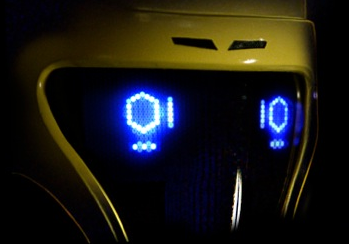
In-store Apple monolith
Uh, er…
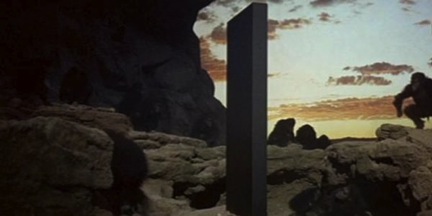
Monolith from 2001: A Space Odyssey

Apple took Arthur C Clarke’s line that, ‘Any sufficiently advanced technology is indistinguishable from magic’ as a guide for their design aesthetic. The copy for the iPad promised, “A magical and revolutionary product at an unbelievable price”. That’s three mystical promises in one sentence. People who are really into technology hate Apple because it promotes magical thinking and denies or conceals the reality of the tech.

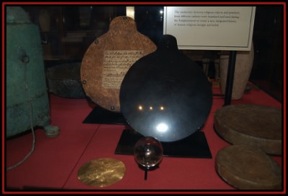
The tablet or smartphone is anticipated by the black scrying mirror of Elizabethan magus Dr John Dee. In The Red Men, the futuristic company takes a sigil from John Dee as its logo. The title of Charlie Brooker’s science fiction TV series ‘Black Mirror’ closes the loop for us between tomorrow’s tech and magic.
the black scrying mirror of Dr John Dee

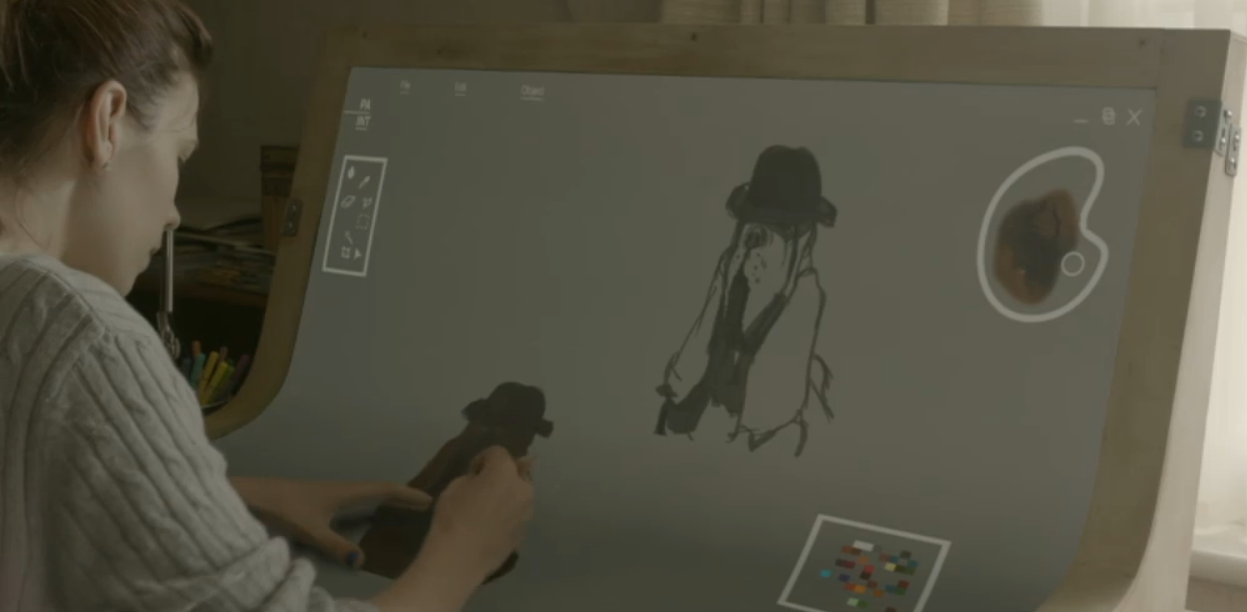
Someone invented a nice screen for the first episode of the second series of Black Mirror. Notice the character is using it to paint and draw and not to code. You will increasingly see advanced technology sold with images of craft and finger-painting and suchlike. It’s the best way to make the tech appear homely and modelled around the individual.
The screen from Charlie Brooker's Black Mirror
We will only recognise a technology as truly advanced only when it is wrapped and concealed with a layer of magic. No sooner had this thought coalesced than I was reminded of the copies of Harry Potter’s Book of Spells, an augmented reality Playstation game. Sell technology that helps you imagine yourself as a wizard.

Richard Matheson’s classic horror SF novel I Am Legend devises scientific explanations for the supernatural phenomena of vampires. It digs around in medical textbooks for plausible physiological explanations for vampirism.   One of my favourite workshops with my science fiction students this term was asking them to devise scientific explanations for magical artefacts: I particularly enjoyed one student using quantum entanglement to explain how Voodoo dolls work. Superheroes mix up science gods and supernatural monsters; the co-existence of the magical with the scientific, of Iron Man and Thor, is a quirky paradox that is creatively generative for the Marvel Universe.

We divide science fiction from fantasy because one features magic and the other features technology that behaves like magic. Here’s Adam Roberts from his History of Science Fiction:
‘Science fiction, in contemporary publishing and bookselling practice, is distinguished from “Fantasy”, the latter involving fantastic or non-realistic form in which the mechanism for fantasy is magic rather than technology.’

Lord of the Rings revolves around a magical ring. The magic sword of Excalibur. Aladdin’s magic lamp. The next generation of digital accessories, that is, Google’s glasses, Apple’s watch, Microsoft’s handbag with a portable hole in it, will be magical implements.

Adam Roberts’ history of science fiction is founded upon ‘a historicised definition of SF as that form of fantastic romance in which magic has been replaced by the materialist discourses of science.’

One of the crucial decisions I made when writing The Red Man was whether to give in to the imaginative allure of magic which, in the late 1990s, roved around an axis of techno-narco-mysticism. In the novel, I used gnosticism as a cover for zealotry in the American power structure, whether it was the Christian fundamentalism of George W Bush or the anarcho-libertarianism of the tech gurus. That Gnosticism has a strong connection to science fiction through Phillip K Dick’s Valis experience only pushed me further down that path. In The Red Men, the artificial intelligence Ezekiel Cantor is understood by the Monad management in terms of their gnostic beliefs. The original inspiration for The Red Men was Kurzweil’s The Physics of Immortality, as succinct an expression of our desire to see, in the future of science, a way of fulfilling our mystical yearnings. The title of William Gibson’s Neuromancer makes the same point.

The Red Men is built around a dialectic of technology and mysticism, expressed in the rival yet inter-dependent companies of Monad and Dyad, two sides of one artificial intelligence. Looking back at my decision all those years ago to push the novel out into mysticism, I regard it now as a florid but permissible response to an abiding cultural dialectic, and not merely an unwarranted or ill-disciplined diversion.

Also, screens have moved on. And soon they will be moving on of their own volition.

The doctor-poet Dannie Abse

Cultivate your inner editor

A writer must cultivate their inner editor. Often, I’ll query an aspect of a story with the author and they’ll say, ‘Yes, I didn’t get around to dealing with that’ or ‘Did I leave that in’? Their inner editor whispered a note and they screened it out. It’s perfectly natural to screen out the voices that speak of faults in your work. Without these screens, we’d give up on the first page. But as the manuscript builds up, and the redrafting begins in earnest, notes from the inner editor are vital.

Cultivating sensible criticism of your work is crucial. Part of this is learning how to listen to informed criticism. Prior to submission for publication, I redrafted The Red Men after a few notes from my agent. She told me to reduce the amount of swearing in it and to ditch the original title ‘Leave My Soul Alone’, a quotation from a disturbing poem by the doctor-poet Dannie Abse about an operation for a brain tumour; as the surgeon’s probe blindly pushes its way through the brain in search of the cancer, the conscious patient suddenly begins to speak. It’s so arresting I’ll just take a moment to quote the pertinent verse from ‘In the Theatre’:

The doctor-poet Dannie Abse

The doctor-poet Dannie Abse

‘Then, suddenly, the cracked record in the brain,
A ventriloquist voice that cried, ‘You sod,
Leave my soul alone, leave my soul alone,’ –
The patient’s dummy lips moving to that refrain,
The patient’s eyes too wide. And, shocked,
Lambert Rogers drawing out the probe
With nurses, students, sister, petrified.’

So I had reasonable literary reasons for calling the novel ‘Leave My Soul Alone’ as I was likening the colonisation of the mind by digital technology and media to the blunt early era of brain surgery, but I had not considered how ridiculous the title may appear to other people coming cold to the book. Of course, part of me will never give up that title, will always maintain that it has some value; every novel is the consequence of a dozen major decisions and a hundred thousand minor ones, and the ghostly advocates for those various positions persist in the author.

When I was discussing the novel with my agent, I spoke about how pleased I was with the writing in chapter four, a big section of back story set in the Scottish island of Iona. My agent made a face. I now know what that face meant: did I really want a big section of flashback at that point just as the plot was getting going? What happens on the island of Iona, and the characters who are introduced, only really begins to effect the action in the second section of the book. At the time, I was convinced the flashback was crucial. Perhaps having already persuaded me to change the title of my novel and to excise much of its profanity, my agent decided enough was enough for one session.

Re-editing The Red Men in preparation for digital publication, I’ve removed the entire chapter set on Iona. I may reinstate it later in the book at the point at which the characters introduced in this long flashback become more active in the plot. The only reason to keep it in is that it provides insight into the peculiar religiosity of Hermes Spence, the CEO of Monad, and his interest in gnosticism, all of which pays off at the end of the book.
Writers need their inner editor because sometimes, these days, publishing does not provide an outer editor for them. Concerned primarily with how the book will play in the marketplace, a publisher can be indecently indifferent to a work at the level of the sentence.

Not always though. For my non-fiction book The Art of Camping I sat down with my editor Juliette in a coffee house in Lewes. She put the manuscript between us and turned it slowly page-by-page. For the sections, she was happy with, the speed of the page turning increased. For the sections she felt could be improved, the page turning slowed to a crawl, creating a kind of silence that my inner editor felt compelled to break: ‘You’re right,’ I would say, unable to take the incredibly slow page-turning anymore, ‘perhaps that section could lose some of the historical detail. Perhaps I could add some more present day amusing memoir material in to break it up.’ The technique was skilful, forcing me to admit what I already knew but had not been able to face. It’s one of the hardest truths for a writer to deal with: that more work is required.