Category Archives: The Red Men

“They only want you to do the wrong thing”

Jonathan Thornton visited me in Hackney for an interview he transcribed in its entirety for Fantasy Faction. I treated him to warm gozleme on Broadway Market and then coffee in the battered armchairs of Edgars. His transcription captures every molecule of caffeine in my brain. Our discussion ranged over my three SF novels and their connection to my book on camping. It can be read here.

Science fiction authors Jeff Noon and Matthew De Abaitua

Interview with Jeff Noon

I was invited by the BSFA to interview Jeff Noon to mark the publication of his new novel A Man of Shadows. I first read Jeff Noon’s Vurt in the 90s and my first published short story ‘Inbetween’ appeared in anthology of rave fiction called Disco Biscuits along with a story by Jeff.
Science fiction authors Jeff Noon and Matthew De Abaitua
Chad Dixon of the BSFA recorded the whole conversation. Here is the link. Hope it still works.

The cover of The Red Men by Matthew De Abaitua by Raid71

The Red Men in America

My novel The Red Men will be published by Angry Robot in the US this November 2017.

It will be the first time that the novel is available in America. Readers will get the chance to read the loose trilogy comprising The Red Men, IF THEN and The Destructives together in one swoop. Because Angry Robot are lovely, the novel has a new cover by Raid71.
The cover of The Red Men by Matthew De Abaitua by Raid71
The three covers follow a theme of doubling. Two realities intersect in each one. The trilogy sure looks purdy.
The three novels in Matthew De Abaitua's science fiction trilogy

Barnes & Noble have a feature on the new edition, which you can read here.

The Red Men by Matthew De Abaitua

The Red Men revisited

I was lying facedown on the rug when this new review of The Red Men popped onto my stream. It is by Jonathan Thornton, and it highlights aspects of the novel that have gained in currency in the ten years since I first wrote it. Also, the review engages with the whole novel, particularly its dualistic structure.

The review can be read here.

It arrived at pretty much the same time that I learnt that the proposed film adaptation of The Red Men now has a scriptwriter attached. So, progress on both fronts. I hope at some point to see The Red Men published in the US alongside my subsequent two SF novels IF THEN and The Destructives. If only to complete this loose trilogy, a concept I explored further for Sci-Fi Bulletin.


The Red Men by Matthew De Abaitua

The Red Men published by Gollancz

Gollancz  are delighted to be publishing an updated edition of Matthew De Abaitua’s Arthur C. Clarke Award-shortlisted debut novel The Red Men in eBook for the first time. The release will coincide with Film4’s worldwide digital release of Dr Easy, a short film based on The Red Men’s opening chapter, starring Tom Hollander and the voice of Geraldine James.

The Red Men by Matthew De Abaitua

Buy the ebook from Gollancz/Orion

Buy the ebook from Amazon UK

Buy the ebook from Amazon US

Marcus Gipps, editor at Gollancz, has acquired the UK and Commonwealth (ex Can) digital e-book rights to Matthew De Abaitua’s cult novel The Red Men from Sarah Such of Sarah Such Literary Agency, who has also recently sold The Red Men feature film rights to Warp Films, producers of This is England,Four Lions, and The Stone Roses: Made of Stone amongst many others.

Set in tomorrow’s Hackney, the novel’s ambitious executives and new technology satirise the modern workplace, where the Red Men of the title are an alluringly strange and prescient vision of the human cost of digital culture.

Dr Easy is written and directed by Shynola, multi-award-winning animators and directors of music videos for international bands including Coldplay, Radiohead, Beck and Blur. It is produced by Warp Films and shot by DOP Barry Ackroyd. It will premiere at Edinburgh International Film Festival 2013 the day before Film 4.0’s simultaneous worldwide online release on 21st June on film4.com and Vimeo, from where it can be embedded into other sites, with both platforms promoting its release heavily as part of a sustained digital marketing campaign to reach wider audiences.  Gollancz publish The Red Men (ebook) on 13 June 2013 at an introductory price of £2.99.

Marcus Gipps says: ‘We’re delighted to welcome Matthew to Gollancz, and thrilled that his remarkable novel will be available in eBook for the first time. With the forthcoming release of the very exciting short film Dr Easy, this is the perfect time to rediscover Matthew’s chilling vision of the near-future.’

Matthew De Abaitua says:  ‘It’s a great honour for me that The Red Men is appearing on the Gollancz imprint. I am always inspired by their SF Masterworks list, from Theodore Sturgeon’s More Than Human to Philip K Dick’s Ubik. And as the novel explores the outer possibilities of digital culture, I’m very pleased that Gollancz are making The Red Men available as an eBook for the first time.’

Buy the ebook from Gollancz/Orion

Buy the ebook from Amazon UK

Buy the ebook from Amazon US

Follow @MDeabaitua @Gollancz @SFGateway @SHYNOLAfilms  @WarpFilms @Film4  @SarahSuch

Hieroglyphic Monad of Dr John Dee painted outside Sainsbury's

Weird stuff happens to writers all the time

Like a lot of writers, I work in bed. The stolen time between dreaming and getting out of bed is vital for the compositional process. In this stolen time, I imagine the story, dream out what is to be written that day, and what will happen next. In dreams, I mine the rabbit hole and then just afterwards, I take a look at my haul and decide what to keep and what to throw back.
Our family life is busy and demanding, especially in the morning. I have to force myself to lie in bed throughout the various travails, pulling the duvet firmly over my head to screen out the sound of children arguing over cereal so that I can steal more time with dreamstate; extra time in bed can save me hours if not days of hacking away at the keyboard.
My wife is as understanding about this process as our circumstances allow. We play out variations upon the following conversation:
‘Are you going to get out of bed now?’
‘I’m working.’
Exasperation.
‘They are being sods.’
For the avoidance of doubt, “They” are the children.
‘But my characters live here.’
‘Under the duvet?’
‘In this moment. Please, I must return to them.’
‘Under the duvet.’
But they’ve gone. Chased away like fairies at the bottom of our garden.
There is no such thing as the unconscious. Dreams are random flushings that only become narrative at the moment of telling. I know all that. Still, writers continue to report peculiar phenomena when they are in the throes of a big fictional work. Books seem to fall open at just the right page. Overheard conversations supply exactly the right words. A road sign is suddenly pertinent. In a state of hyper-connectivity, everything pleads to be included in your creation. These are the times when it is necessary to go down the rabbit-hole. Slip the leash of control, let the imagination range around.
It was in such a mood, standing on Wilton Way in Hackney sometime in the previous decade, that I decided to incorporate into my novel The Red Men a vision of an enormous dosser on a park bench, a sozzled Gulliver attended to by numerous white-suited Lilliputians. In the novel, this giant figure is called Leto, a reference to the God Emperor of Dune, and he presides over an organisation called Dyad:  Dyad is about living in the land of do-as-you-please, the unbounded imagination, all the delights of the dreamstate and none of the horrors of breakfast.
The Red Men is a dialogue between the reality principle and the pleasure principle, between subordinating oneself to the will of others – as the narrator Nelson has done – or giving into the desire to dash one’s inner self all over the streets like so much terrible graffiti.  After writing the scene with the enormous drunken Leto, I decided to flick through the pages of a book and search therein for a portent as to whether The Red Men would ever find a publisher.
The book I chose for this task was Robert Anton Wilson’s Cosmic Trigger, as a good a resource as any for writers who have chosen to go headfirst down the rabbit hole.
I flicked through the pages of Cosmic Trigger, stopped at random, and jabbed my finger at a page.
The word I jabbed was ‘monad’.
This was peculiar because the name of Dyad’s rival company in the novel is Monad.
And monad is quite an unusual word. It crops up a bit in philosophy. According to Google’s Ngram, its peak usage was between 1895 and 1900, around the upsurge of Bergsonian philosophy, Theosophy, Vitalism, that kind of thing.
Nevertheless as portents go, it had – as they say in the corporate world – traction.
I’d already chosen the brand for Monad, taking it from the Hieroglyphic Monad of Dr John Dee, the Elizabethan wizard.

As I said, these kind of coincidences crop up a lot when you are writing. When you have your ear to the glass, and the glass is on the wall, and on the other side of that wall live the beings who stalk our imagination.

Alan Moore had warned me it would happen. I’m old enough not to dwell upon it.
Last week, after signing off the revised proofs of The Red Men for digital publication, I put my feet up to relax. My wife went to the shops and I had childcare to catch up on.
I thought back to the last time I had signed off proofs of the novel. I’d just sent them off to Shynola for them to read; they were deciding whether or not to go ahead and attempt to make the novel into a film when a minor character from the novel, a local figure I had drawn upon, knocked on their door.
They took it as a sign and decided to option the book.
This kind of thing happens all the time.
My wife returned from the shops.
‘Look at this,’ she said, holding out her phone. ‘I saw it scrawled outside Sainsbury’s.’
And this is what she saw. The Monad symbol in orange paint.
Happens all the time.

Hieroglyphic Monad of Dr John Dee painted outside Sainsbury's


Apple in-store monolith

Science, magic and the iPhone

In The Red Men, the characters do not use computers, they use screens. These screens are pliable and can move around in response to haptic gestures or remote commands. They float on a cushion of air across the floor and can winnow out into a large landscape format or shrink down to fit into your palm.

“Gelatinous screens billowed out like spinnaker sails to catch the data pouring in.”

The novel was written just before the advent of the iTouch but I claim no special prophecy. Screen-based user interfaces were prevalent in SF and Bill Gates’ living room and appear in everything from Star Trek: Next Generation to Minority Report.

I made the screens soft. The prospect of a flexible quasi-organic screen fascinated me, and I visualised them as floating medusa jelly fish capable of exercising limited volition of their own. By the mid-section of the novel, robots wrap themselves in screens to project a different appearance. Characters are suffocated by these screens too.

Editing the novel this week in preparation for its digital publication, I‘ve been adding to the set of haptic gestures the characters use to operate the screens. With tablets we are accustomed to the swipe, the three-finger flick, the two-finger scroll. But why not a screen that sparks to life at the click of your fingers? Or a blown kiss? Or a beckoning index finger? When will I be able to stroke my screen and make it purr like a cat? Or whistle for it to come to me like a dog? Tomorrow presumably.

A useful repository of haptic gestures can be found in magic. The wave of a wand. The magic finger firing lightning bolts. ‘Open sesame’ combines voice recognition with security protocol.

Exploiting the potential of magic to conceptualise user interfaces is key to marketing the next generation of tech.

Apple already know this.

In-store Apple monolith
Uh, er…
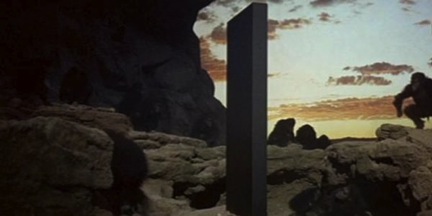
Monolith from 2001: A Space Odyssey

Apple took Arthur C Clarke’s line that, ‘Any sufficiently advanced technology is indistinguishable from magic’ as a guide for their design aesthetic. The copy for the iPad promised, “A magical and revolutionary product at an unbelievable price”. That’s three mystical promises in one sentence. People who are really into technology hate Apple because it promotes magical thinking and denies or conceals the reality of the tech.

The tablet or smartphone is anticipated by the black scrying mirror of Elizabethan magus Dr John Dee. In The Red Men, the futuristic company takes a sigil from John Dee as its logo. The title of Charlie Brooker’s science fiction TV series ‘Black Mirror’ closes the loop for us between tomorrow’s tech and magic.

the black scrying mirror of Dr John Dee

Someone invented a nice screen for the first episode of the second series of Black Mirror. Notice the character is using it to paint and draw and not to code. You will increasingly see advanced technology sold with images of craft and finger-painting and suchlike. It’s the best way to make the tech appear homely and modelled around the individual.
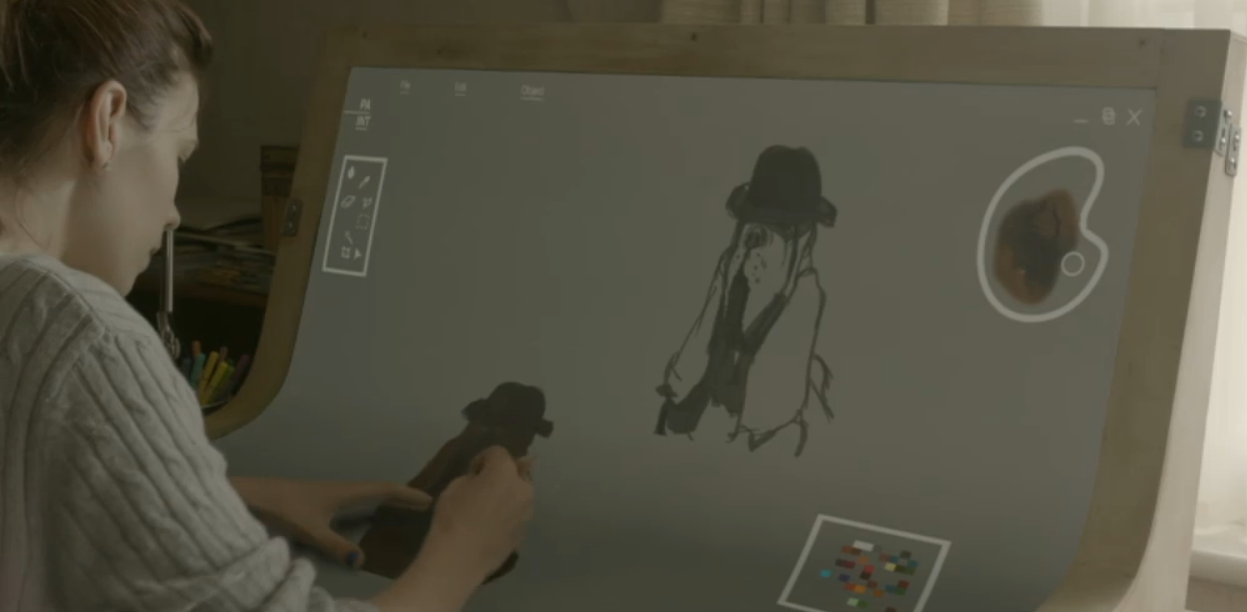
The screen from Charlie Brooker's Black Mirror
We will only recognise a technology as truly advanced only when it is wrapped and concealed with a layer of magic. No sooner had this thought coalesced than I was reminded of the copies of Harry Potter’s Book of Spells, an augmented reality Playstation game. Sell technology that helps you imagine yourself as a wizard.

Richard Matheson’s classic horror SF novel I Am Legend devises scientific explanations for the supernatural phenomena of vampires. It digs around in medical textbooks for plausible physiological explanations for vampirism.   One of my favourite workshops with my science fiction students this term was asking them to devise scientific explanations for magical artefacts: I particularly enjoyed one student using quantum entanglement to explain how Voodoo dolls work. Superheroes mix up science gods and supernatural monsters; the co-existence of the magical with the scientific, of Iron Man and Thor, is a quirky paradox that is creatively generative for the Marvel Universe.

We divide science fiction from fantasy because one features magic and the other features technology that behaves like magic. Here’s Adam Roberts from his History of Science Fiction:
‘Science fiction, in contemporary publishing and bookselling practice, is distinguished from “Fantasy”, the latter involving fantastic or non-realistic form in which the mechanism for fantasy is magic rather than technology.’

Lord of the Rings revolves around a magical ring. The magic sword of Excalibur. Aladdin’s magic lamp. The next generation of digital accessories, that is, Google’s glasses, Apple’s watch, Microsoft’s handbag with a portable hole in it, will be magical implements.

Adam Roberts’ history of science fiction is founded upon ‘a historicised definition of SF as that form of fantastic romance in which magic has been replaced by the materialist discourses of science.’

One of the crucial decisions I made when writing The Red Man was whether to give in to the imaginative allure of magic which, in the late 1990s, roved around an axis of techno-narco-mysticism. In the novel, I used gnosticism as a cover for zealotry in the American power structure, whether it was the Christian fundamentalism of George W Bush or the anarcho-libertarianism of the tech gurus. That Gnosticism has a strong connection to science fiction through Phillip K Dick’s Valis experience only pushed me further down that path. In The Red Men, the artificial intelligence Ezekiel Cantor is understood by the Monad management in terms of their gnostic beliefs. The original inspiration for The Red Men was Kurzweil’s The Physics of Immortality, as succinct an expression of our desire to see, in the future of science, a way of fulfilling our mystical yearnings. The title of William Gibson’s Neuromancer makes the same point.

The Red Men is built around a dialectic of technology and mysticism, expressed in the rival yet inter-dependent companies of Monad and Dyad, two sides of one artificial intelligence. Looking back at my decision all those years ago to push the novel out into mysticism, I regard it now as a florid but permissible response to an abiding cultural dialectic, and not merely an unwarranted or ill-disciplined diversion.

Also, screens have moved on. And soon they will be moving on of their own volition.

The doctor-poet Dannie Abse

Cultivate your inner editor

A writer must cultivate their inner editor. Often, I’ll query an aspect of a story with the author and they’ll say, ‘Yes, I didn’t get around to dealing with that’ or ‘Did I leave that in’? Their inner editor whispered a note and they screened it out. It’s perfectly natural to screen out the voices that speak of faults in your work. Without these screens, we’d give up on the first page. But as the manuscript builds up, and the redrafting begins in earnest, notes from the inner editor are vital.

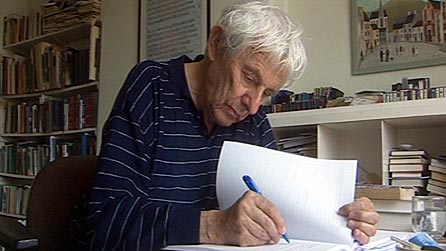
Cultivating sensible criticism of your work is crucial. Part of this is learning how to listen to informed criticism. Prior to submission for publication, I redrafted The Red Men after a few notes from my agent. She told me to reduce the amount of swearing in it and to ditch the original title ‘Leave My Soul Alone’, a quotation from a disturbing poem by the doctor-poet Dannie Abse about an operation for a brain tumour; as the surgeon’s probe blindly pushes its way through the brain in search of the cancer, the conscious patient suddenly begins to speak. It’s so arresting I’ll just take a moment to quote the pertinent verse from ‘In the Theatre’:

The doctor-poet Dannie Abse

The doctor-poet Dannie Abse

‘Then, suddenly, the cracked record in the brain,
A ventriloquist voice that cried, ‘You sod,
Leave my soul alone, leave my soul alone,’ –
The patient’s dummy lips moving to that refrain,
The patient’s eyes too wide. And, shocked,
Lambert Rogers drawing out the probe
With nurses, students, sister, petrified.’

So I had reasonable literary reasons for calling the novel ‘Leave My Soul Alone’ as I was likening the colonisation of the mind by digital technology and media to the blunt early era of brain surgery, but I had not considered how ridiculous the title may appear to other people coming cold to the book. Of course, part of me will never give up that title, will always maintain that it has some value; every novel is the consequence of a dozen major decisions and a hundred thousand minor ones, and the ghostly advocates for those various positions persist in the author.

When I was discussing the novel with my agent, I spoke about how pleased I was with the writing in chapter four, a big section of back story set in the Scottish island of Iona. My agent made a face. I now know what that face meant: did I really want a big section of flashback at that point just as the plot was getting going? What happens on the island of Iona, and the characters who are introduced, only really begins to effect the action in the second section of the book. At the time, I was convinced the flashback was crucial. Perhaps having already persuaded me to change the title of my novel and to excise much of its profanity, my agent decided enough was enough for one session.

Re-editing The Red Men in preparation for digital publication, I’ve removed the entire chapter set on Iona. I may reinstate it later in the book at the point at which the characters introduced in this long flashback become more active in the plot. The only reason to keep it in is that it provides insight into the peculiar religiosity of Hermes Spence, the CEO of Monad, and his interest in gnosticism, all of which pays off at the end of the book.
Writers need their inner editor because sometimes, these days, publishing does not provide an outer editor for them. Concerned primarily with how the book will play in the marketplace, a publisher can be indecently indifferent to a work at the level of the sentence.

Not always though. For my non-fiction book The Art of Camping I sat down with my editor Juliette in a coffee house in Lewes. She put the manuscript between us and turned it slowly page-by-page. For the sections, she was happy with, the speed of the page turning increased. For the sections she felt could be improved, the page turning slowed to a crawl, creating a kind of silence that my inner editor felt compelled to break: ‘You’re right,’ I would say, unable to take the incredibly slow page-turning anymore, ‘perhaps that section could lose some of the historical detail. Perhaps I could add some more present day amusing memoir material in to break it up.’ The technique was skilful, forcing me to admit what I already knew but had not been able to face. It’s one of the hardest truths for a writer to deal with: that more work is required.