Back in 1998, I interviewed Alan Moore in a pizza restaurant in Northampton.
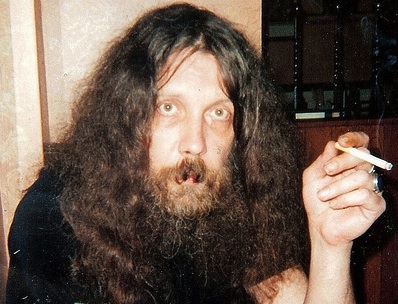 Meeting him was the fulfilment of an ambition. I would go on to interview him on two other occasions; once in his house just after the publication of League of Extraordinary Gentleman, for a Guardian piece that I could not make work to their satisfaction, and again for the filming of SF:UK. In the acknowledgements of my novel The Red Men, I thank Alan Moore for the six or seven hours we spent in conversation that first time, a chat that fairly reprogrammed my mind and sparked insights that I continue to explore. I haven’t seen or spoke to him since; I skulked around when he came to London to do a talk with Michael Moorcock, but when I looked up, there were a dozen other gentlemen of my age skulking around, so I left.
I released a transcript of that interview back in 1998 to whoever emailed and requested it. And here it is again.
We pull up in a pizza restaurant, where the waiters greet Moore with familiarity.
MDA: Is this a regular haunt then?
AM: Pretty much. I’ve been in most of the restaurants of Northampton, I tend to do them on a circuit, I’ll eat at one of them for a couple of months and then get bored with it and go on to the next one. I’m less than electrifying today, I’ve been doing a lot of work this week and have not been getting to bed until four or five, and then getting up at nine, so I’m shell-shocked.
I’ve had some guys up, Alex Osbourne who has been producing the Acid House Trilogy for Irvine Welsh and The Granton Star Cause, he is planning to do Big Numbers as a TV series, the full twelve-part colossus, like Our Friends in the North.
MDA: Has that all been published now?
AM: No, no it’s never going to be published now, I’ve had two artists just run screaming into the night, and it becomes increasingly difficult to resurrect as a comic book with each one. I’ve written the scripts up to issue five. But what do you do? Do you get a new artist in? Do you start running it again from issue one and promise the readers that this time we are going to finish it.And what happens if the artist leaves halfway through again? I wonder, is it me? Is it me doing this to these poor boys? I’ve been thinking what am I going to do about Big Numbers, I don’t want to leave it unfinished, and then when Alex Osbourne approached me and asked me if I had anything suitable for television, I said ‘no’, because most of it is either owned by other people or too peculiar. Then he started talking about “Big Numbers” and I said well that’s even more of a problem because I don’t think I’m going to be able to finish that as a comic book.
While I was saying the words I thought, maybe I could finish it as a television series. I’ve got the whole plot, the structure’s practically done, so we’ve been working with a scriptwriter to put the whole thing together. I’ve got this huge A1 sheet of paper with forty characters listed down one side and twelve numbers across the top, so there are twelve hundred squares filled with my little tiny mental patient handwriting saying what was happening to each character in each issue, it is a wonderful piece of work in itself. It turns out to be a good schematic for the entire twelve part series. If it goes anywhere.
MDA: Prospective TV and film projects are always so up in the air.
AM: It’s barely even up in the air, it’s in some vapourous netherdimension from which it may coalesce into something as sturdy as a soap bubble: the From Hell film is going to go into production in April, May, June – I understand Sean Connery has been signed for it, Hughes brothers to direct, it sounds like it might happen. But I’ve seen two of my books, V for Vendetta and Watchmen go through various stages of Hollywood optimism. But I’ve not been that interested. I mean, it was nice to meet Terry Gilliam, the first thing he said to me over lunch was “Well, how would you turn Watchmen into a film?” and I said, “Well to be honest Terry, I wouldn’t.” So we went on to talk about other things and just had a great lunch. But Big Numbers could work, it was always more like a TV series than a comic book anyway. All the visual elements, the backgrounds were photo-referenced, it might have been a lot easier if we had just filmed it to begin with. But Hollywood, television and film is not my prime area of interest. Because I would never have any control, working in those areas. It’s nice to get the money from a Hollywood project, but whatever they do with it, it would be their piece of work, and not mine. Someone said to Raymond Chandler, ‘how do you feel about Hollywood ruining all your books’ and he took them into his study, pointed to the shelves containing ‘Farewell My Lovely’ and all the rest of them and said, ‘there they are, they’re alright, they’re not ruined.’
MDA: You said you’d been working quite hard this week. Is that the way you normally work, with long periods of research that snap into sudden flurries of activity?
AM: It doesn’t really work like that. Because there are so many projects going on, when I’m researching one, I’m doing three others, so it tends to be pretty frenetic, not many days go by without me actually writing a few pages, at the very least. I imagine it will be that way for the foreseeable future, I’d like to get the chance to slow down at some point, but on the other hand, it’s surprising what you can do. I quite like working in this frenetic zone of ideas. As the ideas come up, you have to see which of the projects you are working on it is most applicable to, sort them properly, it’s pleasurable, it doesn’t feel stressful. It’s kind of exhilarating, to be able to do two or three things you are pleased with a week. It’s also nice to be able to refresh the palette between courses. I mean, if you’re writing something like From Hell without a break, I should imagine that would be horrible. But if I can take a few days off to write some baroque pornography like “Lost Girls”, or some harmless superhero fun, or do a bit of recording in the studio, stuff like that. There is a kind of synergy between the different forms of work, you’ll learn things from one sort of work that will have tremendous application in another. They all tend to pull each other forward.
MDA: What I like about that form of work is that you are never trying to shoehorn various ideas and concepts into one project.
AM: When people first start out and they’ve got all these wonderful ideas in their head with very few opportunities to vent them, you do find people who’ve got three very good ideas that they are trying to combine into one lousy idea. I did hear that Quentin Tarantino and Roger Avary had originally written a long sprawling and probably unusable screenplay containing the ideas for True Romance, Pulp Fiction, Reservoir Dogs and Natural Born Killers. The Natural Born Killers was a fiction written by the characters in True Romance. So you can imagine in its original form it was unreadable, but you come to learn how to discriminate between ideas. So I have a more fractal way of working, if you like, it is more like the way most people’s minds actually work. They don’t work in any linear way. When your mind wanders if you ever pay attention to some of the paths it takes, you generally find it’s these paths of association that can link all over the place. Rudy Rucker the mathematician did an essay called “Life is a Fractal in Hilbert Space,” where he was talking about how, if you light up a cigarette, this may spark up any number of possible topics, you might start thinking about recent problems cigarette companies are having, you might start thinking about cancer…
(quick break to order drinks)
The movements of the mind don’t follow any linear pattern, they can’t be explained with a mechanistic, clockwork view. You could find quantum models of how the mind works that might fit.
MDA: When we interviewed Bez, he likened God to a particle in the corner of his mind.
AM: It’s like The Copenhagen Interpretation […Nils Bohr…] that he made the Carlsberg Brewery, that all our scientific observations of the universe and quanta can only, in the end, be observations of ourselves. These are more interesting models of the mind than these deterministic models that a lot of biologists seem reluctant to let go of. They desperately want to explain all human thought processes as the squirt of a gland, and some chemical reaction in the temporal lobe.
MDA: They are really stoked up in the press – the media always seizes upon genes for different forms of behaviour, the gay gene, the criminal gene, and these things always have more sinister sociological intents behind them.
AM: It’s Nazi science, let’s face it. People are more comfortable with that. I am currently writing this thing that is a study of some of my associates in this magic business are trying to formulate some quasi-rational thoughts on what we think of consciousness, language, magic and art and the relationships between them. And connect that with human development and show how these things are incredibly intertwined and inextricable from each other. We start out talking about how the ‘I’ is its own blind spot. Mind has come up with this brilliant way of looking at the world, science, but it can’t look at itself. Science has no place for the mind. The whole of our science is based upon empirical, repeatable experiments. Whereas thought is not in that category, you can’t take thought into a laboratory. The essential fact of our existence, perhaps the only fact of our existence – our own thought and perception is ruled off-side by the science it has invented. Science looks at the universe, doesn’t see itself there, doesn’t see mind there, so you have a world in which mind has no place. We are still no nearer to coming to terms with the actual dynamics of what consciousness is. In questing after artificial intelligence, we seem only to have learnt that normal intelligence is so far beyond our comprehension.
(picks up menu)
I’ve got to focus here, focus on food, I tend to forget to eat when I’m not sleeping so I should shove something satisfying down my neck.
MDA: Have you come across the works of Rupert Sheldrake?
AM: Yeah, the morphogenetic field theory – you’ve got to admire a guy who has had Nature magazine recommend burning all his works. I’ve got a lot of sympathy for his ideas. My theories of ideaspace aren’t necessarily complimentary to his notion of morphogenetic field theory, but they would probably have much the same effect.
MDA: When I re-read Swamp Thing, your interpretation of his origins reminded me of Sheldrake’s theories.
AM: Well, if I’m right, all these ideas are in the air. And if he’s right, then there is morphic resonance around these in his morphogenetic field. Not unsurprisingly then, these ideas will turn up in fiction, comic books, cheap trash movies, scientific dissertations, I can’t think of any other explanations for why these ideas should be so prevalent. It’s what Charles Fort called Steam Engine Time. When James Black (chk) invented the steam engine, there were about eight other guys who invented it around the same time but just not quite fast enough to make it down the patent’s office.
(We order food.)
MDA: I have a great attraction to theories like Sheldrake’s morphic resonance – I read an interview with him, when he was talking about how there is no proof that memory is actually held in the brain. He posited a view that the brain is more like a radio tuner than a video recorder, receiving thoughts, memories – both those of the self and the collective – from localised morphic fields. These ideas are very attractive because they posit an alternative to straightforward mortality – you read it and feel that leap within, ‘perhaps there might be more to life than just death’. You have to be suspicious of your own motivations for seizing at these ideas – like a dying man reaching for miracle cures.
AM: Sheldrake’s idea of the brain as a radio receiver – I feel something quite similar. But I’m still thinking it through, so this is a thought in progress. It strikes me that self, not just my self, but all self, the phenomenon of self, is perhaps one field, one consciousness – perhaps there is only one ‘I’, perhaps our brains, our selves, our entire identity is little more than a label on a waveband. We are only us when we are here. At this particular moment in space and time, this particular locus, the overall awareness of the entire continuum happens to believe it is Alan Moore. Over there – (he points to another table in the pizza restaurant) – it happens to believe it is something else.
I get the sense that if you can pull back from this particular locus, this web-site if you like, then you could be the whole net. All of us could be. That there is only one awareness here, that is trying out different patterns. We are going to have to come to some resolution about a lot of things in the next twenty years time, our notions of time, space, identity. The flowerings of seemingly outlandish concepts like Sheldrake’s are what you would expect. At the scientific end of the spectrum – and I am a regular New Scientist reader – I like to balance the mad howling diabolism with a dose of scientific reality – I have noticed that the crossover is getting a bit extreme. The people at the cutting-edge of quantum physics and cosmology are trying to come up with a practical, workable model for the original expansion of the universe, and what is happening now at a quantum level. They were saying that they are having to turn to these archaic belief structures, like Sufi beliefs, or the Qabbalah. They were talking about how this idea of expansion from a single point is the core of the Qabbalah – and the most accurate description of the Big Bang, knowing what we know now, would be (Hockma Bine – er). So I was reading this in the New Scientist and I was thinking, well surely this is the sort of idea I would expect from Robert Anton Wilson. All of us collectively are fumbling towards an apprehension of something that feels like a kind of group awareness – we are trying to feel the shape of it, it’s not here yet, and a lot of us are probably saying a lot of silly things. That’s understandable. There is something strange looming on the human horizon. If you draw a graph of all our consciousness, there is a point we seem to be heading towards. Our physics, our philosophy, our art, our literature – there is a kind of coherence there, it may look disorganised at first glance, but there is a fumbling towards a new way of apprehending of certain basic fundamentals. In post-modern literature you can see similar things happening to what is happening, at the same time, in science with the quantum theory advances. They are trying to come up with non-linear ways of viewing things, trying to think our way outside of our own perceptions to find a new perception. Some people mistake this approaching new perception as the approach to Armageddon. In a certain sense, they might be right. There is a sense that we are reaching a critical point in the expansion of our inner worlds. For better or worse – I mean, I have no dreamy New Age notions of this – whatever awaits us up the road might not be all sunshine and smiles, pretty flowers everywhere. That all sounds a bit Yellow Submarine to me. But it will certainly be different. To me, when we talk about the world, we are talking about our ideas of the world. Our ideas of organisation, our different religions, our different economic systems, our ideas about it are the world. We are heading for a radical revision where you could say we are heading towards the end of the world, but more in the R.E.M sense than the Revelation sense. That is what apocalypse means – revelation. I could square that with the end of the world, a revelation, a new way of looking at things, something that completely radicalises our notions of the where we were, when we were, what we were, something like that would constitute an end to the world in the kind of abstract – yet very real sense – that I am talking about. A change in the language, a change in the thinking, a change in the music. It wouldn’t take much – one big scientific idea, or artistic idea, one good book, one good painting – who knows – we are at a critical point where the ideas are coming thicker and faster and stranger and stranger than they ever were before. They are realised at a greater speed, everything has become very fluid. I like to imagine setting a camera up in a field in the Bronze Age, taking a frame a week, – I worked out the maths of this in a sad moment if I can just remember it – over the intervening two thousand years, you would have a two hour film there, it would be very boring and slow for an hour and half, the buildings that were appearing very slowly, staying there for a long while, and then decaying very slowly. For the last half hour, buildings would be boiling. Going up and down in seconds. Some of the more alarming possibilities for nanotechnology that people are talking about, you get that as a literal reality without needing a speeded up film. You would be able to assemble and disassemble matter at the speed of thought. As far as I know, that is the definition of fluidity. We are approaching a more fluid state. I have talked about cultural boiling. The idea of the phase-transition period which, in fractal mathematics, is the chaotic flux between one state and another. Cold water is one state, you heat it up till boiling point, then it reaches a phase-transition where there is this immense chaos – that mathematically, we still don’t know what is going on, when a kettle boils, in the boiling – and what comes out is steam. Which is nothing like hot water at all. An alien could not predict steam from water, anymore than he could predict water from ice. They are three different things, each with a phase-transition dividing them. Culturally, and as a species, we are approaching a phase-transition. I don’t know quite what that means, on a human level. A bronze age hunter is analogous to cold water. We, with our very different lifestyle, are analogous to very hot water. But we are still both water. There is less difference between us and the bronze age hunter than what is twenty years down the line.
MDA: The steam.
AM: The steam. Whatever that means. I can’t conceive of vapour culture. I might not survive it. But that is where we are heading. I don’t know quite what I mean by my own metaphor, but I have feeling, it may bring in an even greater, faster space of fluid transmission, where no structures, as we used to understand structure, will sustain itself – we will have to come up with new notions of structure where things can change by the moment. I’m talking about physical structures, political structures, I can’t see coherent political structures in the traditional sense lasting beyond the next twenty years, I don’t think that would be possible.
MDA: But there are lot of recessive genes. The Fundamentalist Christians exist to hold the novelty in American society in check. In this country, the traditions of monarchy and parliament function in a similar way. There is a lot of inertia within traditional political and economic structures designed to hold culture and society in place, where they are now. I can’t see how any force of change could overcome these historical power bases.
AM: In terms of almost everything, things are getting more vaporous, more fluid. National boundaries are being eroded by technology and economics. Most of us work for companies that, if you trace it back, exist within another country. You are paid in an abstract swarm of bytes. Consequently, the line on a map means less and less. The territorial imperatives that until very recently have been the main reason for war start to make way. As The physical and material world gives way to this infosphere, these things become less and less important. The nationalists then go into a kind of death spasm, where they realise where the map is evaporating, and there is only response to that is to dig their hooves in. To stick with nationalism at its most primitive, brutal form. The same thing happens with religion, and that is the reasons behind the Fundamentalist Christians. If you look at the power of the Church, starting from the end of the Dark Ages up until the end of the Nineteenth century, you can see a solid power base there with a guaranteed influence over the development of society. If you look at this century, it is a third division team facing relegation. Fundamentalism in religion is the same as the political fundamentalism represented by various nationalist groups, or in science. Take the Committee for Scientific Investigation for Claims of the Paranormal, the ones who hounded Uri Geller, James Randi – The Amazing Randi – persecuted Uri Geller and when he found he couldn’t disprove Geller’s claims resorted to suggesting Geller was a paedophile, and getting his ass sued, quite justifiably.
MDA: Was he the man who put up the reward for anyone who could perform a paranormal act that he couldn’t replicate with conjuring?
AM: Yes. As if that proved anything.
MDA: It was an amazingly effective stunt though, it lodges in their mind and when you talk about paranormal acts, they respond with ‘well, why hasn’t that person taken Randi’s money?’.
AM: Randi says he can do it by tricks, so the person making the claim must have done it by tricks, which is fallacious.
MDA: I’ve been researching the CIA programme into Remote Viewing, and came across the people involved in this programme.
AM: Ingo Swann and the other guys. Yeah, interesting shit that. I only found out about that a few years ago. I wasn’t surprised that the CIA would be doing something like that, once anyone has had any sort of intimations that that type of stuff might be possible, an intelligent person presumes that other people have probably figured this out before me, and if it’s got any military application, they are probably doing it.
MDA: Did you follow how the Remote Viewing Group was closed down by the CIA?
AM: There was a guy, I believe he was an Admiral, who took over the Remote Viewing project in the Seventies, and he might have committed suicide, maybe he just died, and I saw them on TV talking to one of the heads of the CIA, it might have been Stansfield Turner, and they were talking about the Remote Viewing and how the Admiral had set up a splinter group, apart from the original Remote Viewing group, then he died, and his group was closed down. The interviewer asked what this splinter Remote Viewing group was up to and Turner was saying, “no, no, their work was not connected to Remote Viewing, per se”. The interviewer then asked “What was it concerned with?” and he said “Well, I suppose you could say it was concerned with contacting entities.” Then the camera moved away. And I thought: entities? What are they doing there? It makes you understand why the Pentagon is that shape!
MDA: I found out that to test the range of the Remote Viewing, they got the team of psychics to focus on the NASA probe that – at that time – was orbiting Jupiter. The team said they saw rings around Jupiter, and mountainous formations. And these observations were contrary to both accepted scientific orthodoxy and the information coming from the Probe. So the experiment was deemed a failure. It has only in the last ten years, that rings have in fact been discovered around Jupiter, and there are even workable theories about how a mountainous structure could have come about. By the time these cosmological discoveries were made, the team had been disbanded – so those that are still alive are sorting through their old observations to see if they were, in fact, true.
AM: The problem is you also get remote viewers, like that guy who was remote viewing the Hale-Bopp comet, who was convinced there was a spaceship full of evil reptiloids following on behind it. That sort of stuff tends to come from a misunderstanding of the nature of mental space. Mental space and its existence is what makes things like remote viewing possible. There shouldn’t be any limit to it. As I understand mental space, one of the differences between it and physical space, is that there is no space in it. All the distances are associative. In the real world, Lands End and John O’Groats are famously far apart. Yet you can’t say one without thinking of the other. In conceptual space they are right next to one another. Distances can only be associative, even vast interstellar distances shouldn’t be a problem. Time would also function like this.
MDA: If it is associatively linked, then presumably it would be predicated upon language. If you say to someone, “focus on Jupiter”, then they would have to find an alien planet in the vastness of Interstellar space, with just that English word.
AM: As I understand, or as I hallucinate conceptual space, nearly all form in conceptual space is language, I might even say all the form in non-conceptual space is language, I’m not even sure of what the difference between physical space and conceptual space is anymore, in the interface. All form is language. The forms that we see, or imagine, or perceive, or whatever it is Remote Viewers are doing, in conceptual space are mindforms made from language, and by language I also mean images, sounds. We dress these basic ideas in language we can understand. Sometimes there are sizable errors of translation.
BREAK
AM: A lot of conspiracy theorists, they find it comforting, secretly. The idea of the Illuminati and the CIA and whoever controlling our lives and destinies. You know, because that means that at least someone is in control, at least someone is at the steering wheel. And it’s not a runaway train. Paranoia is a security blanket, a massive security blanket. Whereas I think that yes these people do try to have an influence, and they often do have a very big influence, the CIA’s unique method of funding its wars over the last thirty years has contributed to the crippling drug problems of most of the Western world. So, yes they have an effect. Do they control our destinies? No, they don’t. They are nowhere near that powerful or organised. Does anything human control our destinies? No. Does this mean that God does? No, for all I know, God might just be a simple, two-line, iterative equation, with no more awareness of itself than that.
MDA: It is difficult to locate the exact beginnings of money – I think of money as being that non-human force that controls our destinies, a self-replicating viral idea that – at the moment – runs us as a species.
AM: The origin of money is something to do with representational thinking. Representational thinking is the real leap, where somebody says ‘hey I can draw this shape on the cave wall and it is, in some way, the bison we saw at the meadow. These lines are the bison. That of course lead to language – this squiggle is, of course, a tree, or something. Is the tree. Money is code for the whole of life – you can bind in everything that is contained within life for money, money is a certain amount of sex, a certain amount of shelter, a certain amount of sustenance. I had those wacky K2 boys up at my house, I was part of the itinerary of their star – studded tour of Britain. In the book, Watch the K Foundation Burn A Million Quid, they have a list of venues that they showed the film at, and they’ve got Alan Moore’s Living Room, Northampton, and I thought that was an interesting film because it was the apocalypse in miniature. Money is the code for the entire world. Money is the world, the world in the sense I was talking about earlier, our abstract ideas about the world. Money is a perfect symbol for all that, and if you don’t believe in it, and you set a match to it, it’s just firewood – it doesn’t mean anything anymore. I thought that was a great film. I like a film where you can see every penny of the budget up there on the screen.
MDA: Bill Drummond now writes for us, which the fulfillment of a long-term ambition of mine.
AM: I like Bill but he’s as mad as a fucking snake. But I like him. He’s great. We were having dinner here last month and he was planning to bulldoze Stonehenge at that time, I think, on January 1st Year 2000. But that just have been the Peroni talking.
MDA: He’s discussing building a giant pyramid at the moment.
AM: I thought that was a nicer idea, the People’s Pyramid, he can go and build it on that island out at Althorp. This is only gets in the Northampton papers, but doesn’t get in all the rest of them, I was hearing rumours in my psychic web that extends over the entire county. I was hearing rumours from Brinton, couple of days after Diana’s funeral, a big van, police escort round the back of Brinton churchyard for a couple of hours, then out again. I was also hearing people saying, “well how did they get the coffin out to the island.” The official explanation was that we had this crack team of marines who built this special, portable bridge, floated her out to the island, then dismantled the bridge again afterwards. One of the waiters here, he was having a party in this pub which is on this lonely little road and is the only access to the rear of Althorp House: and he said, well there were no army vehicles going either way for twenty four hours. Then all these other rumours started coming out, she’s not out on the lake at Althorp, she’s in the churchyard at Brinton where she wanted to be. So I thought these were just rumours until, in the local paper, they had a headline saying “Stop these sick rumours”. Then I thought, gotta be true. There was a signed statement from the Bishop saying yes, I definitely buried her on the island. Again, this made me think the rumours were true. It’s like the Queen Mother ~ her husband died and they went through the funeral, but she’s a little eccentric, and wouldn’t let him be buried for months. She kept her husband on a slab. The Bishops had to say he’d been buried because the Queen’s head of Church of England – so anyway, that’s where he should build the People’s Pyramid, out on Althorp, because there’s fuck all else there.
The K Foundation are interesting and lively, a good laugh and they mean it. They are very dedicated to their irrational ideas, which I am wholeheartedly in favour of.
Gimpo, the man who filmed it, is a pretty extraordinary character as well. Me and my people were doing one of our one-off performances in Highbury Garage, in November. it was quite intense, a forty minute piece with music and words and a dancer, and Gimpo happened to be there, and he filmed it for us. There is an underground again. Probably kill it stone dead to call it that. But I get the sense that there is an underground again, it’s not as self-conscious as it was in the Sixties. There are some subterranean people about – people who only pop their head above the ground infrequently – Iain Sinclair and Stewart Home’s art mafia crowd. It’s a lot healthier than the Groucho Club.
MDA: When I was coming here, I sat outside St Pancras church: I had a headful of the psychogeographical theories, and your own writing on the significance of London’s churches, and I had one of those moments: when all the theories and information I had absorbed about his church focused about the faces of the caryatids, there was a haze about their faces, the statues seemed to be not quite stone. These are the great moments in life.,/p>
AM: The moments where you are actually there for a moment or two. I tell you what man, one the greatest, most mentally enriching, physically debilitating experiences of my life was going on a walk with Iain Sinclair, when he was doing this art exhibition at a gallery on Shoreditch High Street. He was going together four male artists and four female artists. And the idea was he was picking sites from his AA road atlas of London, and he got them all to pick a site, and he would either meet them there, or he would do a walk there. One of them was Michael Moorcock, who had come up from California. I was the only one who was actually doing the walk with Iain, the site I had chosen was Moorgate Churchyard, John Dee’s place. I went to Iain’s place at half eight in the morning and we walked the twenty miles through London, up the river to Moorgate. He had his special psychogeography socks, he was skipping. I was crawling along, sobbing. It was incredible. It’s not just the walk – it was doing the walk with Iain.
He would say “oh see that grating over there, that’s the grating that TS Eliot used to peer up women’s skirts from under.” “Oh this is where they used to push Ezra Pound along the pavement while he was cursing about the Jews.” You suddenly get this sort of…everything becomes light. New age woolly-hat Glastonbury mystics weary me, sometimes, but they talk about energy, the energy of a place, of a person. We all know what they mean, but at the same time it has to be said that this is not energy that is going to show up on an autometer. We’re not talking about energy in the conventional sense that physics talks about energy. To me, energy is information – I think you can make that bold a statement. The only lines of energy that link up disparate sites in London are lines of information, that have been drawn by an informed mind. The energy that we put forth is information we have taken in. We will see a work of art and it will give us inspiration, it will give us energy. It’s given us information that we can turn to our own use and put out as something else. That’s the kind of energy that we – and psychogeography – are talking about. So Iain Sinclair’s London is a much richer, more extraordinary place than almost anyone else’s.
I have been reading about the ancient Egyptians, and trying to get into their mindset. They used to have this really complex symbol matrix that they lived within. They get up in the morning, they want to put a bit of slap on, put coal around their eyes and look into a mirror. A mirror to them symbolises a pool of water. Now to them, a pool of water represents the eye of The Goddess. So you’ve this other >cosmological idea coming in; just having a shave and putting on your make-up means you have a lot of concepts to play with. You are looking at your reflection in the eye of the Goddess. What does this mean Does this mean that how I see myself is how the Goddess sees me? Does this entail saying that I am the Goddess in some sense? Now I’m not saying any of these ideas are earth-shattering, but they are interesting to play with while you’re having a shave. It makes shaving a richer experience. That’s just the mirror. Everything else that they touch or see, during that day, during their entire lives, was part of this learned alphabet of symbols that came from a rich symbolic language with which to approach the symbological world if you like, the conceptual world. A stone picked up on a beach is a unit of information, if a child picks it up the information the child is drawing from the stone is probably how heavy it is, how far it would go if you threw it, whether it is the right shape to skim a couple of times across the waves. That is information. Obviously a geologist picking up that stone is going to be able to abstract more information from it. It is possible that an archaeologist noticing an imprint in the stone – that would tell him a lot more – a quantum physicist considering the stone would be able to get different levels of information from it. A William Blake picking up the stone is going to have a whole new channel of information from which he can draw from it. To some degree, the stone is only the compound sum of its information. As are any of us. We are all the aggregate of the ideas about us, including our own ideas about us. That is all that any of us can be considered as – units of information in a sea of information. When you get to a certain point, there is not much more to it than information. Which for our terms is practically synonymous with language, because that is the only way we understand information, in one sort of language or another. Yeah, well that’s not bad, we’ve managed to dissolve the entire universe in a sea of language before I’ve finished my coffee.
MDA: Do you mind if I take a single picture?
AM: Whatever you want.
MDA: I was interested in what you were saying about the return of a was going to squash people out the way again. Hopefully that won’t be the case.
AM: The economic boom is only there for such a small percentage of the population that I don’t think that will be the case. Excuse me, I’m just trying not to look self-conscious.
MDA: That was what was troubling me when I went back to Liverpool over Christmas. I realised that for the first time, the power base in this country just doesn’t need it. The North and South of this country, while being locked in an admittedly antagonistic relationship, nevertheless had to maintain a relationship. They needed each other. But without an industrial base, without the docks, the North is redundant to the economic needs of the South.
AM: Liverpool in that sense is a symbol for the working class in general. While we were needed to actually man the conveyor belts…that was were the ruling class made its big mistake, you know, “hey let’s educate the brutes, we know we are superior to them anyway, just through genetics, we are genetically superior to the working class. They are a shaved monkey. If we educate them, they will be able to read instructions, turn up on time and man the conveyor belts, sorted.” So they started to educate the working class and giving them a proper diet, things like school milk. All of a sudden it turned out that this genetic thing didn’t hold up. Often the working class seemed to be stronger, physically and mentally, than these products of long-term inbreeding experiments. Now of course they are not needed to turn up at the conveyor belts any more. But they are educated, they have high expectations, this is a problem. “How do we tell them they are not needed?”
I can remember my Dad, god bless him, and he was telling me – when I was growing up – that machines would do everything. It would be great. There wouldn’t be any need to go to work because the machines would do everything. He thought that the working class would then be given a holiday, to Yarmouth or somewhere, forever. He was right except about the holiday to Yarmouth. He hadn’t really thought it through. He still trusted the society he was in. That he would be looked after. It turns out to have been a much more pragmatic relationship all along. I think we should have taken the clue when Thatcher said there is no such thing as society. What she meant was – just like the London-Liverpool thing – “we don’t need there to be a society anymore”. “We are getting what we want anyway, therefore we do not need your support. Therefore we do not need to maintain the illusion of society anymore.”
MDA: My first thought on leaving London to come to Northampton was, ‘oh I’m back in England again’.
AM: It’s the city. It doesn’t matter what country you are in. There is only one city. They all have their own type of populace – it’s the same city, the same derelicts on the street whether you are in New York, Paris or London. New York is three Londons stacked on top of each other. Different accents, slightly better food – but it’s the same city. Doesn’t matter. Tokyo – doesn’t matter. I find London fascinating and horrifying. I would never want to live there. There is a deeper emotional reality here, in Northampton. The city is designed to be concentration living. There is something funny happening there.
There is no need for cities anymore, there was when we had to get everyone near the factories, it made sense. I see cities over the next fifty years becoming like theme parks. They will have less actual function – I mean who needs to rent office space in the city these days?
MDA: But social hierarchies require a certain amount of physical proximity to operate.
AM: Yeah, you’d have your square mile. Traditionally, everywhere has needed a certain amount of physical proximity to operate, but whether that will be true in the future. The virtual office is cheaper to run than the London office. I can see practical reasons for that making cities obsolete. It will lead to crater culture. I mean, look at Liverpool, despite attempts to re-invigorate it, it has never really attracted the big business option that it hoped to. Consequently, you have a crater and everybody is moving to the rim. In the middle you’ve just got the urban despoilment. Toffler talks about a return to rural areas, the electronic cottage.
MDA: But what people get out of work, the power and the status, I think that requires an office environment, the strange greenhouse some thrive on.
It’s difficult to say. We only know the world as we have lived in it. A lot of things we thought were givens have turned out to be local and temporary phenomena. Capitalism and communism felt like they were always going to be around, but it turns out they were just two ways of ordering an industrial society. If you were looking for more fundamental human political poles, you’d take anarchy and fascism, for my money. Which are not dependent upon economic trends because they are both a bit mad. One of them is complete abdication of individual responsibility into the collective, and one of them absolute responsibility for the individual. I think these will both still be with us, but fascism becomes less and less possible. We have to accept that we are moving towards some sort of anarchy.
MDA: But earlier you were talking about a coming together in society, a more holistic realisation of one another, but against that, there is the prevalent cultural trend of difference, that over the Eighties we became aware of our ethnic, sexual, religious difference. To me, these seem opposing trends.
AM: Take disintegration far enough and you get a new form of integration. I tend to see all this in neural terms. It doesn’t matter how big your brain is, or how many cells or neurons in it, what matters is the synaptic fusions, the connections that determine how intelligent you are. As with the individual, so with the macrocosm. That’s how the kind of society I live in works, me and my friends and my contacts, we don’t work in any hierarchical sense. No one wants a boss, to be a boss, to work under a boss. The people you like working with are the people you respect as individuals.
Sometimes in connecting up – and I’ve worked a lot in collaborative media – you get something that is better than either of you could do. I couldn’t have done the Watchmen without Dave Gibbons, and he couldn’t have done it without me. That was the result of an almost sexual union. Dave will be very surprised to hear about it in those terms, but in the creative sense, the procreative sense. His and mine mental genetics producing a healthy bouncing baby boy. The sexuality of creativity – on that level, human interaction becomes less of an oppressive pyramid and more of a dance, an orgy, something that you can imagine being a bit of fun. It seems to work naturally, except when order is imposed upon it, from above, and then everything starts getting a bit screwed up. The information, the energy, starts to get messed up.
The only organisation I have ever enjoyed being a part of was the Northampton Arts Club, when I was seventeen. Arts Clubs are a phenomenon that no longer exist. They only existed for the late Sixties, early Seventies. I can’t even begin to describe the effect that had upon me, and I suspect that it would be difficult to measure the effect they had on British culture. It was basically the idea that in any town, anywhere, there was nothing to stop like-minded people who were interested in any form of art getting together and forming completely anarchic experimental arts workshops – magazines, live events, whatever they could imagine doing. And it was completely non-hierarchical, and it worked fine. There would be other artists you respect, and you would talk about possible collaborations. I’ve not seen another organisation like that and therefore I’ve never joined another organisation until this magic cabal, which we’ve just made up, as we went along. It’s pretty much the same to me – art and magic are synonymous. It’s just that this is a magic lab rather than an arts lab. That sort of organisation, where it is arranged in an natural, neurological pattern – I mean it was the arts labs that gave us David Bowie, from Beckanham Arts Club, and I can see that kind of consciousness that he was bringing to it. the mixed media, to me that is the only organisation that works. To me, any other organisation has got a whiff of fascism. I’m not using the word in the sense ‘of all politicians are fascist’. I think all girl guides are fascists. It’s facia, the roman word for a bunch of bound twigs, and that was the original symbol for fascism, and the symbolism of it is that one twig can be broken but in unity, there is strength. Inevitably, this translates as ‘in uniformity there is strength.’ The twigs will be tied together in a neater and stronger bundle if they are all the same size and length. That’s fascism. It suggests that you have two contrary organisational principles involved in anarchy. One is a kind of linear, meccano-like organisation – tie up all the sticks, make sure they are the same length, and you have a brick wall or something. The other one – anarchy – is a more fractal more natural more human organisational system in that it organises society in much the same way that we organise our personalities. Where it is purely the interplay of neurons – we haven’t got a king neuron that tells all the other neurons what to do. It seems to me to be a more emotionally natural way of working with other people.
MDA: That might be why some of the collective social experiments of the Twenties didn’t work – because they wrote down the rules before hand, they were focused around figureheads like Bernard Shaw.
AM: Anarchy – anarchon – no leaders. Which means, everybody is a leader. You can’t have an official set of rules for anarchy. I tend to think such connections casually, and break and form and break and form throughout our lives. If you look back ten years, you will remember a group of friends who you were productively involved with at that time, now some of them have drifted away, new people have come in. These are more naturalistic linkages, which exist while there is a need for them to exist. It’s more like the way ants work. Douglas Hofstadter did an illuminating piece called Ant Fugue, which is actually a picture by MC Escher. What Hofstadt does is frame it is as one of his dialogues between Achilles, a tortoise, an ant eater, and one other creature. It is a four-handed conversation about the idea of fugues – and it is talking about how, with a fugue, if you listen to one voice within it, you can follow it perfectly, but you can’t hear the overall music. If you listen to the whole fugue, it makes perfect sense and is beautiful, but you can’t hear the individual voice. Then they start talking about how this applies to consciousness, and they start talking about anthills. On the scent level, where a scent will be released – the signal level – ants will stop what they are doing and follow the scent until they reach a place in the nest where they are needed. At which point, the scent will break down. So you’ve got this perfect organisation going on. None of the ants are conscious, but the next level up is the signal level. And if you go right to the top, he says there is the symbol level of the anthill – which is what you could call the mass consciousness of the anthill, which no individual ant has. But it is what is really going on there. That seems natural – that we all follow our little scents, and do what we need to do, and when there isn’t a need for us anymore, we move onto something else. Things tend to organise themselves. If there is any message from contemporary science, it is surely that. I am very fond of the anarchist proverb regarding laws – good people have no need for them, bad people pay no attention to them, what are they there for, other than as a symbol of power – ‘We can say this is law’. I could say I rule the universe, it depends on whether anyone believes me or not. To some degree, I don’t think the authorities care whether the law is observed or not, as long as it is there, and everyone accepts the idea of law. As long as they buy into the idea of law.
These days it’s difficult to actually define anything as underground culture. But I can see things like this – (holds up The Idler) – if the same impulse had been expressed thirty years ago it would probably have been an underground magazine. They don’t really exist anymore, apart from on a fanzine level. So it has to be something like this – I can see that, you know. There is an eclecticism returning to a culture that I like – on one level, you get Qabbala (Kabbalah trad.Jewish) turning up in New Scientist, certain fundamental barriers don’t seem to exist anymore. There has been an integration of gay culture into mainstream culture – there is not the same level of heterosexual assumption. Even in the personal ads in local newspapers, you’ll have a men seeking men category. Which is a small thing, but it’s a step. We don’t need to the same degree special interest magazines, you can get to this level of simple human integration that we were talking about earlier. Break us all up until we are a different organisation, a different category in our own right, then fine, we can start working together.
MDA: Is your cabal focused around Northampton?
AM: It’s not really around Northampton. It started about five years ago when I decided to become a magician. It was largely to begin with me and Steve Moore, no relation, he’s a long-standing editor on Fortean Times, he handles Fortean Studies, which is the academic part of it. He used to be a comic book writer, friend of mine since I was fourteen, fellow of The Royal Asiatic Society. He’s a heavyweight intellectual, Steve, with an interest in gods, magic, and we initially formed a secret society of two. Within which context we could discuss our emerging ideas of magic, language, consciousness and art. As these developed, we found ourselves discussing them with other people, it started to expand into this loose-knit cabal, which now includes various artists and musicians that I’ve worked with, various occultists that each of us have been in contact with – it’s the idea of all of us having our different areas of speciality, our different talents, but all of us being able to call upon the information, knowledge or talents of the others, should we need to extend ourselves into that area. This has led to some interesting performances with me and Dave J from Love and Rockets, Bauhaus. Dave is somebody who is very definitely part of the cabal that we generally refer to as The Moon and Serpent Grand Egyptian Theatre of Marvels. Just ‘cos we thought it sounded like a good name. We just wanted something grandiloquent, a bit mad, with an air of fraud about it. An air of charlatanry, mountebanquery, because there is a certain amount of sham in shamanism. There is a certain amount of theatre. It’s as loosely knit as that. We’re sort of coming out of the closet a bit more over the next couple of years. We’re going to be bringing out – manifesto’s too pushy a word – if it’s a theatre of marvels, we’re bringing out a theatre programme in the next couple of years. We’re working on it at the moment – our unified field theory of spookiness where we try to explain everything from language, consciousness, grey aliens to Rosicrucianism or whatever. It is a grand, mad theory which I’m working my best on at the moment to make it rational. It is an anti-rationalistic theory but I’m trying to couch it in rational terms so that it is not as insular as a lot of magic stuff. I understand that the word ‘occult’ means hidden, but surely that is not meant to be the final state of all this information, hidden forever. I don’t see why there is any need to further obscure things that are actually lucid and bright. Language and strange terminology – to keep them as some private mystery. I think there is too much darkness in magic. I can understand that it is part of the theatre. I can understand Aleister Crowley – who I think was a great intellect – that was sometimes let down by his own flair for showmanship but he did a lot to generate the scary aura of the magician that you find these sad, Crowleyite fucks making a fetish of. The ones who say ‘oh we’re into Aleister Crowley because he was the wickedest man in the world, and we’re also into Charles Manson because we’re bad. And we are middle-class as well, but we’re bad’. There are some people who seek evil – I don’t think there is such a thing as evil – but there are people who seek it as a kind of Goth thing. That just adds to the murk to what to me is a very lucid and flourescent subject. What occultism needs is someone to open the window, it’s too stuffy and it smells. Let’s get some fresh air, throw open the curtains – I can’t go for that posturing, spooky guy stuff. When they wanted me to do Fortean TV it became apparent that they wanted me to be Spooky Bloke. But I’m not actually trying to look spooky. I dress in black because it makes me look less fat, it’s as simple as that. It’s not a gothic flourish. I don’t want to be thought of as a figure of mystery or a master of the occult, surely this is about illumination, casting light on things. I’m an illuminist, that’d do for me.
MDA: The cabal seems to be like an artistic movement, like the Surrealists, in which you have a philosophy and a worldview that unites around an artistic practise as a particular way of seeing and portraying things.
AM: The Surrealists are a good example. The more I look at most of the art movements, it’s all occultism, when you get down to it. The Surrealists were openly talking about being magicians. Duchamp’s “Bride Stripped Bare by Her Bachelors” makes no sense except in alchemical terms. Ernst, Magritte, Dali – these were people who were taking their inspiration from magic. That’s just the Surrealists. Turns out Annie Beasent’s book where she put forward the idea that theosophical mystical energies could be portrayed as colours or abstract shapes was practically the invention of abstract art. A lot of artists rushed out and read it and suddenly thought, ‘oh God you could, you could portray love as a colour, or depression as a colour” All of a sudden abstract art happens, a flowering out of occultism. What we tend to do is cover the waterfront. I like a form of occultism that has some result that you can show people. Now if I tell people that I’ve been doing lots and lots of initiatory work inside my head inside my bedroom, and that I’ve risen to the level of Magestic Templi and blah blah blah, then they’ll think ‘Yeah, I guess you’re right Al, you have done that’ but what’s it mean to them? Show me. You say you’re a magician, you say you can do this or that, show me some magic. What I would prefer to have is to have a kind of magic where we say, ‘OK, we’re going to do a magical performance on this night, at this time. You come along, if you don’t think it’s magical, that’s fine. We’ll show you. We’ll show you what we mean, and you judge for yourself. That’s only fair. So a lot of the magic we do tends to gravitate toward the practical end, toward something that is tangible. Where you’ve got a record at the end of it, a performance at the end of it, a painting at the end of it. You’ve conjured some energy, some idea, some information from somewhere and put it in a tangible form. You conjure something into existence in a literal sense. A rabbit out of a hat. Something out of nothing. That’s one level to it, but there’s a lot of background to that. That’s the stuff that people see, that’s the end result of the process. But we also do a lot of ritual work purely on our own. Last time I was up with Steve we started messing around with John Dee’s Enochian language system. It was John Dee and Edward Kay, the Elizabethan magus and his assistant, who turned up with the language spoken by angels, or what they referred to as angels. Me and Steve had never tried it before, so we got into Enochian for a couple of days. It turns out to be very easy to use, very simple, very powerful, very direct, you get results straight away. You don’t even have to be on drugs. I’ll put that on the backburner for a while because it looks like a big system that will need a lot of investigation. At the moment, I’m still too immersed in the Qabalah, the Jewish mystical system, and it’s a separate one. They are two different ways of looking at the universe. But with the Qabalah we are working through numerous different exercises and the information we are getting from these we are channelling into this project we are doing at the moment, the Disco Qabalah, where we are trying to translate these different states as described in the Qabalah into dance tracks. Because there has always been a dance element in my mysticism. We just think ‘why not’. Music is imposing a state of consciousness by its very nature. If what this Tree of Life is is a hierarchy of different states of consciousness, would it be possible to simulate and stimulate those states of consciousness in the listener by producing the right sorts of music. Is it possible? We don’t know, but we’re working on it.
MDA: Writers are deliberately using language to induce a different state of mind, whether it be disorientation, a certain disjointed set of emotions, it’s not like Joyce, where the moment you look at it you know it is trying to play with your mind, it is demonstrably difficult so it doesn’t quite insinuate itself into your mind if you’re doing it rhythmically.
AM: I come from the Arts Lab. Most of the writing I used to do was used for performance, so consequently I learnt that when you are reading a poem it has to read properly, which is to do with syllables and stresses. What takes me the longest with my fine writing, like say Voice of the Fire, is reading it through and finding the bits where it clunks, where it’s one syllable too long, and once you find that rhythm – the reader probably won’t be aware of it, consciously, but there is a tidal wave embedded in the prose that the reader is responding to. In the last chapter of Voice in the Fire, where it is actually me talking in my own voice, I don’t use the word ‘I’ or ‘me’ or ‘mine’. I don’t know why – perhaps I had been reading that Private Eye column where it is all ‘I’ ‘I’ ‘I’ and started to feel a bit self-conscious about it – but I thought if I can still be the central voice but without having an ‘I’ there, and by not having it there, it makes it easier for the reader to slip into the consciousness of the narrator. If you remove the letter ‘I’ it becomes a universal I. Everybody is the author walking down those streets while they are in the prose. The reason I got into magic was that it seemed to be what was lying at the end of the path of writing. If I wanted to continue on that path, I was going to have to get into that territory because I had followed writing as far as I thought I could without taking a step over the edges of rationality. The path led out of rational confines. When you start thinking about art and creativity, rationality is not big enough to contain it all. Otherwise you end up at a B.F. Skinner hypothesis where it is all purely to do with stimulus and response. B.F. Skinner actually put forward – and this is a measure of scientific desperation over consciousness – the idea that consciousness was a weird vibrational by-product of the vocal cords. That we did not actually think. We thought we thought because of this weird vibration caused by the vocal cords. This shows the lengths that hard science will go to to banish the ghost from the machine.
MDA: Like Biblical exegesis – you end up with absurdities of angels on a pinhead.
AM: To me, consciousness, the mind, language is the prime channel – part of this thing I am doing with the Moon and Serpent, this theory with Steve Moore, is any nascent consciousness, whether you are talking about an emerging culture or a single human infant, what they first have to do is undergo a process of discrimination when they are trying to come up with a worldview. What you have to do first is separate yourself from the world, most new-born babies don’t see any difference between them, their playpen and their Dad. It’s all them. Only after a little while do they start to realise that it’s not all me, just this bit is me. So by the invention of something similar to the word or concept ‘I’ we separate ourselves from the universe. Then we start to separate up the universe. We will divide sky from ground, the organic from inorganic. Looked at like this, doesn’t it provide a literal interpretation of the Biblical Creation story. If you take the idea of God in the Bible as a metaphor for any nascent, formative just-created intelligence, is that not how we all create the universe. We divide the firmament up from the waters of the abyss, and the key to how to do this is in the first line: in the beginning, there was the word. By giving sky one word, the ground into another, we break the universe down into manageable things that we can interact with through language.
MDA: That’s very clear in what Adam does: he is standing there pointing going ‘sheep’ ‘cow’.
AM: He is almost creating them by pointing. It’s a process of finer and finer discrimination. In the beginning, there is just universe. There is no us. There is just God in His or Her universe. Then we separate God from the universe until we are trapped in it, in the universe we have created.
MDA: So how does this relate to your practice as a magician? My understanding of magic is that through words you can create events, if events are a consequence of perception and perception is composed of language, then language can change perception and therefore change events.
AM: Here I think we are getting down to the difference between traditional perceptions of language and one that I would be comfortable with. The traditional definition of magic – and I think this comes from Crowley who laid down a lot of the ground rules – he defined magic as bringing about change in accordance with the will. I’m not sure about that. It’s certainly part of it, but to bring about change in the universe in accordance with your will seems to me to be misunderstanding the relationship between the individual and the universe. In my relationship with the universe, I do tend to see myself as very much the Junior Partner. I don’t want to impose my will on the universe, I’d rather the universe imposed its will on me. I would rather that what I wanted was more in tune with what the universe wanted. So my definition of magic is a bit less invasive and intrusive.
MDA: It’s less of a power fantasy than Crowley’s?
AM: It’s more exploratory with me. I see magic as a vantage point from which one can look down on the rest of consciousness. It’s a point outside normal consciousness from which you can look at normal consciousness, it’s a point outside beliefs from which you can look at beliefs. All beliefs are reality tunnels, to use Anton Wilson’s phrase. There is the Communist reality tunnel, the Feminist reality tunnel, all of which seem to be the whole of reality when you are in the middle of them. The whole universe is based on Marxist theory if you’re an intent Marxist. Magic is having a plan of all the tunnels, and seeing the overall condition in which they all work. Being aware of different possibilities. If the universe is as a magician sees it, then there are wider possibilities. For example, do I believe I can raise the dead and talk to them? Yes, I do. Not in any physical sense because that would smell. I don’t see any point in that. You don’t want a maggot bag walking around your living room. But could I re-animate the idea of a person in the useful sense and be able to communicate with that person – or, at least, to believe that I was communicating with that person to such an extent that the information I received was as good as if that person was talking to me? Yes, I do. Most of the effects described in classical magical tradition I believe I can duplicate with art, possibly drugs – or some other means of integrating myself more deeply with that sort of reality, that sort of consciousness – I believe I could do most of the things that are described in traditional magic. This opens up wider possibilities. It also enables me to understand myself on a deeper level. By accepting the idea of endless pantheons of gods, I somehow accept these creatures as being distinct and separate from me, and not as being, to some degree, higher functions of me. Iain Sinclair was asking me about this: he asked me ‘do you think they are inside you, or outside you?’ The only answer I could come up with was, the more I think about it the inside is the outside. That the objective world and the non-objective world are the same thing, to some degree. Ideaspace and this space are the same space. Just different ends of the scale. That’s not a very good explanation, but the best I can come up with so far. All of these things are exploratory, they are exploring me, exploring the world of ideas, attempting to contact what I believe may be potent forms of energy. Like for example, I might do a work to put me in contact with the god Mercury. If the information I get from that is valuable to me, and new enough, it doesn’t really matter whether the god Mercury is there at all, does it? There is a channel that I have called the god Mercury, some sort of information source I have named.
MDA: I can understand that on an abstract level. If the information provided is useful, why question the actual existence of whatever is providing that information. But on a personal level, if you were receiving information that you couldn’t immediately attribute to as coming from yourself, wouldn’t you feel absolute terror?
AM: In my own experience – and this is where we get into the complete madness here – I have only met about four gods, a couple of other classes of entity as well. I’m quite prepared to admit this might have been a hallucination. On most of the instances I was on hallucinogenic drugs. That’s the logical explanation – that it was purely an hallucinatory experience. I can only talk about my subjective experience however, and the fact that having had some experience of hallucinations over the last twenty-five years or so, I’d have to say that it seemed to me to be a different class of hallucination. It seemed to me to be outside of me. It seemed to be real. It is a terrifying experience, and a wonderful one, all at once – it is everything you’d imagine it to be. As a result of this, there is one particular entity that I feel a particular affinity with. There is late Roman snake god, called Glycon, he was an invention of the False Prophet Alexander. Which is a lousy name to go into business under. He had an image problem. He could have done with a spin doctor there.
Anyway, the False Prophet Alexander is a Moon and Serpent hero, a saint if you like. He was running what seemed to be a travelling Seleni medicine show, he would do a performance of the mysteries of the goddess Soi. The only reference to him is in the works of Lucien, who calls him a complete charlatan and fraud. At some point, Alexander the False Prophet said he was going to preside over the second coming of the god Aeschepylus, the serpent god of medicine. He said this is going to happen at noon tomorrow, in the marketplace. So everyone said ‘sounds good’ and they all went down there. After a little while, they said “come on, False Prophet Alexander, where is the second coming of Aeschepylus?” At which point, The False Prophet Alexander bent down, reached into a puddle at his feet, pulled up an egg, split it with his thumbnail, and there was a tiny snake inside, and said “Behold, the new Aeschepylus”, took it home with him, where over a week it apparently grew to a prodigious size until it was taller than a man, and had the head and features of a man. It had long blonde hair, ears, eyelids, a nose. At this point he started to exhibit it in his temple, providing religious meeting with this incarnate god. At which point Lucian said, it was obvious, I could have done that. Lucian is another James Randi, you know, I could have done that, he got the snake’s head under his arm, speaking tube over his shoulder, child’s play. And he’s probably right, that’s probably how he did it. If I’m going to adopt a god, I’d rather know starting out that it was a glove puppet. To me it’s a real god, there’s nothing that precludes a glove puppet from being a real god. How else would you explain the cult of Sooty? But a god is the idea of a god. The idea of a god is a god. The idea of Glycon is Glycon, if I can enhance that idea with an anaconda and a speaking tube, fair enough. I am unlikely to start believing that this glove puppet created the universe. It’s a fiction, all gods are fiction. It’s just that I happen to think that fiction’s real. Or that it has its own reality, that is just as valid as ours. I happen to believe that most of the important things in the material world start out as fiction. That everything around us was once fiction – before there was the table there was the idea of a table, and the idea of a table before tables was fiction. This is the most important world, the world of fictional things. That’s the world where all this starts. So I had an experience which seems to be an experience of this made-up, Basil-Brush type entity. It was devastating.
MDA: This was the pivotal experience. You were forty when you had this occult Road to Damascus.
AM: Yes. On the day I was forty, I decided I was going to become a magician. That was on November 18th. On January 7th the following year, that was when all of a sudden the lightning bolt hit. It all got a bit strange. For a couple of months after that, I was – looking back – probably in some borderline schizophrenic state. I was very spaced out – godstruck, you babble for a while. It’s a natural response. Babble like an idiot. I’m surprised that – when I look back at what I was saying – that so much of it at least makes a fragment of sense because I was in some divine haze. “I see it all now”, you know, I must have been unbearable for two or three months. I’ve integrated that now into the rest of my life. Now I can deal with functionality on a practical level. And I still have this relationship with this imaginary snake. My imaginary pal. If I’m going to be dealing in totally imaginary territory, it struck me that it would be useful to have a native as a guide. So I can have my imaginary conversations with my imaginary snake, and maybe it gives me information I already knew in part of myself, and maybe I just needed to make up an imaginary snake to tell me it.
MDA: Do you have a ritual during which these various conversations take place?
AM: Increasingly, with that particular god, it becomes more casual. It will be talking to the giant imaginary snake god much in the same way you talked to God when you were six, in the quiet silence of bed. If I wanted a full-scale manifestation, one that was apparent to other people, then I would do a ritual. I have displayed the snake god to other people. Or I have consciously hypnotised them into accepting my psychotic belief system, given them drugs, and made them think they are having the experience I have. Whatever you want. I’m not fussed.
MDA: How did they react? I mean, they’re your friends, they are going to be curious, they are going to want to see what is going on.
AM: They want to know if I’m mad or not.
MDA: So you organised a ritual with them in which you said, “well, let’s find out”.
AM: I went through it with numerous friends. Most of which seemed to experience something, something they had never experienced before. It got very weird. It’s surprising, you don’t have to believe in this stuff very much to get extraordinary stuff out of it. I was surprised by how easy it was to reproduce these effects for other people to experience. I remember one guy – I hadn’t even told him the details of what I believed – he didn’t particularly like the mushrooms so he only took a couple. I did the invocation and he got a bit giggly. He said “I’m trying to listen to what you are saying but I’ve got this Hanna Barbara cartoon in my head, a sort of Jungle Book type animals, and there’s this one thing…” And I said “Can you describe these Jungle Book animals?” And he said “Well, it’s just cheap animation that I can see, it’s just cartoons. There is nothing mystical about it. There is this one particular animal, it’s a snake, but it’s got a tea towel over its head.” And I drew a snake, drew the tea towel, and I said “does it look like this?” And he said “Yeah, like that.” Then I pulled out this picture I had done – one I had drew earlier – a fully rendered crowned drawing of the snake as I saw it, with the long hair. He went “Oh Jesus Christ”. I said, “Don’t worry about it, this is the snake god, this is Glycon, he’s in your head now talking to you. Don’t worry about it.” Yeah, so it was that sort of thing. It’s proven very easy to work with, frighteningly easy. All you have to do is take that step from “this can’t possibly happen” to “oh, maybe it could happen”.
Also, I can understand why magicians have such a high insanity rate. We don’t end well, most of us, it has to be said. Paul Daniels might escape the worst effects, but the rest of us are pretty obviously doomed. Once you step over that line, you are in danger from a lot of stuff. Delusion, obviously, being the main thing. When I started to get into magic, I said to a lot of friends “well, I’m not going to know if I go mad, am I?” So let’s think about this. I want you all to keep an eye on me. If I am happy, that in itself is no indication of not being mad. You can be drawing pictures on the wall in your own shit and be completely happy. The only thing I can use as a yardstick is if I am happy and functional and productive. If I am producing more work than I did in the past, then that’s a good sign. And if it’s better work. Madness and insanity are two terms that are so vague and relative that you can’t really apportion proper values to them. The only thing I can think of that has any use it functional and dysfunctional. Are you working as well? In which case, it doesn’t matter if you are mad. So it was quite an experience. I was also surprised to find out how frightening it was for everyone else. How much powerful the magic has got when we were all, officially, not supposed to believe in it anymore. But if you start saying “Actually, I’ve become a magician” there is a look of terror on people’s faces, which I understand. You can divide them into two categories. There were some people who had fear and worry on their faces because they were afraid I had gone mad, which is understandable. Then there were the other people who were afraid that I hadn’t. Who were faced with a dilemma because they were faced with somebody who seemed relatively articulate, relatively sane, and who they respected, intellectually, who was suddenly saying they were a magician and talking to a snake, an imaginary snake. I can see why that would worry them because they are faced with a choice. Either they have to decide I am deluded, or if I’m not deluded, then that opens up a whole can of worms – or snakes – because they have to re-adjust their view of the universe to include that possibility. If I realised the power of magic to worry and terrify people before, then I certainly would have used it before. Everyone freezes before it for different reasons – perhaps because it means madness to them, or because it means opening the door to a whole lot of stuff that the Age of Reason should have firmly bolted the door upon. A lot of concepts that we got rid of a long time ago that would be a bit creepy to have them back.
MDA: The reason why I’m interviewing you on this subject, in very straightforward terms, is that a lot of the questions it raises are cropping up elsewhere, in other more ‘respectable’ fields. It is serendipitous or fortunate that your declaration has come at a time when a lot of people are considering the idea that things are other than what they seem, or other than what we have previously believed them to be.
AM: If there is an ideaspace, then there is no serendipity. I know exactly what you mean. Aren’t we all creatures of our times? If there is an overlying mental space in which we all exist, then presumably it would have its own weather, weathers of ideas that just blow in. Certain storms of ideas – the renaissance, things like that. It would be only natural that any mind that is actively involved in trying to find that frontier should not be surprised if it suddenly has luminous snakes thrumming into its head. I think that we are approaching a kind of event field – fifteen years, twenty years up the road. There is a big event in the future and because time is not what we think it is, that event radiates in all directions. We are entering its field and have been for hundreds of years. We are starting to approach the core of it.
MDA: We were discussing madness, and why I don’t think you are mad. A friend of mine once described the insane as giving off a high-octane whiff like cat urine. Which I don’t pick up from you.
AM: I’ve known a lot of people go mad over the years, and it is more distressing than people dying. People dying is quite natural, people going mad is the complete antithesis of that. Just after I became a magician, the son of a close friend of mine – who was a kind of rave culture casualty – had quite a powerful and florid breakdown. Very grim, I was going to visit him every day in the local loony bin – I wouldn’t dignify it with the term ‘mental home’ – and his florid beliefs, his messianic fantasies, and I was listening to him and thinking “well, he’s putting it in different terms, but this is pretty much what I believe.” Where are we going with this? I cannot I stand here with my hand on my heart and say that my perceptions of reality are any madder than his, or less mad, what’s this about? The best description I could come up with was that somebody had said “all of us, as human beings, through our accumulated perceptions, that could be considered to be our window on reality – what we perceive. We know that it is limited, what we perceive, but it is still our window upon reality. Just as if you are looking out of a window from your house, you can see a little bit of the houses across the street, a little bit of sky – you know there is a whole universe out there, but the limits of your window just show you that view. What the magician is attempting to do is alter the dimension or the angle of that window, broaden it perhaps, tilt it so it can see different things. The schizophrenic has had their window kicked in, the magician has got a body of law – probably most of it bollocks, it doesn’t matter. The magician’s got a system into which the alien information that will be pouring into him or her will be fitted. They’ve got a filing cabinet, like the Qabalah, which is a filing cabinet for ideas. It divides the whole universe up into ten drawers. Any experience can be passed into one of the drawers. The schizophrenic is probably having exactly the same experience as the magician but has no context in which to understand it. If I see some particularly florid vision, I can think ‘right, Qabalistically, because I saw this number of flying talking fishes, then this number relates to here on the Qabalah, the fact that they were fishes would mean they tend to relate to this, and I can start to make sense of this apparently incoherent vision. The schizophrenic can’t. They get the same feeling. The schizophrenics I have known, the most evident thing about it is the interconnectedness of everything. That’s standard lunacy, it’s also standard magic. But with one of them, it is uncontrollable, you are lost in a world in which everything is obviously connected by symbolic threads. That is what the magician is seeking, to see these threads that connect things up. If you’ve got a system – even if it’s a completely made-up bogus system – then you’ve at least got a filing cabinet to sort this stuff into, you don’t have to get crushed under it. It’s like what we were saying earlier about signal and noise. In linguistic terms, there is this weird paradox that I think Alfred Kazinsky pointed out. Ironically, something that is pure signal will have almost no information content. Pure signal is a Janet and John book. Something that has got noise, up to a certain level, like a page of Ulysses or a page of Iain Sinclair, when you look at it it makes no sense whatsoever, but has actually got an incredible amount of information in it. Information is a product of noise, to some degree, as much as it is of signal. It just depends on whether you’ve got a decoding mechanism. This is why a lot of people don’t get on with Iain Sinclair’s books. The stuff he is talking about is so far outside their grasp of reality that it is noise, noisy babbling about these churches, these Sixties film makers, these historical figures – it doesn’t make any sense. But if someone takes it as signal, sees the point of how one thing connects to another, then they are going to get a wealth of information out of it. The same thing goes for magic. If you’ve got a decoding system, the manual, the information can flood over you in a tidal burst and you won’t drown.
MDA: This reminds me of Lester Grinspoon’s experiments when he compared transcripts between people under the influence of LSD and people under the influence of schizophrenia, and he concluded that the difference was that the people tripping had chosen to be dosed. That choice was what kept them sane, they knew what was happening to them, this is why they could come out of it afterwards. Right the way through the experience, you could always attribute it back to that choice to go into that area.
AM: The magician to some degree is trying to drive him or herself mad in a controlled setting, within controlled laws. You ask the protective spirits to look after you, or whatever. This provides a framework over an essentially amorphous experience. You are setting up your terms, your ritual, your channels – but you deliberately stepping over the edge into the madness. You are not falling over the edge, or tripping over the edge.
When I was a kid, I used to go to the seaside and play in the waves. The thing you learn about waves, is that when you see a big one coming, you run towards it. You try and get out of its way and you’ll end up twenty yards up the beach covered in scratches. Dive into it, and then you can get behind it. You get on top it, you won’t be hurt. It is counter-intuitive, the impulse is to run away, but the right thing to do is to plunge into it deliberately, and be in control when you do it. Magic is a response to the madness of the twentieth century.
MDA: Is it a safety mechanism for you? Is it a safety response kicking in against what might have been happening in your mind beforehand?
AM: Well, I don’t distinguish between magic and art. When I got into magic, I realised I had been doing it all along, ever since I wrote my first pathetic story or poem when I was twelve or whatever. This has all been my magic, my way of dealing with it. Actually stepping into it as magic with a capital “M” was just a clarification of something I think a lot of us do, if we are creative. It’s the standard moron’s question that drove me away from comic conventions; “Where do you get your ideas from?” And yet, it is the only question worth asking. Where do we get these ideas from? Something is not there, then it is an idea from, then it is a book you pick up and read. Where is this nothing, this pregnant vacuum, that these things come from? Once you’ve noticed that then sooner or later you are going to have to come to turns with it. You’ve got something that is pouring ideas down into you. When I was twenty-five my big problem was that I had so many ideas, I couldn’t finish any of them. Everyone has been through that phrase. The big sprawling projects laying around in your head that vaguely depress you because you know you are never going to finish it. You need to get this raw energy into some form of acceptable, digestible form for the rest of the population. We tend of think as creativity and art, pop music as a Twentieth century thing, we don’t give them the same power that they’ve always had. This is all entertainment, this is all commerce, this is all culture. We forget what power these things originally had. The bardic tradition of magic whereby if someone puts a curse on you, it may sour your milk for a month, or burn your house down yeah yeah yeah. Someone puts a satire on you that will destroy you in the eyes of your friends, in the eyes of your family, in your own eyes. If it’s a particular good satire that’s well-worded and funny and clever, then five hundred years after you are dead, people will still be laughing at what a shit you were. That is destroyed. That’s not just making your cow sick. People understood that as a real power, which of course, it is. There are books that have devastated continents, destroyed thousands. What war hasn’t been a war of fiction? All the religious wars certainly, or the fiction of communism versus the fiction of capitalism – ideas, fictions, shit that people make. They have made a vast impression on the real world. It is the real world. Are thoughts not real? I believe it was Wittgenstein who said a thought is a real event in space and time. I don’t quite agree about the space and time bit, Ludwig, but certainly a real event. It’s only science that cannot consider thought as a real event, and science is not reality. It’s a map of reality, and not a very good one. It’s good, it’s useful, but it has its limits. We have to realise that the map has its edges. One thing that is past the edge is any personal experience. That is why magic is a broader map to me, it includes science. It’s the kind of map we need if we are to survive psychologically in the age that is to come, whatever that is. We need a bigger map because the old one is based on an old universe where not many of us live anymore. We have to understanding what we are dealing with here because it is dangerous. It kills people. Art kills.
In the bardic tradition, art was understood as magic, the guy who could paint on the cave wall, he was a magician. The idea of representation was a magical idea. Then something happened, and then we all started to believe we were entertainers, and it was just a job, an aesthetic Thatcherism was imposed and we all thought “oh shit, there isn’t an art union and we’re lucky to have a job. We better accept that we’re just the court jesters, and all we are here to do is keep the masses happy, write some more pot-boilers, we are magicians, we are not gods.” Which in fact we are. We just forget that. We forgot our searing power and lost it, as a result. This is not a searing power coming from an elite of artists that I’m talking about, this is an inherent human power that all of us have the possibility of contacting. If you look at early shamanic texts and cultures, the magical powers that the shaman hopes the gods might give him, flying, turning into animals, invisibility, poetry – as if poetry was a magic power. As if it was the equivalent of turning into a dog or flying. As if. What does this tell us? Maybe there was a time when we could legitimately ask the gods for it as a gift. But we know there aren’t any gods, and that they can’t give those gifts, so the best thing we can do is go to church, listen to the lesson and hope we don’t burn. Have no direct contact with whatever form of god we choose to worship. It’s like the magical or spiritual equivalent of the big flaw in Marxism. Karl Marx, lovely geezer, very humane, a bit middle class but we’ll gloss over that, but his big flaw was that when he said “The reins of society will inevitably rest in the hands of those who control the means of production” didn’t take into account middle management. All the people who get between those with the means of production and the society. That translates onto a spiritual level as the shift from our earliest beliefs, which are all shamanic, the shaman is not a priest, the shaman has no secret knowledge, he is equivalent to the hunter. He has a specific skill that is subjugated to the needs of the group. He is prepared to take drugs, go loopy, visit the underworld, bring back knowledge and tell everybody. He’s not keeping a secret knowledge. Originally priests were instructors, they passed out the mysteries and revelations to the masses. Increasingly, they say ‘you don’t need to have a religious experience, we are having that for you. That’s what we are here for.” Eventually, they start saying ‘you don’t need to have a religious experience, and neither do we. We’ve got this book about some people who – a thousand years ago – had a religious experience. And if you come in on Sunday, we’ll read you a bit of that and you’ll be sorted, don’t you worry.” Effectively a portcullis has slammed down between the individual and their godhead. ‘You can’t approach your godhead except through us now. We are the only path. Our church is the only path.’ But that is every human being’s birthright, to have ingress to their godhead. Organised religion has corrupted one of the purest, most powerful and sustaining things in the human condition. It has imposed a middle management, not only in our politics and in our finances, but in our spirituality as well. The difference between religion and magic is the same as what we were talking about earlier – I think you could map that over those two poles of fascism and anarchism. Magic is closer to anarchism.