Category Archives: Articles

Sun Ra

HiLobrow hero: Sun Ra

My brief appreciation of Sun Ra is at HiLobrow.

To write of SUN RA (1914–93) is to balance Saturn upon an egg cup. He was born Herman Poole Blount in Birmingham, Alabama, a fact he obscured. An unearthly child prodigy, Herman went on to found a swing band and meet with Duke Ellington. Pouring over the Duke’s sheet music, he was emboldened when he discovered that the Duke used dissonance in his rhythms in a way that corresponded to Herman’s own theory of music.

With the onset of the draft for World War II, Herman was briefly imprisoned for conscientious objection. An intellectual, he conducted his own impassioned legal defense but to no avail. Prison brought the unworldly Herman to the edge of suicide. He was afraid of the violence of normal people, and their self-destructiveness, and wrote in his diary that he was indifferent to sex: “My orchestra and the management of it, the arranging and composing, the rehearsing, the developing of potential talent, that is my work and the only earthly pleasure I love.” Total immersion in the imagination demands self-reinvention. He renamed himself Sun Ra and sought out a group of musicians who were equally devoted to their art.

The Sun Ra of popular culture is a high watermark of the far-out. In the film Space Is The Place, Sun Ra quietly mocks the tendency of white counter-culture to project druggy transcendentalism upon his art. Space, he points out, is not just high. It is also as low as a bottomless pit. His incantations are calls to arms — “Space Is The Place,” “Rocket Number Nine Take Off For The Planet Venus” — that sound lonely and desolate. When June Tyson sings “We Travel The Spaceways,” you imagine a massive spaceship with only one passenger.

HiLobrow hero: Russell T Davies

My brief appreciation of Russell T Davies, the man who revived Doctor Who, is here at HiLobrow.com.

I could have written at much greater length about his work on Doctor Who. The show obsesses my family. I have three children ranging from two to eight years old. Across her repeated viewings, my eldest child Alice has noticed things that I have missed – are the shadows that kill the parents of the narrator of Love & Monsters the Vashta Nerada that appear in Silence of the Library, she wonders? Last week she declared Jon Pertwee’s Planet of the Spiders to be the scariest episode, and explained to me the similarity between the spiders that squat invisibly upon the backs of their victims, and the fate changing beetle that besets Donna in Doctor Who (my portrait of Russell T Davies appreciates his creative looting).
Every time I watch Doctor Who I do so in the company of children: I see what excites them, what annoys or bores them, and their reactions are mostly the same as mine – it’s very rare they will like something I do not. There is a universal appeal. What I think Russell T Davies did, that other great science fiction revivals have avoided or failed to do, is engage the family, and that’s not an achievement to be treated sniffily.

Grant Morrison

My brief appreciation of Grant Morrison, based on my interview with him in the early Noughties, an interview I spent mostly halfway up a step-ladder and wrapped in the American flag.

GRANT MORRISON’s (born 1960) house was on a distinguished street in Glasgow, purchased with the proceeds from his 1989 Batman graphic novel, Arkham Asylum. In the attic was a replica of his teenage bedroom; downstairs lurked the cellar in which, he told me, he summoned the giant floating head of John Lennon. These two rooms are twin engines, generating the unceasing momentum of ideas and intensity that characterizes Morrison’s comic-book writing. A self-proclaimed chaos magician, for The Invisibles (1994-2000), Morrison’s early Pop postmodernism (the god-like hand of the artist appeared in the 1988-90 run ofAnimal Man) became a florid psychoactive performance as Morrison reshaped himself in the image of lead character King Mob — and vice versa.

Read more at Hilobrow

What was Drug Porn?

I was being fitted for my wedding suit when Raymond called. I told him that it wasn’t a good time to talk, that I had a tailor attending to my inside leg on a hot day. Raymond ignored me and said: “You promised me that, if I ever really needed it, you would move heaven and earth to help me. Exact words. Heaven and earth. I would have been happy with just one of them.”
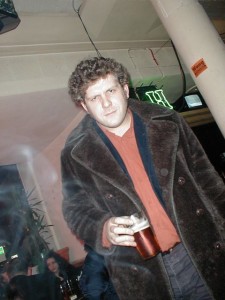
Matthew De Abaitua editor of short-lived 1990s magazine Drug Porn

Yes, I remembered a party from our bohemian salad days, sometime in the last century, when I was editor of Drug Porn and arrogant with all the attention that flared around that position


Had I really promised him that? In the memory-lagoons, a flatfish stirred, straining to shift itself free of the mud. Yes, I remembered a party from our bohemian salad days, sometime in the last century, when I was editor of Drug Porn and arrogant with all the attention that flared around that position. I have not forgotten taking Raymond under my arm at the bar. At this time (somewhere between 1994 and 1999, five years of which I have barely two weeks of memories) he was fierce and sharp and wrote fantastically detailed stories about the hilarious catastrophe of his daily life. I could see even then that it would not turn out well for him. With no facility for compromise, and an Essex boy’s contempt for the liberal bourgeoisie, he was ill-fitted for success in the mediasphere.

I tried to pass on some wisdom:
“Never hold a beer and an opinion at the same time.”
“When on a first date, don’t mention that you are out on bail.”
All I had were callous aphorisms, linguistic narcotics, which were the main form of communication in that age of ideas.
If it was the mid-Nineties, then I was wearing a fake fur coat and t-shirt pronouncing my magazine’s logo: a silhouette of a man taking a woman from behind while snorting a line of coke off her back.
We all thought we were very funny back then.
Devising and launching Drug Porn from the back room of my Hackney flat earned me notoriety but no money – at least, not directly. There was a lucrative sideline in minor media punditry and youth consultancy. During the great brand realignment (a recalibration of capitalism’s iconography to accord with the desires of the latest generation) I even found myself nude under a white sheet, hosting ayuascha self–discovery sessions for six marketing managers in a cellar in Clerkenwell. Having communed briefly with the snake god, they all agreed to redesign their brand to more closely resemble a caduceus.

I have copies of the magazine lying around here somewhere – politically correct erotica interspersed with columns on over-the-counter medication (and how to mix it!), ethnovoyeurism on the latest Amazonian entheogen, interspersed with the drug pulp of the era – “Oi you slag I’m raggin’ me tits off” etc. There were always young Oxbridge journalists keen to keep their hand in with seriousness by penning essays on the hedonistic indiscretions of Petronius, Hassan I Sabbah or David Icke. There was always another outrageous ironic joke to crack, another fashionably lackadaisical artwork to feature. With retrospect, the notion of an alternative magazine is as preposterous as an alternative arms manufacturer, or a countercultural oil company. It is a consumerist medium. Hopeless to deny it, really. It was a compromised endeavour from the outset, our outlandish stylings quickly co-opted into the imagery of youth-orientated brands. Even the free tin foil helmets tipped on to our madness issue were sponsored by a video game. As the decade inflated, there was less and less time to put the magazine together and our shock tactics paled in comparison to the kind of things eight-year-old girls were downloading from the internet. The end came when three of the drug-addled junior staff tore the office apart in search of listening devices, convinced we were under surveillance.

The final issue signed off with a valedictory verse called ‘My Nineties’.
My Nineties
Nineteen ninety.
“Do you want one of these?”

Nineteen ninety-nine.
“Don’t you think you’ve had enough?”

It must have been sometime during this period that I made my promise to help Raymond.

From an early draft of The Red Men by Matthew De Abaitua
Kibbo Kift & The Usable Past

Continuing the series of excerpts from my essay on the Kindred of the Kibbo Kift, due to be published in The Idler in 2010.

A prehistoric track stretches across 250 miles from the Dorset coast to the Norfolk Wash. For over five thousand years, people have walked or ridden this trail. The first section we know as the Ridgeway, a chalk ridge beginning in the uplands of Wessex and bisected by the River Thames at Goring Gap, rising above the low ground and valleys that once would been treacherous with woods and marshes, wolf and boar.

Kinlaw of the Kindred of the Kibbo Kift

Kinlaw of the Kindred of the Kibbo Kift

At Ivinghoe Beacon in the Chiltern Hills, the second part of the track commences, the Icknield Way, a narrow corridor and ancient line of communication between South-West England and the East coast, a path worn steadily by traders, travelers, and invaders as far back as the Bronze Age.
On a night hike returning to his encampment in Latimer overlooking the River Chess, John Hargrave crossed the Icknield Way, inspiring the closing address of The Confession Of The Kibbo Kift, published in 1927, Hargrave’s public manifesto for a secret movement that was already seven years old.

Read more at hilobrow.com

Hilobrow – John Carpenter

John Carpenter on the set of Ghosts of Mars with Ice Cube

John Carpenter on the set of Ghosts of Mars with Ice Cube

Few cultural scraps are as redolent of lo-fi VHS genre pleasures than a movie trailer with JOHN CARPENTER’s (born 1948) name above the title and his own analog synth score. Carpenter’s breakthrough was Dark Star (1974), a wiseass repudiation of 2001: A Space Odyssey’s intergalactic awe. Bits of the movie’s code can be discerned in the DNA of Douglas Adams’ Hitchhiker’s Guide to the Galaxy (chirpy talking bombs and planet-destroying contractors); the SF:UK comedy series Red Dwarf (opening credits featuring a Country & Western number playing over a shot of a sauntering space ship); and — via Dan O’Bannon, who co-wrote both — Ridley Scott’s Alien.

Read the full article at Hilobrow.com

Here is a highly misleading Dark Star trailer that makes no mention of comedy

The Stone Tape

It’s hard for 21st Century whippersnappers to appreciate the impact Nigel Kneale’s 1950s Quatermass serial had on the nation. Back when there was only one channel, and the programmes all went out live, a writer could step out of Alexandria Palace, look out across the TV aerials rigging the dark London skyline and know that everyone with a set had just been watching his show.

stone tape title card

The Stone Tape

Pubs emptied for Quatermass, especially the second series, Quatermass And The Pit, a landmark in sci-fi horror later remade by Hammer. That’s why the BBC – when faced with filling the Christmas Day schedule in 1972 – turned to Kneale, commissioning a ninety minute ghost story to follow the traditional Morecambe And Wise special. The Stone Tape was the result.

A group of computer experts (think ZX Spectrum guru Clive Sinclair and his Open University mates) hole up at a stately home to invent a data storage medium that will restore Britain to the forefront of the information revolution and, as their leader Peter Brock (Michael Bryant) says, “put the boot in old Nippon”. But while clearing out a room in which to store their anachronistically immense computers, they disturb ghosts. Being scientists, the researchers decide to knuckle down and study the ghosts, discovering that the shades appear to be unthinking recordings of old presences, imprinted upon the stone walls, rather than self-aware phantoms. Could this stone be the storage medium they are looking for?

The performances have the exaggerated, stagey quality typical of the era, particularly Bryant’s philandering team leader, who fills out his beige slacks with thrusting actorly presence. Jane Asher is both heroic and disturbed as his mistress, doing some decent work before her career went into a period of doily purdah. Aside from the script, the best work here is done by the BBC Radiophonic Orchestra – their avant garde electronica burbles sinisterly in the background; the robotic death-fantasies of physics teachers.

Made on the cusp of the peak year in British horror (Don’t Look Now and The Wicker Man were just around the corner) The Stone Tape is profoundly disturbing, especially at the climax, which taps into deep evil.

The Year Of The Sex Olympics

In the near-future, a media elite rule a dull-eyed society through television. The highpoint of their pacifying schedule is ‘The Year Of The Sex Olympics’, in which couples from around the country display their sexual prowess with the suburban smarm of ‘Come Dancing’ contestants.

year-of-the-sex-olympics

Producers Nat Mender (Tony Vogel) and Lasar Opie (Brian Cox) lounge around the Sex Olympics studio, commenting on the skill of the performers while monitoring the reaction of their focus group, the aim being to keep them as docile as possible. The theory is that a glut of expertly-performed TV sex will act as a contraceptive against desire, curbing the numbers of the lumpen masses, or ‘lo-drive’ as they are called. Their hunger and rage is likewise satiated by ‘The Hungry Angry Show’, in which two half-naked fat men bellow and throw fish slop at one another.

Like ‘Castaway’ and ‘I’m A Celebrity Get Me Out Here’, the ‘Live Life Show’ entertains by exposing its pampered contestants to harsher, pre-modern ways of life

Penned by Nigel Kneale (‘Quatermass’) during the so-called sexual revolution, this BBC production aroused a similar controversy to those other landmark TV dramas of the decade, Cathy Come Home and The War Game. But The Year Of The Sex Olympics has had to wait until the 21st Century for its message to become truly pertinent.

Kneale’s vision of the future is so prophetic it is uncanny. The way the producers instantly consult focus groups anticipates both our ratings-obsessed TV culture, and the way in which the focus group has replaced democracy as the most influential expression of citizenship. Furthermore, the displacement of activity from ‘doing’ to ‘watching’ is the defining aesthetic of contemporary British television – cookery programmes for a country that no longer cooks, 24 hour TV shows you can watch instead of living.

An aspiring artist falls to his death. The focus group explodes into laughter

The final act of The Year Of The Sex Olympics is set within an around-the-clock reality TV show called the ‘Live Life Show’. Like ‘Castaway’ and ‘I’m A Celebrity Get Me Out Here’, the ‘Live Life Show’ entertains by exposing its pampered contestants to harsher, pre-modern ways of life. The three unfortunates are disillusioned TV exec Mender, his former lover and their young daughter. After spending their entire lives within a complex, they find the wind, the grass, and even the fire strange. With only a tape recording of instructions, they must survive in a cottage on a remote seemingly Scottish isle, their every act broadcast to a bovine nation.

Unfortunately for them, fellow executives Ugo Priest (Leonard Rossiter) and Opie have chanced upon a new way to entertain their audience: “fruit skin”. During a broadcast of clowns – which utterly fails to amuse their focus group – an aspiring artist falls to his death. The focus group explodes into laughter, and Priest remembers something from the old days, when people would laugh at things because it didn’t happen to them. The ambitious, amoral Opie decides to test this theory further, and he arranges for a murderer to visit Mender’s family.

Penned in a clipped argot (reflecting the debased language of an idiot box society), it takes a while for the audience (and the actors) to become comfortable with the futuristic language. Also there are those pesky BBC production values standing in the way of a whole-hearted suspension of disbelief. These glitches aside, the final act is as horrific as you would expect from a writer who gave us the shattering climax of ‘Quatermass And The Pit’ (“I saw a crowd fall upon a blind man. They tore him apart”) and Jane Asher’s descent into a cowled sacrificial ritual in The Stone Tape.

Matthew De Abaitua’s SF:UK feature on The Year Of The Sex Olympics and interview with Nigel Kneale can be watched here.