Author Archives: Matthew De Abaitua

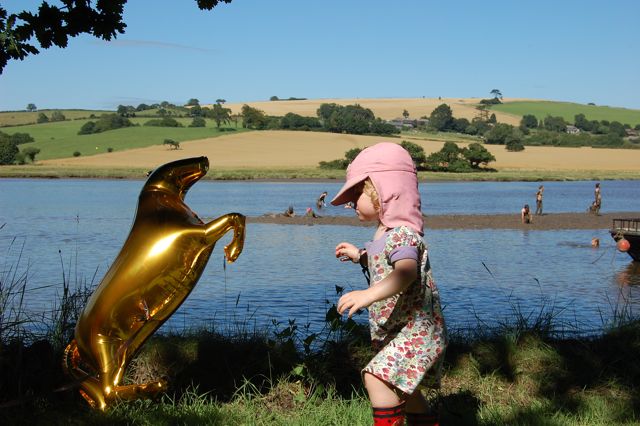
child with golden horse balloon beside a river

Short story – Childcare

child with golden horse balloon beside a river

Childcare

We are sitting with our children on a rug beside the river. A woman approaches us. She is a stranger and in her arms she is carrying a child.

She says, “Excuse me, would you mind looking after my baby?”

We look at one another with confusion. How should we respond?

“Just while I go for a swim,” she says, gesturing to the river with a slender hand.
She is lean and beautiful in her black swim suit but her face is unreadable.

“I won’t be long,” she says. “And he’s a very independent baby boy.”

Our Mums nod and smile and calculate. We are busy negotiating with half a dozen toddlers of our own but we are not the kind of people to refuse a favour.

The baby is a chubby boy who has just learned to walk, and he has the clumsy tippy-toe excitement of that discovery. He is dropped into our party, and he stumbles a few steps into my arms.

His mother walks away gracefully and into the throng.

“What’s your name?” we call after her.

She whispers her name but it is too exotic for us to grasp.

“What’s your baby’s name?”

“Jack,” she calls back and then disappears over the edge of the bank and into the water.

Child gazing into golden horse balloon

The river is tidal. At noon, it was a narrow sinuous channel cut into heaving mudflats, then the water trickled back from the estuary like a rumour, heightening everyone’s excitement about the arrival of the river itself, as if it were a famous guest at a party. There is a diving board and a wild swim. We have not brought our costumes. We are content to miss out. Parenthood, for us, is about missing out. The river wants beautiful women with eyes that are unreadable. Why is she such a mystery to us? Is it because her eyes are slightly too far apart for us to apprehend? Or is there something in them that we have decided to overlook, a cold impatience that modern etiquette requires her to be thankful of our help, and not merely insist upon it.

We sit on our rug in the shade. Jack slavers and pants with excitement at our golden horse balloon. All of our children want the golden horse balloon but it is given to Jack because he is our guest and it is important that we learn to share. He cries when the golden horse balloon drifts out of reach. It is returned to him and his excited panting resumes.

Jack’s cry attracts a beautiful man with a mustang’s mane, naked under an insouciantly draped towel. The beautiful man glances at us to check that we are not failing in our duties. He is not a Dad, we can see that in his stomach muscles, yet he feels responsible, not for the boy, but for ensuring that we do our job. He looks down at us and reassured that the proper measures have been taken – the annexing and enclosure of the golden horse balloon – he walks on by.

Boys somersault into the river. They swim wild, with different rules to the municipal pools of our childhood; bombing, diving and petting are encouraged. Emerging from a secluded meander, a naked man and woman wade hand-in-hand, their skin glittering in the sun. They are imperious in their freedom. We are in the shade.

Jack’s mother returns from her swim with wet hair and gooseflesh. She walks by without acknowledging us, finds a towel, and begins a conversation with the beautiful young man with the mustang mane. We seek her gaze. She is unreadable to us. More of us arrive. Our picnic rug is overwhelmed with children, all of whom want the golden horse balloon that Jack is chewing.

One of us has to go to the toilet. We will be too few to safely care for Jack. Our Mums agree that he should be returned to his mother, and that I should do it.
I go to her. She is surprised to see Jack in my arms.

“Is he upset?” she asks.

“No,” I reply.

She blinks, allocating a microsecond for me to reconsider my actions.

She speaks quietly, without catching my eye: “he looked very happy with you all. You have other children with you. He likes other children. And you all seem such nice people.”

I explain that I have to go to the toilet and that we only have so many pairs of eyes. This disappoints her. She looks up at me. I see an unflattering reflection of myself in her eyes.

“And we are beside a river,” I say.

It takes her a moment to understand my inference. When she looks at the river, she does not see danger, she sees pleasure.

When I return from the toilet, Jack is back on our picnic rug; the little boy is once again grasping and gnawing at the golden horsey balloon. And he is holding toy cars in his chubby palms, cars that belong to one of our boys. Our boy has been instructed to share but he doesn’t like it. We don’t know what to think. Is it right that we make the small sacrifice of looking after one more child, so that this stranger can have an hour to herself? Just because there are no words, in our language, for the question, “Excuse me will you look after my baby?”, it does not mean that we should disapprove of this custom of engaging strangers in childcare when an opportunity presents itself.

golden horse balloon beside the river

The river deepens. Intimations of dusk. We are growing hungry, the children fractious and cold. Where and what shall we eat? Is it time for cardies and long trousers? We must return to our camp. And what is to be done about Jack? Our littlest girl scowls at the boy; she knows that he does not belong and can’t understand why we allow him to take such liberties with the golden horse balloon.

Again, I take Jack up in my arms and return him to his mother, who is still chatting to the beautiful man with his casual towel.

I tell her we are leaving and pass Jack down to her. He cries.

She gazes at her son, and then at me: “he’s not happy,” she says.

Jack makes the brum-brum sound of a toy car and strains in her arms to return to our rug.

She strolls over to our mothers, who are busy packing to leave, and she finds what her son wants, a pair of toy cars, and she quickly steals them.

“There, there,” she says to Jack, “that’s better.”

We leave the river and return to our camp.
***
We are sitting under the gazebo. There is pasta and pesto for tea. A few of our children are with us and eat quietly, but most of our children are out there roaming around alone and who knows where. We believed that they would return for dinner. We were deluded.

Has anyone seen Hector?

The last time we saw Hector he was throwing a wellington boot at a duck. We consult the children about his whereabouts. They saw Hector trying to sell ripped pieces of paper to the people beside the river. Alexandria wonders if Hector is with his father, Will.

Has anyone seen Will?

Yes, we saw Will doing card tricks at the Boat House. And didn’t he say something about going fishing?

Now Jones is here. Hello Jones!

Has anyone seen Flint? asks Jones.
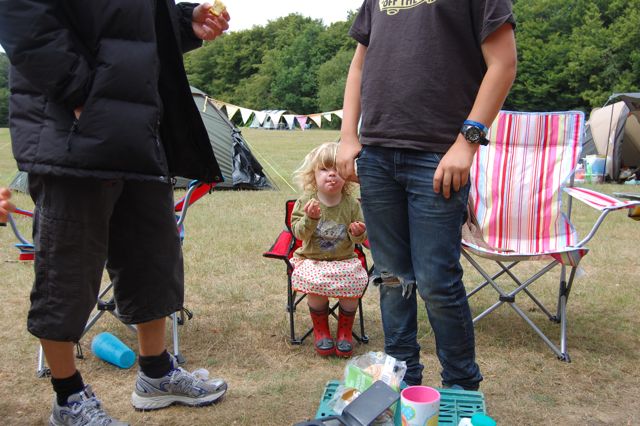
feet in group camp
We make a show of looking to our left and to our right, and under the deck chairs, but Flint is nowhere to be found. We deliver reports of Flint: Cathy saw Flint at the circus tent. Noni saw him amongst the chefs upon the green. Kirk saw Flint riding on the back of a quad bike driven by a copper-coloured clown.

We don’t know who Kirk is, or why he is here. Kirk freaks us out.

Here’s Hector. He arrives back at camp with the bemused look of a reveller who popped out of the party to buy another bottle of champagne and returned to find the guests transformed into apes: who are these people, wonders Hector, and why aren’t any of them my parents?

Has anyone seen Mama, Hector asks. She was here a moment ago. Has anyone seen Papa? Kirk glimpsed Papa roaming the woods wearing the head of a wolf. Kirk is not helping. Kirk appeared last night, attaching himself to our camp with the blithe confidence of a lonely posh lunatic. Kirk concerns us.

Matthew leaves a message on Papa’s phone. Kirk wants to show us the decanter he bought from a stall holder, but the decanter is already broken, the spout jagged glass: who would have guessed that a decanter would break in the middle of a festival? Kirk resolves to return it to the stallholder. We hope that he will go. Kirk is still talking about the decanter so we find it hard to concentrate on the whereabouts of the children.

We need someone to hold the baby while we put a tent up. Our baby is only a month old. Kirk volunteers. I am so broody, he says, and before we can say NO! Kirk takes the baby from us. Her big head lolls briefly on her weak neck and then settles into the crook of his arm. One handed, he carries her off and looks at us, expecting us to smile at the sight of him, Kirk, with our baby, and it takes all our strength to smile despite every cell of our being screaming. We cannot concentrate on feeding the children. Time slows, and we hold our breath as Kirk struts around the camp, showing everyone his new baby and his new but broken decanter.
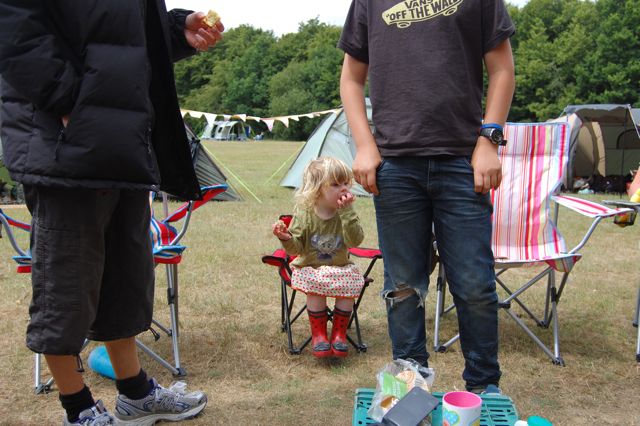
feet in group camp 2
Our worst fears are interrupted by Hector. He is still looking for Mama and Papa, and his big brother. Have you seen Albert? he asks.

Has anyone seen Albert?

He jumped into the river, we remember, he somersaulted in from the edge of a sunlit wheatfield.

From a small tent, there comes the halting cries of a little girl. She fell asleep and when she woke up, Mummy was gone. Where is Mummy? Which Mummy, we wonder? We are losing track of ourselves. It is getting dark and the children move so quickly. The little girl wanders away through the guy ropes lead by another girl that we have never seen before, who is dressed in a tiger suit. We go to stop them but then someone asks us, where is Albert? Have we seen Albert’s Papa? And do you think a baby should play with a decanter? And in that time, the little girl and tiger disappear into the dark, and we cannot follow because we have so many children here. We chew our cheeks and bite our lips and wring our hands.

A mother arrives with a friend and couple of cocktails from the bar and an apology for leaving her little girl with us, in the little tent.

But you didn’t tell us you were leaving her here, we say. So we didn’t know.

The mother looks in the little tent. Her girl is gone. Where is she? the mother panics.

She left with the tiger girl, we say.

No one knows any tiger girl.

They were here a minute ago, we say.

No, I say, it was ten minutes ago.

At dusk, the tents rustle quietly in the wind. Mothers call for their children, and the wrong children answer them. Mosquitos hover over the river like patches of white noise.
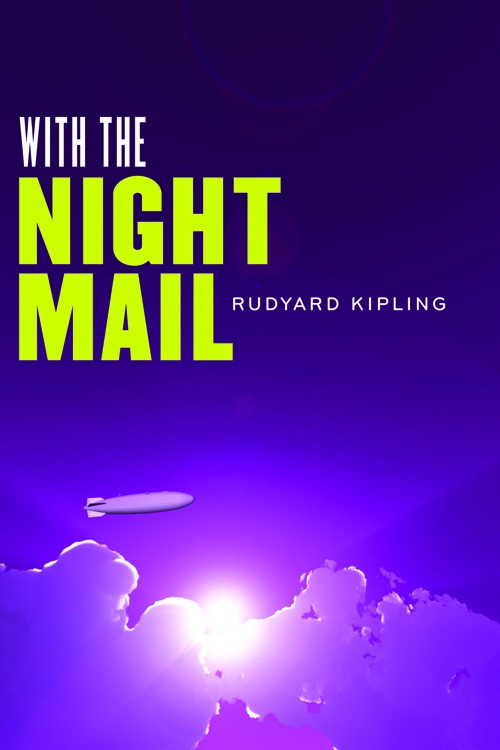
With the Night Mail by Rudyard Kipling (Hilobooks)

With The Night Mail

In 2012, Hilobooks will issue three classics of Radium Age science fiction including Rudyard Kipling’s With The Night Mail and As Easy as A.B.C., for which I have written the introduction.
With the Night Mail by Rudyard Kipling (Hilobooks)

On June 12
With the Night Mail, A Story of 2000 A.D. and “As Easy As A.B.C.”: Two Yarns About the Aerial Board of Control
By Rudyard Kipling
[978-1-935869-52-8]
By 2000 A.D, airships have replaced aircraft for freight and human travel. Kipling’s novella follows the exploits of an intercontinental mail dirigible battling foul weather, while detailing a planet-wide Aerial Board of Control (A.B.C.), which enforces a rigid system of command and control not only in the skies but in world affairs too; they outlaw war in 1967. Kipling got so excited by his own utopian vision that the story was accompanied by phony advertisements and other ersatz magazine clippings.

In Kipling’s 1912 followup story, “As Easy As A.B.C.,” set 65 years later, we learn just how complete the A.B.C.’s control is over the social and economic affairs of every nation. When a mob of disgruntled ‘Serviles’ in the District of Northern Illinois demands the return of democracy, the A.B.C. sends a team of troubleshooters (from England, Russia, Japan, and Italy) and a fleet of 200 zeppelins to retake the skies.

2012 marks the centennial of the publication of “As Easy As A.B.C.” “It is a glittering essay in the sham-technical; and real imagination, together with a tremendous play of fancy, is shown in the invention of illustrative detail.” — Arnold Bennett (1917). “A most remarkable little story… It is rather a fascist picture which Kipling gives us.” — Norbert Weiner, The Human Use of Human Beings (1950)

‘Once there was The People — Terror gave it birth;
Once there was The People, and it made a hell of earth!’
(Then the stamp and pause):
‘Earth arose and crushed it. Listen, oh, ye slain!
Once there was The People—it shall never be again!’

The levellers thrust in savagely against the ruins as the song renewed itself again, again and again, louder than the crash of the melting walls.

De Forest frowned.

‘I don’t like that,’ he said. ‘They’ve broken back to the Old Days! They’ll be killing somebody soon. I think we’d better divert ‘em, Arnott.’

‘Ay, ay, sir.’ Arnott’s hand went to his cap, and we heard the hull of the Victor Pirolo ring to the command: ‘Lamps! Both watches stand by! Lamps! Lamps! Lamps!’

‘Keep still!’ Takahira whispered to me. ‘Blinkers, please, quartermaster.’

‘It’s all right–all right!’ said Pirolo from behind, and to my horror slipped over my head some sort of rubber helmet that locked with a snap. I could feel thick colloid bosses before my eyes, but I stood in absolute darkness.

Introduction by Matthew De Abaitua, author of the science fiction novel The Red Men.

More at Hilobrow

matthew de abaitua drunk and stupid

Monogamy and the city

I wrote this sketch during the long boom, back when I lived in London. It summons up the privileged boredom of the early noughties. My life is nothing like this now, and I have a whole different set of problems.

matthew de abaitua drunk and stupid
“I am stupid.” We were sitting in the George, on the corner of Wilton Way, Hackney.

“I know what you mean,” said Walter.

“I am becoming stupider by the hour,” I continued.

Walter put his glasses aside, revealing eyes trimmed with a thin frame of exhausted blood vessels. “I am too.”

You expect ageing to be an accumulation of experience, a daily accretion of ballast against the unknown. You don’t expect time to beat the smarts out of you, to mercilessly reprogram you with its weary cynicism, until you become a quarter of the man you once were, even though that was only half the man you wanted to be.

“Yes,” said Walter.

It’s our fault. We both sold out. Cut it any way you want, neither of us have ideal jobs. We’re doing something much stupider.

“It’s not just us,” Walter had a starred first in English Literature, with a Distinguished Masters from LSE, where he was trying to unify post-colonial literary theory with supply-side economics in a way I can’t even begin to understand.

Now he spends his evenings having Heat magazine explained to him by his twenty five year old lodger.

Walter was still talking. “Work does not demand intelligence, just perseverance. The people who do well are the ones who keep their heads down, bide their time easing up the corporate hierarchy. In fact, the higher up you go, the stupider everyone seems to get. Their minds have drawn tightly about their career; there is no space for anything else. In my line of work (television) a certain ignorance is an advantage. It shows you are in touch with the audience. In fact, applying your ignorance to a subject is pretty much the definition of a successful television programme.”

I nodded in recognition. “You feel daft.”

“I used to be a genius. Now I’m an imbecile. They took it from me.”
Man dancing at Idler party in the stupid Nineties with a snail projection behind him
Walter squinted, squashing his thoughts into some kind of cohesion. “I went to a dinner party the other day.”

In the past I would have mocked him for this confession. Now it didn’t seem to matter, being middle class. It made no difference. In fact, I was curious to hear about it. “Did anyone say anything interesting?”

“I don’t know. All I remember is long periods of silence punctuated by this other guest, a woman who looked just like Tony Blair, talking about peas. She liked the smell of them, ‘like freshly-dug soil’. Every now and again I’d try and talk about creative stuff.”

“Creative stuff?”

“You know, the arty things that everyone reads and chats about?”

“Oh. Culture.”

“I didn’t have the energy. Holding a glass of wine, holding an opinion. Couldn’t be arsed. ‘Have you seen the new exhibition at the Tate? It’s very good. The new exhibition at the Tate. We went last weekend, very thought provoking if a little showy. The new exhibition at the Tate.’ You know how it goes.”

Certainly ideas had lost their lustre of late. In our bohemian salad days, we had been quick with ideas, believing success and self-esteem could be constructed out of one good idea. But theorising is so callow. Experience teaches you that ideas get you nowhere. For example, a friend of mine invented the one shoulder-strap backpack. Has he seen a penny from his idea? No, of course not. It was pinched, copied. Ideas will get you so far, but money, nepotism and plagiarism will get you a lot further.

I’m not bitter about that, in the same way I’m not bitter about gravity. Sure, they both hold you back, but what can you do?
The bar at Idler party in Old Street
I was hungry to hear about the dinner party. I hadn’t been to one for nearly three years. Four couples staring at one another over a little bowl of black pepper, talking about the food while eating the food. God I miss it.

“She looked just like Tony Blair?”

“Yes. Exactly. But with a bob. There was a basket of raw pea pods in the middle of the table. She picked one out, split it with a run of her thumbnail, and took a hefty whiff. Someone was talking about all that state of the nation, government stuff-”

“-politics.”

“It was her boyfriend, he was talking politics, or rather, he was paraphrasing a column from The Guardian when she interrupted him – which was a relief, we’d all read it and didn’t particularly need a cover version – to comment on the peas. She rolled one between her thumb and index finger. ‘It smells of earth, when you turn it over’ she said, with a look of amazement. She held the pod out for me. I took one and gently raised it to my nostril. I sniffed. She watched me with the most unnerving grin. Slowly, I put the pea onto my tongue, bit it, and swallowed. An erotic charge passed between us, we shared a moment over the pea. Her boyfriend’s doing Guardian karaoke. We thought briefly about fucking.”

“Did anything happen?”

“No, of course not.”

We both have long-term girlfriends. Monogamy And The City. All the women seem to be having sex, while the men are having monogamy. Certainly Walter and I lack the wit for infidelity. We are too tired, exhausted by stupid work, the days spent rolling around a washing machine of nonsense, pulled on by thoughtless centrifuge.

Walter was still wearing his suit at 9pm, while the rest of the patrons in The George were all chunky jumpers, roll-ups and community art projects. Citizens of Old Hackney, loony left Hackney, carved wooden Buddha Hackney, unemployable bohemians subsisting on the burgeoning equity in houses sought after by people like us, New Labour Hackney, consultancy and media Hackney.

“In work today,” said Walter, “I had a meeting with the composer of this big new documentary series we’re editing. I had to make some changes to his score.”

“What was wrong with it?”

“Nothing. But insisting on changes is my job. I asked him if he could fit another chord in.”

I laughed. “Good one.”

“He had to go back and rewrite and re-record the whole thing. It really cut into his profit margin. I didn’t know what else to do. I had to say something.”

“Don’t you normally ask for ‘more warmth’?”

“That was getting tired. It was time for a new change. ‘Can you fit another chord in there’ will keep me going until at least October.”

I had to say it. “Your job sounds really stupid.”

“It is. I ask for changes to things I know nothing about. It doesn’t matter if it’s music, comedy, or drama, or a documentary, or the news or a soap opera. If it’s edgy, I tell them to make it more mainstream. If it’s too mainstream, I tell them to add more edge. One of my presenters used the word “corpulent” in a link: I tore a strip off him. “Corpulent” is not a ‘now’ word. I made them reshoot a game show because the set was the wrong colour. It should be hot pink, because research shows that hot pink is the colour of entertainment. Of course, you laugh and say it is stupid, but I don’t see why I should be singled out. Most jobs are stupid. The only exist to keep us busy.”

“I am very busy at the moment.”

“Everyone is very fucking busy. This morning, I heard a DJ announcing that he was keeping it busy. On pirate radio! Even the people at Radio Crackhead are failing to manage their work/life balance! Something is really wrong with us, with the people…with…”

“Society.”

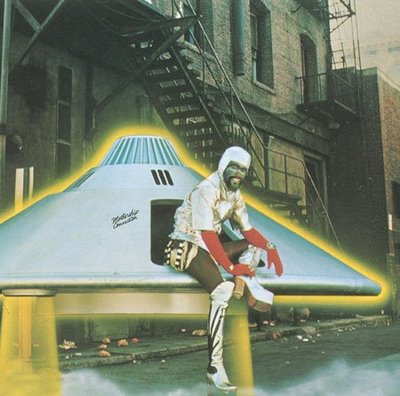
George Clinton dressed as the Star Child climbs out of the Mothership UFO

Mothership of Invention

Wearing a long blue pirate-themed funk coat decorated with golden skull and cross bones, George Clinton takes the stage at the British Library conference centre flanked by Nona Hendryx and Chuck Lightning. He and Nona are friends from way back in New Jersey, from when he was a barber (I notice his famous multi-coloured braids are gone, replaced by a peak cap).  As the young and up-and-coming talent, Chuck Lightning sits apart from these two funk legends in tuxedo and cruelly pointed shoes, waiting his turn.Nona Hendryx burning an old photograph of herself

Mr Clinton, as the interviewer Jacqueline Springer addresses him, was ring leader of Funkadelic and Parliament. Nona Hendryx was one third of Labelle then went solo; both artists started out in doo-wop, then realised they had arrived too late for that waning genre. Determined not to be left behind again, they projected themselves into the future, pioneering afro-futurist funk-rock, and on-stage descents from the heaven: Labelle’s lead singer Patti glided down from the gods during ‘Nightbird’ while George Clinton was tucked away in the mothership, the infamous UFO that landed during the Parliament-Funkadelic freakathon.

“We had two motherships,” explains George Clinton. “A little one, about six foot long, that flew over the heads of the audience. I was scared it was gonna fall and we’d get sued. We only used the little one for twenty performances.” The small mothership circled above the audience and then the enormous sixty-foot version descended with George Clinton inside. “It was dangerous up there. I was wearing platform boots, about fifty feet up in the air, fifteen hundred feet up in my mind, and I could easily fall. And the crowd were looking up at me like I was god. And I was not god. I was just trying not to fall.”


His exit from the Mothership, playing the role of Dr Funkenstein in thirty thousand dollars worth of ermine-tails, never fails to cheer me up.

“I just wanted to make people think,” he explains. “I didn’t want them to follow me. I didn’t want to be a leader because reality changes, and you have to change along with it.” (This reminds of John Maynard Keynes’ famous observation that “When the facts change, I change my mind”.)

Chuck Lightning comes into the conversation. He describes himself as ‘Creative Director’ of Wondaland Arts Society, the loosely affiliated group that includes Janelle Monae, and which seems – on the surface – to be in the tradition of afro-futuristic collectives such as Sun Ra’s Arkestra and the Parliament-Funkadelic Mothership.

The differences are instructive. The Arkestra was cultish in the way the musicians gave themselves over to Sun Ra’s singular vision and rehearsed exhaustively to realise it.  I would love to know more about the dynamic in the Mothership, the working process between the sixty people who toured with Parliament-Funkadelic during the peak years of 1974-1979, a time George Clinton describes as “all of us altogether, all of the time”. Was George an autocratic enforcer of quality control, stamping product as it left the funk mines? I am guessing it was more subtle than that.
George Clinton dressed as the Star Child climbs out of the Mothership UFO
Discussing Janelle Monae’s cover of Flashlight, he is incredulous that she could sing it as if it was a normal song, and not just a collection of incredibly funky decisions arrived at by the band. “The band made it,” he croaks, as if to ask, how could it exist without the band?

I’d been listening to Flashlight that very morning, struck by the strange spontaneous unfurling of its layers: the incredible choppy synth line, the chicken scratch guitar, the chunky thighs of that bass (Bernie Worrell on the mini-moog), the knocked back vocals – how many voices are there on it, 40? 50? Flashlight came off what passed for the Motown production line in Parliament-Funkadelic; that is, not a production line at all but a network of talent from which music emerged. A network that Clinton alternatively tightened and slackened to astonishingly productive ends: I count over thirty albums between 1970-1979 that bear his signature, albums by Funkadelic, Parliament, Boosty’s Rubber Band, Bernie Worrell, Parlet, Brides of Funkestein, Eddie Hazel, and the Horny Horns.

Vernon Reid interviewed George Clinton about the making of Flashlight for Vibe magazine, and his answers clue us into the creative process in the Mothership. Play around, keep your ears and eyes open, and eventually something will emerge. Once it does, switch modes. Grab it and hone it before it wriggles away.

“First of all the track was Bootsy’s track. He didn’t want it. He couldn’t hear it so I took it… First it was just the jam. Give me a crowd like you’re at the baseball field. Then, okay, let’s see how precise we could get that. Bernie [Worrell] aught me about motifs. You get a melody, you have every motherfucker playing it – everybody did that in ‘Flashlight’”.

Trained in the order of Motown but attracted by the renegade funk of James Brown and the renegade rock of Hendrix, the Parliament-Funkadelic process was chaos arranged in such a way that beautiful order could emerge, and vice versa. (“Consciously that was our intention, to do chaos and order at the same time,” George Clinton.)

It is hard to imagine George Clinton describing himself as “Creative Director’ of the Mothership. The title of Creative Director belongs to the formal creative output of an advertising agency. Chuck Lightning’s Wondaland look is sharp with curly extremities: the tuxedo with its clear delineation between black and white is made subversive through the lengthening of the shoes, the plastic framed shades and potent hairdo. Chuck’s hair is shaved at the sides, wild and mohican down the middle, another sharp division, between the organic and the artificial, between the process and the natural. I wonder if the thinking is too binary to be sustainable.

Wondaland state they are “watching Steve Jobs the way Berry Gordy watched Henry Ford”. A funk collective with the ferocious brand control of Apple? Why not? Control is easy. Enforcing brand identity is easy. Coaxing dozens of brilliant works out of creative talent requires something other than control: an understanding of the uses of chaos, the art of guiding without touching, leadership not management, the ability for something to exist in a superposition of this and that until just the right moment for collapse. Mr Clinton knows. Ask him.

The British Library event was organised by Union Black and climaxed with a thunderous standing ovation.

Is it worth asking: who is writing George Clinton’s autobiography?


Neuroadvertising Paradox

Advances in neuroscience are being adopted by marketing and advertising industries keen to show the efficacy of their communication in an era of falling budgets. Companies such as the Boston-based Innerscope have developed a cheap and effective way of monitoring part of the brain’s response to media. From this data, they create “Engagement maps – moment by moment analysis of the audience’s emotional response to the media stimuli.” Welcome to neuromarketing, where brands and marketers push the frontier of consciousness in search of an answer that perennial question: do you like me?

”Emotions are our quick decision makers,” explains Gareth Ellis, senior planner at Saatchi and Saatchi. “On the most basic level, emotions instruct our instinct: Fight or flight. We have a saying here, ‘Reason leads to conclusion but emotion leads to action.’

Saatchi and Saatchi have developed their own language of love, specifically the terminology of ‘lovemarks’: brands that don’t just inspire admiration, but ‘Loyalty Beyond Reason’. “Lovemarks reach your heart as well as your mind,” explains the official website, “creating an intimate, emotional connection that you just can’t live without. Ever.” But how do you create that emotional connection? Opinion is divided. While some are attracted to neuromarketing’s promise of monitoring the emotional responses of an individual’s brain, other experts feel that the answer to emotional engagement lies in the culture, in the domain of signs and symbols known as semiotic analysis. Many brand managers will engage a grab bag of these feuding experts and pick and mix from their advice. The various sects and dogmas of Marketing are treated expediently by their clients though: they just want an approach that works

Gareth Ellis was the planner behind T-Mobile’s advert ‘Dance’, which saw an outbreak of choreographed joy in Liverpool Street Station in January 2009. ‘Dance’ won a Golden Lion at the Cannes 56th International Advertising Festival in recognition of its impact as a pop culture phenomenon (13 million views on YouTube and counting). Launched against a backdrop of a wintry recession, but with the tailwind of hope blowing in from Barack Obama’s imminent inauguration, its communal dancing in the grim, banal surroundings of Liverpool Street Station was a celebration of the human spirit, an outbreak of pure positive emotion.

The most prominent adverts of the age seem to swerve around the rational to light up an emotional response. Chocolate is equated with sex in advertising, specifically female masturbation. The famous Cadbury’s Gorilla, made by top creative house Fallon, took an unsung toiler, a drummer, combined it with the physical discomfort of a gorilla suit, and gave them their moment in the sun. On an unconscious level, the gorilla’s drum solo was a moment of solitary orgasm. The gorilla suit is the body horror that regular female consumers of chocolate feel. And the drummer is the person at the back who does all the work – a position that resonates with a target-audience weighed down by thankless domestic chores. That’s my back-of-the-envelope interpretation, none of which diminished the pure joy the advert aroused in viewers

On a rational level, the advert seemed incongruous – on an emotional level, we understood it. Think also of Sony Bravia’s coloured balls pouring down the hills of San Francisco – a refined visual expression of giddiness with only the subtlest appeal to the rational (the balls enact the promise of the television’s vivid detailed colours). Music also plays a prominent role in these three adverts, from Phil Collins’ ‘In The Air Tonight’ to Jose Gonzalez’s ‘Heartbeats’, for its power to unconsciously influence feeling.

On June 8 2009, Andre Marquis Senior Vice President of Sales and Marketing at Innerscope, a three-year-old biometrics research company, gave a lecture at Google. Here he presented his company’s methods and their belief in the crucial role of our primitive emotional responses in the choices we make, citing obesity as an example of how “our cognitive mind has a minimum effect upon our decision making”. “Neuroscience has figured out that emotions are what drives us,” he continued. “Everything we do is filtered by our emotions first. What you see and what you experience is influenced by what you are feeling on a second-by-second basis.”

At Innerscope, viewers wearing light wireless biometric vests are shown adverts in a “clutter reel”; that is, the advert is surrounded by trailers and film clips to reflect the way we encounter advertising within a stream of other culture. These biometric vests are a shift away from the use of functioning magnetic resonance image scanners (fMRI) – the big white doughnuts into which subjects are slowly immersed – or the older electroencephelogram (EEG), a collection of scalp sensors that pick up activity in the various lobes of the upper cortex, both of which have been and still are used in other practises of neuromarketing. The vests are cheaper and less claustrophobic than a fMRI, and unlike an EEG, they focus upon the emotional limbic system.

The emotional limbic system, sometimes referred to as the “lizard brain”, evolved to ensure our survival. Emotions influence what we pay attention to and what we remember. “The emotions are mechanisms that set the brain’s highest-level goals,” writes Steven Pinker, author of How the Mind Works. Emotions make decisions. In the Romanic view of the brain, reason and emotion are separate – like Kirk and Spock. Pinker demonstrates that there is no line between thinking and feeling: cognition and emotion function simultaneously and in tandem. Without fear, how would Spock have realised that defending himself against a Klingon was more important than playing a round of Vulcan chess? In the limbic system, the amygdala is the specific nuclei responsible for processing and storing the memory of emotional reactions. It is an almond-shaped organ buried in each temporal lobe that fires signals to the whole brain. Experiments have shown that the injection of chemicals into the amygdala of rats influence their ability to recall tasks or indeed to forget them.

Innerscope partnered with the global research group OTX to bring their biometric methods to the UK. “The OTX scale has two axis – one is emotion and the other is cognitive. And ‘Dance’ was off the scale,” explains Gareth Ellis. “Some people take the view that advertising in the UK needs to be either incredibly emotional or incredibly rational – so either Cadburys Gorilla and Andrex Puppy, or a hard sell of the message, like Direct Line.” (Direct Line’s 1980s adverts featured a red phone on wheels beeping a chirpy signature, and the motif has been resurrected, which has in turn revived the addictive ear-worm otherwise known as the ‘jingle’: in a recession, the insurance advertisers’ love of repetition is apparent to anyone unfortunate enough to watch television during the day; this memetic sub-genre attained beery genius with the ‘Compare the Meerkat’ campaign for the insurance price comparison company Comparethemarket.com, which relies on the brain’s stubborn response to error to keep it at the forefront of your perception).

Greg Rowland, expert in brand semiotics, suggests that the emotion vs. rational thought split is often a false dichotomy. “Emotion that isn’t tethered to a product reality can easily float away into pure entertainment, with no tangible benefit for the brand. There is no such thing as pure rationality in advertising – unless perhaps one day a laundry advert displays the chemical compounds for their detergent and nothing else. There is nothing that is entirely emotional or rational. ‘Emotional’ can mean ‘does this create a guiding set of metaphors that connect with culture and engaging symbolism?’, rational can mean ‘does this suggest something useful I can use in life?’ But ultimately, they are just convenient abstractions.”

For marketeers, emotion is their weapon on the battleground of memory. As you walk through the supermarket, processing the thousands of possible choices, in a state of consumer flux between habit and potential experimentation, which products you select could be determined by your emotional memory. Advertising and marketing is about changing habitual behaviour. That is why younger audiences are so valuable to marketers: catch young minds prior to imprinting with brand habits. The further along the timeline of habit a consumer is, the more expensive it becomes to convince them to change. The amygdala’s role in emotional response and learning makes it seem like the sweetspot in changing habit. Although it works in tandem with the higher cortex, the bulk of its work is unconscious.

“Neurobiologists and cognitive psychologists contend that the unconscious mind controls as much as 95% of human behaviour,” writes Dr. Neale Martin in his book Habit: The 95% of Behaviour Marketers Ignore. Martin advances a dual mind theory and insists that for too long marketers have been aiming their messages at the wrong mind. Martin moots two distinct types of mental processing: the executive mind, where conscious cognition occurs, and the habitual mind, which regulates the body, and stores our responses to previously learned behaviours. “If the purchase enters conscious awareness, the realm of the executive mind, it is quite likely that your customer will re-evaluate your offering as well as your competitors.” Better that our consumption of brands remains on the unconscious level of habit.

The underlying trend to these commercial applications of neuroscience is to circumvent the thinking mind. You don’t need a wireless biometric jacket to know that if marketing is to be influential, it needs to tap into an audience’s feelings. But neuromarketing’s promise of more accurate evaluation of the very part of the brain responsible for setting and acting upon goals is particularly alluring.

Greg Rowland of Greg Rowland Semiotics is not impressed. Semiotic analysis of brands comes at the matter from a humanities perspective. Spend ten minutes with this brand semiotician and you will feel like you have met the puppet master.

“Neuromarketing presupposes the human being to be a self-sufficient and self-contained consciousness,” explains Rowland, “and that is not how culture and response works. In the world of cultural theory, we are empty vessels through which identity and symbols pour. So when you dig further into the brain, you are still pursuing the idea that somewhere within the deepest recesses of the brain lies the answer to engaging with a mass audience. I am sure that in ten years time, we will send nanobots out to bring back the chemicals from individuals nodes of the brain so that we can gauge the response to an ad. But digging deeper and deeper is the wrong principle.”

By comparison to the scientific promise of neuromarketing, semiotic analysis may seem rarefied. “But it can lead to effective insight,” responds Greg Rowland, “and creative inspiration rather than simple evaluation.”

It was Greg Rowland’s semiotic observation that Pot Noodle is to real food what pornography is to sex that inspired the famous Pot Noodle “Slag of all snacks” positioning. He uses the example of his recent work with Rexona (Sure) deoderant in Russia to explain the shortcomings of evaluative methods such as neuromarketing:

“The idea was to adopt the strong tone of a Putin in the advertising. To create a 1960s strong-arm paranoia around body odour. [Advertising agency] Lowe’s execution of this idea showed a tattooed pig living in a smelly woman’s armpit. A lot of women were deeply offended. If the ad had been tested by neuromarketeers, it would never have gone ahead. The biometrics would have shown utter disgust. But the ad was highly effective in actually persuading Russians to buy Rexona, and has been used as a template in other countries. (Although pigs were swapped for goats in Indonesia, for understandable reasons).”

Neuroscientific insight into the role of emotions in decision-making is informing the creative work of advertisers and marketers. The most acclaimed adverts of our times have combined music and feeling with a lateral appeal to the unconscious. Yet its main application as another way of evaluating creative concepts only further emphasises how distrustful corporate culture has become of the creative. It is safer to biometrically wire up twenty people to tell you which trailer to promote your film, rather than to trust to your own instinct. Yet it is creative instinct and insight that make adverts like ‘Dance’. ‘Dance’ was filmed and edited in a day before being broadcast. There was no time to test it.

Neuromarketing is a focus group of the emotions set up to evaluate an existing idea. Perhaps if marketers and advertisers invested more in the creation of interesting and entertaining ideas, and less on measuring them, they would make more effective adverts. Put simply, they are overthinking. They need to feel it.

The Art of Camping

My new book The Art of Camping: The History and Practice of Sleeping Under the Stars is published in paperback April 26th by Penguin. It explores the relationship between alternative culture and camping, from the radical idealism of woodcraft groups such as The Kindred of the Kibbo Kift to the progressive influence of the campfire. I have a separate all-camping site for the project, cathandmathcamping.com.

Lineacre Gasworks Mystery

A true story about a father and son whose temperance couldn’t save them from the ultimate betrayal

By MATTHEW DE ABAITUA. Originally published in The Idler, issue 25 ‘Man’s Ruin’, 1999.

I want to tell you a story that happened across the end of the last century. It’s about a man called Eddie Bateman, who was born and grew up in Bootle, in Liverpool, and who waded knee deep through bad luck all his life.

By modern standards, Eddie lived his life on fast forward. He was born in 1876, and by the time he was fifteen, he was already working as a stoker at a local cement works. He was married at twenty, and his first child was born a hundred years ago last July. By the age of twenty three, he had changed careers and was travelling the world as a marine fireman, heroically fighting blazes in rough seas: Eddie went face to face with the flammable gases of decomposing fruit on the banana boats, Eddie crouched into the cloying flame of a diesel fire below decks, gingerly picking his way through scorching iron corridors. It was thirsty work, by all accounts. But Eddie never touched a drop of drink because Eddie had signed the pledge. Eddie Bateman was temperate.

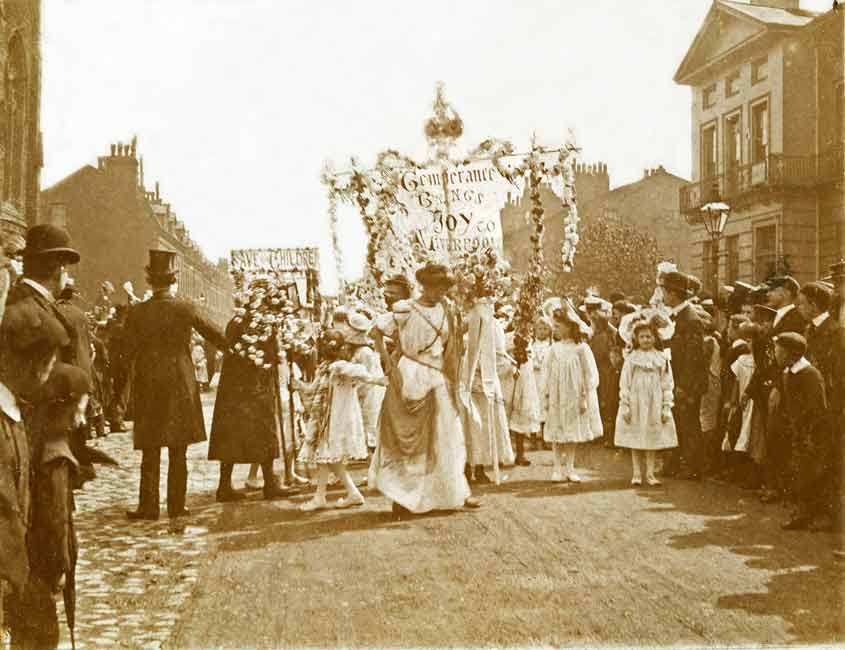
Temperance movement on the streets of Liverpool

Temperance movement on the streets of Liverpool

The idea of temperance has all but died away now, but as a movement it was all pervasive, the self-help or gym culture of its day. Heavy drinking was rife amongst the working classes in the 1840s: one Lord Ashley estimated that the class spent something like twenty-five million pounds on booze a year, and Engels agreed with him. Engels writes of the travelling Irish apostle of temperance, one Father Mathew, who passed through the English cities, signing up between thirty and sixty thousand of these drinkers at a time to the temperance pledge.

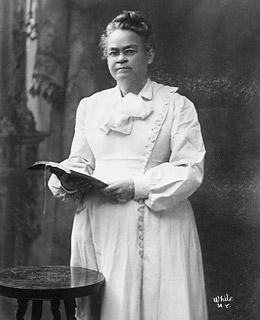
Over a period of about six years in the late 1830s and early 1840s the Cork Total Abstinence Society under Father Mathew enrolled over six million members. Father Mathew even travelled out to America, where at this time, the average American man, woman, and child were consuming between six and seven gallons of pure alcohol a year. After a break for the civil war, The American temperance movement took off again in the 1870s, under a formidable woman called Carry Nation.

Carry Nation

Carry Nation

Both Father Mathew and Carry Nation were celebrities: Father Mathew gets a namecheck in Finnegan’s Wake, and Carry Nation was much in demand as a temperance lecturer. She was six foot tall, weighed 175 pounds, and would storm into saloons with a hatchet, with which she would split the barrels containing the infernal liquor. She gigged all around America, her travelling roadshow of abstinence ending in some dive with her hacking away before bemused drunks while her congregation tortured them with hymns. She once raided the bar of Chuck Conners, who was a character in the Bowery in New York, and the man accredited with first using the phrase “under the table” to describe being drunk. Conners was holding a soiree at the time: Carry Nation stormed through it and swept bottles from tables, snatched ciggies and cigars from lips, and then read out a letter from a mother pleading for information on her daughter who was lost in the vice pit of the Bowery. But a young girl called Pickles took exception to this interruption of her evening, and threw a bottle at Carry Nation, who – subsequently – chased young Pickles around the bar with her hatchet.

There was undoubtable theatre to the whole temperance movement: quotes from Carry Nation are soaked in melodrama: she once said,

“Men are nicotine-soaked, beer-besmirched, whiskey-greased, red-eyed devils.” She didn’t just hate booze either. She hated tobacco, foreign foods, corsets, skirts of improper length, and mildly pornographic art of the sort found in some saloons of the time. She ended her career in vaudeville in Coney Island, having gone from preacher to self-parody, a pantomime villain of excessive prudence.

Her audience weren’t taking it that seriously either. Most people broke the pledge within a month. Engels noted that: “If one counts up the immense numbers who have taken the pledge in the last three or four years in Manchester, the total is greater than the whole population of the town.” It seems that most people signed the pledge after a heavy Friday night on the tiles, only to break it again the following weekend.

Looking back over the life of Eddie Bateman, his first misfortune was to take temperance as seriously as he did. He stuck to his pledge all his life. Even though he suffered the kind of tragedies that traditionally drive a man to drink.

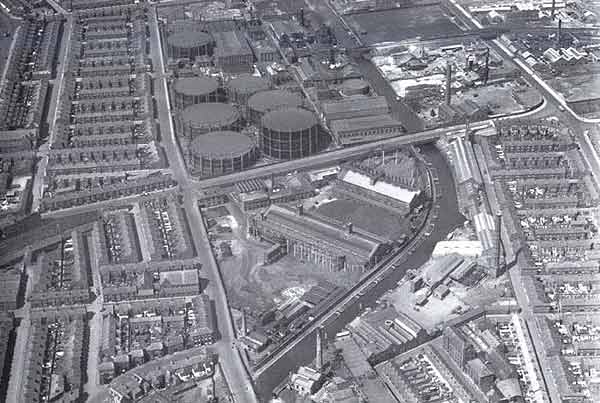
In June 1908, while Eddie was at sea fighting fires, his first son was injured by a swing, and he died. He was nine years old. Eddie sailed home, buried his son, and decided never to go to sea again. Instead, he got a job at Lineacre Gasworks, who supplied the gas for the street lights that lit up Liverpool. Ten months later, Eddie’s two year old daughter, Edith, got hold of some matches, accidentally set fire to her room and died of her injuries – a particularly vindictive prank from the cosmic joker. Fire had taken its revenge for all the defeats suffered by Eddie’s hand at sea. Still, he didn’t crack: he had six other children to look after. After burying Edith, he went back to work as a foreman in charge of a coal transporter in the gasworks.

Lineacre Gasworks in Bootle

Lineacre Gasworks in Bootle

In 1916, the second year of the First World War, men were dying at an average of three thousand a day. At forty years old, and employed in a vital industry, Eddie wasn’t required at the front, although his eleven-year-old son, Thomas, was a drummer boy who would march at the head of the soldiers going off to the killing fields of France and Belgium.

At a time when the great forces of history were moving across Europe, Eddie went to work the nightshift at the gas company on December 16th. He’d had fish for supper, and he left for work at nine o’clock on a Monday night with a pork pie in his pocket. By the early hours of the morning, he was found in what a local newspaper reported to be “an inanimate condition” next to the coal transporter. He was pronounced dead on arrival at the hospital – the Bootle police surgeon gave evidence that the body “was well-developed, well-nourished and there were no marks of violence.” He concluded that death was caused by an invasion of bacteria, and aspersions were cast both toward the fish supper he had eaten before going to work, and the half-eaten pork pie still in his pocket, which some even went so far as to say he had bought from a pub.

The insinuations didn’t end there. His drummer-boy son Thomas sat and listened as representatives from the Gas Company came over to see his mother, Margaret. There were dark hints that Eddie had been drunk, that the story of “the invasion of bacteria” was best for all concerned. It was suggested that her husband had been drinking all these years he had professed to be temperate and had now died because of some pissed-up incompetence at the coal transporter.

Margaret – Eddie’s wife – outlived him by mere months. It is said she died of a “broken heart”, but it was more likely it was cancer of the womb. Either way, it left her six children parentless. It would have been the orphanage for the lot of them, had the Gas Company not stepped in and offered young eleven-year-old Tom a job at the gasworks. Tom accepted. He started work within the month, while his younger siblings went off to the orphanage.

Tom Bateman worked at Lineacre Gas Works all his life. Perhaps mindful of the stories about his father’s death, he too signed the pledge of temperance. He never had a drink, not once: he didn’t eat meat much either, just a little chicken at Christmas. He embodied all the values of discipline and restraint of the traditional working classes – an ardent socialist, erring towards Communism, he slagged off Winston Churchill and disagreed with the private ownership of land. He was the only one of his family not to go to church. But the one thing Tom would never hear a word against was the Gas Company – they had taken him in after his family fell apart, they looked after him all the way through the Depression. When he was sixty- five, he was still working as a fitter, climbing up to the top of the gasometers of Bootle, up the wrought-iron walkway until he was standing atop those great bellows, where he would work to ensure the slow inhalation and exhalation of the city. His fitter’s mate was even a childhood friend – they worked together all their lives. He loved his job.

When he retired after fifty years, the Gas Company gave him a carriage clock. The clock sat on top of the TV in my lounge for the whole of my childhood. To me, it seemed the most precious thing in the world because you only got one after fifty years of work. What could possibly be worth more?

Tom Bateman was my grandfather, on my mother’s side. He died when I was young, and I’m glad he’s not around to hear what I’m about to say. The story of Eddie and Tom Bateman is essentially of two decent men, father and son, who abstained from vice, stuck to their principles, and led good and honest lives but who were – unbeknownst to them – victims of the cruellest barb in the quiver of the cosmic joker.

Newspaper reports of the death of Edward Bateman hint at the truth. The first report of Eddie’s death sells the pork pie bacteria theory very strongly – the police coroner is unequivocal in his diagnosis of natural causes. Yet, six days later, the inquest highlighted the alarming irregularities in the post-mortem, carried out by both the police doctor and one Dr Glynn, acting on behalf of the Gas Company. When Eddie’s corpse reached the coroner, it was missing some organs, and portions of intestine that Dr Glynn had removed: although the report ends with the conclusion that the cause of Eddie’s death was still unknown, the reporter slips in one erroneous detail: This is the actual sentence taken from the edition of the Bootle

Times, December 22nd 1916:
“Neither Dr Glynn or Dr McCormack had any right to do it [remove portions of the body]. If they made a post-mortem and thought they had found sufficient evidence in justifying them in coming to a suspicion that the death was due to electrocution or poisoning, it was their duty to communicate that with him.”

This is the sole printed reference to electrocution in the whole case: in all the previous reports, it never cropped up. Indeed, it was never mentioned in my family until a good five years after even Thomas Bateman was dead, and his youngest sister, May, who had been raised apart from her brother, with the other children in the orphanage, said that she had heard that the ambulance men who found her father’s dead body next to the constructor were adamant he had been electrocuted. This information had never been passed on to Tom, for fear that he would stop work, and the family would be destitute.

After investigating the case with my father, a former policeman, we both think that Eddie was electrocuted by faulty equipment, that the company coroner interfered with the body to conceal this fact, that the police coroner colluded with this, and that ultimately no-one was going to argue with the Gas Company for the sake of one very poor, very dead man. Not back then. I have no doubt that the preposterous cataloguing of the pork pie and fish supper in the reports was a bit of heavy-handed spin to push the bacteria story.

It was unfortunate they had to go so far as to suggest drink was involved: I was worried that Tom had taken the pledge because of these rumours, that not only had he spent his life as an ardent trade unionist unwittingly serving the company that killed his father, he had spent it sober because of the lies they told to avoid any claims for compensation. But: Tom lived a good life. His job – even if it was a salve to a guilty corporate conscience – kept him and his family through the terrible time of the depression. And perhaps temperance wasn’t such a bad thing: he still had the same waist size at sixty five that he had at twenty five: when I think of him climbing up the great gasometers, until the city was laid beneath him, its many lights individual jewels placed there by his own hand, I think maybe he had stepped out of the mire of bad luck his father had trudged through, an achievement that meant that no element of his life – however unjust or unfair – could be regretted.


Tom Hodgkinson

Bath Litfest

I’ll be giving a talk on the art of camping and alternative ways of life with my friend and Idler editor Tom Hodgkinson at the Bath Literature Festival this Spring. The event is on Sunday 11th March 2012 and runs from 8-9pm. Tickets are £7.50.

We performed together at Wilderness Festival and the Edinburgh Book Festival. We have history: Tom and I worked on The Idler together throughout the 1990s.