Tag Archives: hilobrow

With the Night Mail by Rudyard Kipling (Hilobooks)

With The Night Mail

In 2012, Hilobooks will issue three classics of Radium Age science fiction including Rudyard Kipling’s With The Night Mail and As Easy as A.B.C., for which I have written the introduction.
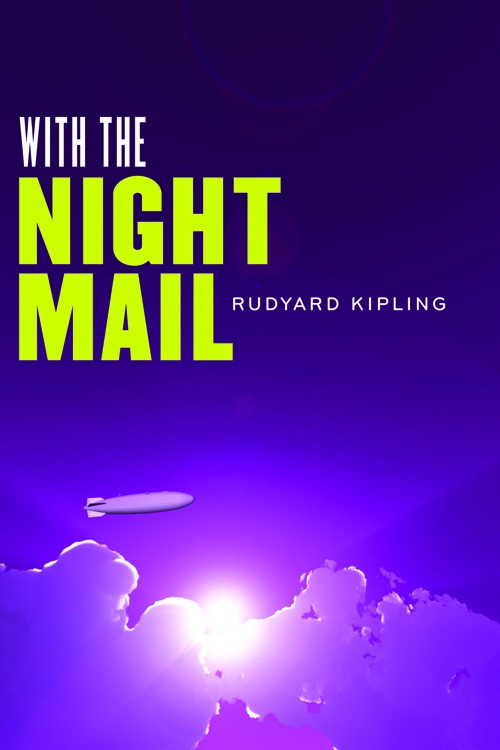
With the Night Mail by Rudyard Kipling (Hilobooks)

On June 12
With the Night Mail, A Story of 2000 A.D. and “As Easy As A.B.C.”: Two Yarns About the Aerial Board of Control
By Rudyard Kipling
[978-1-935869-52-8]
By 2000 A.D, airships have replaced aircraft for freight and human travel. Kipling’s novella follows the exploits of an intercontinental mail dirigible battling foul weather, while detailing a planet-wide Aerial Board of Control (A.B.C.), which enforces a rigid system of command and control not only in the skies but in world affairs too; they outlaw war in 1967. Kipling got so excited by his own utopian vision that the story was accompanied by phony advertisements and other ersatz magazine clippings.

In Kipling’s 1912 followup story, “As Easy As A.B.C.,” set 65 years later, we learn just how complete the A.B.C.’s control is over the social and economic affairs of every nation. When a mob of disgruntled ‘Serviles’ in the District of Northern Illinois demands the return of democracy, the A.B.C. sends a team of troubleshooters (from England, Russia, Japan, and Italy) and a fleet of 200 zeppelins to retake the skies.

2012 marks the centennial of the publication of “As Easy As A.B.C.” “It is a glittering essay in the sham-technical; and real imagination, together with a tremendous play of fancy, is shown in the invention of illustrative detail.” — Arnold Bennett (1917). “A most remarkable little story… It is rather a fascist picture which Kipling gives us.” — Norbert Weiner, The Human Use of Human Beings (1950)

‘Once there was The People — Terror gave it birth;
Once there was The People, and it made a hell of earth!’
(Then the stamp and pause):
‘Earth arose and crushed it. Listen, oh, ye slain!
Once there was The People—it shall never be again!’

The levellers thrust in savagely against the ruins as the song renewed itself again, again and again, louder than the crash of the melting walls.

De Forest frowned.

‘I don’t like that,’ he said. ‘They’ve broken back to the Old Days! They’ll be killing somebody soon. I think we’d better divert ‘em, Arnott.’

‘Ay, ay, sir.’ Arnott’s hand went to his cap, and we heard the hull of the Victor Pirolo ring to the command: ‘Lamps! Both watches stand by! Lamps! Lamps! Lamps!’

‘Keep still!’ Takahira whispered to me. ‘Blinkers, please, quartermaster.’

‘It’s all right–all right!’ said Pirolo from behind, and to my horror slipped over my head some sort of rubber helmet that locked with a snap. I could feel thick colloid bosses before my eyes, but I stood in absolute darkness.

Introduction by Matthew De Abaitua, author of the science fiction novel The Red Men.

More at Hilobrow

Piggy Banks for Significant Objects project

Significant Objects

My story Piggybank is part of the Significant Objects project and will be published in the Significant Objects anthology by Fantagraphics in 2011.
Piggy Banks for Significant Objects project
Significant Objects involved 100 writers creating stories about junk objects. The object and accompanying story were then sold on e-Bay, allowing the organisers to ascertain exactly how much value each story added to the object. My story went for about eleven dollars, I think. In the words of the press release, Significant Objects is “a bold online inquiry into the relationship between narrative and the value of everyday objects, [and] has been the subject of speculation by everyone from NPR to litbloggers to The New York Times’ Freakonomics crew.”

HiLobrow hero: Russell T Davies

My brief appreciation of Russell T Davies, the man who revived Doctor Who, is here at HiLobrow.com.

I could have written at much greater length about his work on Doctor Who. The show obsesses my family. I have three children ranging from two to eight years old. Across her repeated viewings, my eldest child Alice has noticed things that I have missed – are the shadows that kill the parents of the narrator of Love & Monsters the Vashta Nerada that appear in Silence of the Library, she wonders? Last week she declared Jon Pertwee’s Planet of the Spiders to be the scariest episode, and explained to me the similarity between the spiders that squat invisibly upon the backs of their victims, and the fate changing beetle that besets Donna in Doctor Who (my portrait of Russell T Davies appreciates his creative looting).
Every time I watch Doctor Who I do so in the company of children: I see what excites them, what annoys or bores them, and their reactions are mostly the same as mine – it’s very rare they will like something I do not. There is a universal appeal. What I think Russell T Davies did, that other great science fiction revivals have avoided or failed to do, is engage the family, and that’s not an achievement to be treated sniffily.

Grant Morrison

My brief appreciation of Grant Morrison, based on my interview with him in the early Noughties, an interview I spent mostly halfway up a step-ladder and wrapped in the American flag.

GRANT MORRISON’s (born 1960) house was on a distinguished street in Glasgow, purchased with the proceeds from his 1989 Batman graphic novel, Arkham Asylum. In the attic was a replica of his teenage bedroom; downstairs lurked the cellar in which, he told me, he summoned the giant floating head of John Lennon. These two rooms are twin engines, generating the unceasing momentum of ideas and intensity that characterizes Morrison’s comic-book writing. A self-proclaimed chaos magician, for The Invisibles (1994-2000), Morrison’s early Pop postmodernism (the god-like hand of the artist appeared in the 1988-90 run ofAnimal Man) became a florid psychoactive performance as Morrison reshaped himself in the image of lead character King Mob — and vice versa.

Read more at Hilobrow

Kibbo Kift & The Usable Past

Continuing the series of excerpts from my essay on the Kindred of the Kibbo Kift, due to be published in The Idler in 2010.

A prehistoric track stretches across 250 miles from the Dorset coast to the Norfolk Wash. For over five thousand years, people have walked or ridden this trail. The first section we know as the Ridgeway, a chalk ridge beginning in the uplands of Wessex and bisected by the River Thames at Goring Gap, rising above the low ground and valleys that once would been treacherous with woods and marshes, wolf and boar.

Kinlaw of the Kindred of the Kibbo Kift

Kinlaw of the Kindred of the Kibbo Kift

At Ivinghoe Beacon in the Chiltern Hills, the second part of the track commences, the Icknield Way, a narrow corridor and ancient line of communication between South-West England and the East coast, a path worn steadily by traders, travelers, and invaders as far back as the Bronze Age.
On a night hike returning to his encampment in Latimer overlooking the River Chess, John Hargrave crossed the Icknield Way, inspiring the closing address of The Confession Of The Kibbo Kift, published in 1927, Hargrave’s public manifesto for a secret movement that was already seven years old.

Read more at hilobrow.com