Tag Archives: SF:UK

With the Night Mail by Rudyard Kipling (Hilobooks)

With The Night Mail

In 2012, Hilobooks will issue three classics of Radium Age science fiction including Rudyard Kipling’s With The Night Mail and As Easy as A.B.C., for which I have written the introduction.
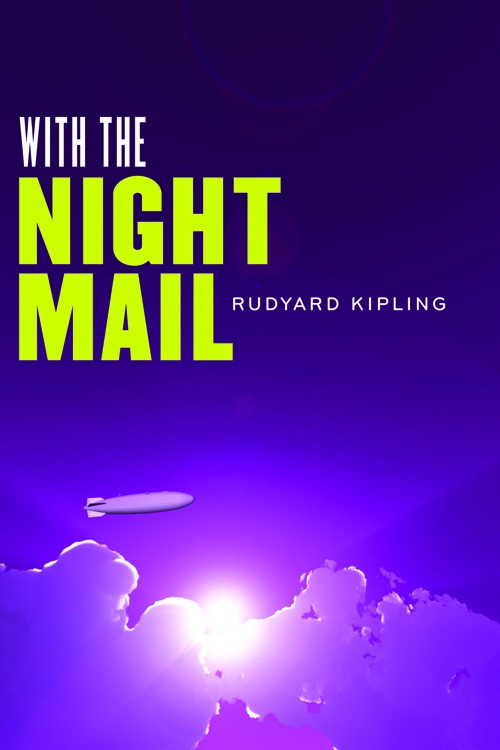
With the Night Mail by Rudyard Kipling (Hilobooks)

On June 12
With the Night Mail, A Story of 2000 A.D. and “As Easy As A.B.C.”: Two Yarns About the Aerial Board of Control
By Rudyard Kipling
[978-1-935869-52-8]
By 2000 A.D, airships have replaced aircraft for freight and human travel. Kipling’s novella follows the exploits of an intercontinental mail dirigible battling foul weather, while detailing a planet-wide Aerial Board of Control (A.B.C.), which enforces a rigid system of command and control not only in the skies but in world affairs too; they outlaw war in 1967. Kipling got so excited by his own utopian vision that the story was accompanied by phony advertisements and other ersatz magazine clippings.

In Kipling’s 1912 followup story, “As Easy As A.B.C.,” set 65 years later, we learn just how complete the A.B.C.’s control is over the social and economic affairs of every nation. When a mob of disgruntled ‘Serviles’ in the District of Northern Illinois demands the return of democracy, the A.B.C. sends a team of troubleshooters (from England, Russia, Japan, and Italy) and a fleet of 200 zeppelins to retake the skies.

2012 marks the centennial of the publication of “As Easy As A.B.C.” “It is a glittering essay in the sham-technical; and real imagination, together with a tremendous play of fancy, is shown in the invention of illustrative detail.” — Arnold Bennett (1917). “A most remarkable little story… It is rather a fascist picture which Kipling gives us.” — Norbert Weiner, The Human Use of Human Beings (1950)

‘Once there was The People — Terror gave it birth;
Once there was The People, and it made a hell of earth!’
(Then the stamp and pause):
‘Earth arose and crushed it. Listen, oh, ye slain!
Once there was The People—it shall never be again!’

The levellers thrust in savagely against the ruins as the song renewed itself again, again and again, louder than the crash of the melting walls.

De Forest frowned.

‘I don’t like that,’ he said. ‘They’ve broken back to the Old Days! They’ll be killing somebody soon. I think we’d better divert ‘em, Arnott.’

‘Ay, ay, sir.’ Arnott’s hand went to his cap, and we heard the hull of the Victor Pirolo ring to the command: ‘Lamps! Both watches stand by! Lamps! Lamps! Lamps!’

‘Keep still!’ Takahira whispered to me. ‘Blinkers, please, quartermaster.’

‘It’s all right–all right!’ said Pirolo from behind, and to my horror slipped over my head some sort of rubber helmet that locked with a snap. I could feel thick colloid bosses before my eyes, but I stood in absolute darkness.

Introduction by Matthew De Abaitua, author of the science fiction novel The Red Men.

More at Hilobrow

HiLobrow hero: Russell T Davies

My brief appreciation of Russell T Davies, the man who revived Doctor Who, is here at HiLobrow.com.

I could have written at much greater length about his work on Doctor Who. The show obsesses my family. I have three children ranging from two to eight years old. Across her repeated viewings, my eldest child Alice has noticed things that I have missed – are the shadows that kill the parents of the narrator of Love & Monsters the Vashta Nerada that appear in Silence of the Library, she wonders? Last week she declared Jon Pertwee’s Planet of the Spiders to be the scariest episode, and explained to me the similarity between the spiders that squat invisibly upon the backs of their victims, and the fate changing beetle that besets Donna in Doctor Who (my portrait of Russell T Davies appreciates his creative looting).
Every time I watch Doctor Who I do so in the company of children: I see what excites them, what annoys or bores them, and their reactions are mostly the same as mine – it’s very rare they will like something I do not. There is a universal appeal. What I think Russell T Davies did, that other great science fiction revivals have avoided or failed to do, is engage the family, and that’s not an achievement to be treated sniffily.

Grant Morrison

My brief appreciation of Grant Morrison, based on my interview with him in the early Noughties, an interview I spent mostly halfway up a step-ladder and wrapped in the American flag.

GRANT MORRISON’s (born 1960) house was on a distinguished street in Glasgow, purchased with the proceeds from his 1989 Batman graphic novel, Arkham Asylum. In the attic was a replica of his teenage bedroom; downstairs lurked the cellar in which, he told me, he summoned the giant floating head of John Lennon. These two rooms are twin engines, generating the unceasing momentum of ideas and intensity that characterizes Morrison’s comic-book writing. A self-proclaimed chaos magician, for The Invisibles (1994-2000), Morrison’s early Pop postmodernism (the god-like hand of the artist appeared in the 1988-90 run ofAnimal Man) became a florid psychoactive performance as Morrison reshaped himself in the image of lead character King Mob — and vice versa.

Read more at Hilobrow

The Stone Tape

It’s hard for 21st Century whippersnappers to appreciate the impact Nigel Kneale’s 1950s Quatermass serial had on the nation. Back when there was only one channel, and the programmes all went out live, a writer could step out of Alexandria Palace, look out across the TV aerials rigging the dark London skyline and know that everyone with a set had just been watching his show.

stone tape title card

The Stone Tape

Pubs emptied for Quatermass, especially the second series, Quatermass And The Pit, a landmark in sci-fi horror later remade by Hammer. That’s why the BBC – when faced with filling the Christmas Day schedule in 1972 – turned to Kneale, commissioning a ninety minute ghost story to follow the traditional Morecambe And Wise special. The Stone Tape was the result.

A group of computer experts (think ZX Spectrum guru Clive Sinclair and his Open University mates) hole up at a stately home to invent a data storage medium that will restore Britain to the forefront of the information revolution and, as their leader Peter Brock (Michael Bryant) says, “put the boot in old Nippon”. But while clearing out a room in which to store their anachronistically immense computers, they disturb ghosts. Being scientists, the researchers decide to knuckle down and study the ghosts, discovering that the shades appear to be unthinking recordings of old presences, imprinted upon the stone walls, rather than self-aware phantoms. Could this stone be the storage medium they are looking for?

The performances have the exaggerated, stagey quality typical of the era, particularly Bryant’s philandering team leader, who fills out his beige slacks with thrusting actorly presence. Jane Asher is both heroic and disturbed as his mistress, doing some decent work before her career went into a period of doily purdah. Aside from the script, the best work here is done by the BBC Radiophonic Orchestra – their avant garde electronica burbles sinisterly in the background; the robotic death-fantasies of physics teachers.

Made on the cusp of the peak year in British horror (Don’t Look Now and The Wicker Man were just around the corner) The Stone Tape is profoundly disturbing, especially at the climax, which taps into deep evil.

The Year Of The Sex Olympics

In the near-future, a media elite rule a dull-eyed society through television. The highpoint of their pacifying schedule is ‘The Year Of The Sex Olympics’, in which couples from around the country display their sexual prowess with the suburban smarm of ‘Come Dancing’ contestants.

year-of-the-sex-olympics

Producers Nat Mender (Tony Vogel) and Lasar Opie (Brian Cox) lounge around the Sex Olympics studio, commenting on the skill of the performers while monitoring the reaction of their focus group, the aim being to keep them as docile as possible. The theory is that a glut of expertly-performed TV sex will act as a contraceptive against desire, curbing the numbers of the lumpen masses, or ‘lo-drive’ as they are called. Their hunger and rage is likewise satiated by ‘The Hungry Angry Show’, in which two half-naked fat men bellow and throw fish slop at one another.

Like ‘Castaway’ and ‘I’m A Celebrity Get Me Out Here’, the ‘Live Life Show’ entertains by exposing its pampered contestants to harsher, pre-modern ways of life

Penned by Nigel Kneale (‘Quatermass’) during the so-called sexual revolution, this BBC production aroused a similar controversy to those other landmark TV dramas of the decade, Cathy Come Home and The War Game. But The Year Of The Sex Olympics has had to wait until the 21st Century for its message to become truly pertinent.

Kneale’s vision of the future is so prophetic it is uncanny. The way the producers instantly consult focus groups anticipates both our ratings-obsessed TV culture, and the way in which the focus group has replaced democracy as the most influential expression of citizenship. Furthermore, the displacement of activity from ‘doing’ to ‘watching’ is the defining aesthetic of contemporary British television – cookery programmes for a country that no longer cooks, 24 hour TV shows you can watch instead of living.

An aspiring artist falls to his death. The focus group explodes into laughter

The final act of The Year Of The Sex Olympics is set within an around-the-clock reality TV show called the ‘Live Life Show’. Like ‘Castaway’ and ‘I’m A Celebrity Get Me Out Here’, the ‘Live Life Show’ entertains by exposing its pampered contestants to harsher, pre-modern ways of life. The three unfortunates are disillusioned TV exec Mender, his former lover and their young daughter. After spending their entire lives within a complex, they find the wind, the grass, and even the fire strange. With only a tape recording of instructions, they must survive in a cottage on a remote seemingly Scottish isle, their every act broadcast to a bovine nation.

Unfortunately for them, fellow executives Ugo Priest (Leonard Rossiter) and Opie have chanced upon a new way to entertain their audience: “fruit skin”. During a broadcast of clowns – which utterly fails to amuse their focus group – an aspiring artist falls to his death. The focus group explodes into laughter, and Priest remembers something from the old days, when people would laugh at things because it didn’t happen to them. The ambitious, amoral Opie decides to test this theory further, and he arranges for a murderer to visit Mender’s family.

Penned in a clipped argot (reflecting the debased language of an idiot box society), it takes a while for the audience (and the actors) to become comfortable with the futuristic language. Also there are those pesky BBC production values standing in the way of a whole-hearted suspension of disbelief. These glitches aside, the final act is as horrific as you would expect from a writer who gave us the shattering climax of ‘Quatermass And The Pit’ (“I saw a crowd fall upon a blind man. They tore him apart”) and Jane Asher’s descent into a cowled sacrificial ritual in The Stone Tape.

Matthew De Abaitua’s SF:UK feature on The Year Of The Sex Olympics and interview with Nigel Kneale can be watched here.

SF:UK Big Brother Goes Hardcore part I

Many years ago I wrote and presented a series of documentaries about British Science Fiction, called SF:UK.

It was a low budget affair, and most of my assertions don’t hold up, but nonetheless we snagged a few giants, such as our interview with the late Nigel Kneale, creator of Quatermass and The Year of the Sex Olympics, which opens the show.
I would love to remake the Year of the Sex Olympics for 2012. Enjoy.