Category Archives: Books

Dr Easy eyes

Point of view

Dr Easy eyes

Editing my novel The Red Men for digital publication, I changed pretty much every line of the third chapter. Why? Simple. Point of view.

The Point of View Police are known to any creative writing student. And the point of view gets complicated with The Red Men. Raymond, the protagonist in the first third of the book, is very oral. The energy in the early drafts came from his way of speaking. Raymond relates the action to Nelson, the first person narrator, and so the action is framed by their dialogue.

For this edit, I let this technique ride with the second chapter introducing Raymond, so that we could meet him through his words. But as the action proper begins, having Nelson report Raymond telling a story adds layers of commentary. The issue of point of view gets even more complicated later on when Raymond drops out of the novel and Nelson takes over the second section.

Raymond’s voice provides much of the comedy. But is there too much comedy for a novel whose main affect lies in horrific science fiction? And does Raymond’s registering of disbelief at the world he is discovering snap the reader out of accepting it? Yes and yes, I think so. The answer is to merge Raymond’s voice into the third person descriptions to create free indirect speech. Free indirect speech combines the immediacy of first person with the solid orientation of the third person.

So here is Raymond relating his job interview at Monad, taken from the published print version of The Red Men, with his speaking voice embedded within the third person. The action is being related at a later date in a conversation between Raymond and Nelson. So how far away is the reader from what is going on?

Eventually, a female PA came down to escort Raymond to the elevator. “I stared at her skin. Its radiant milk-fed blush, the way she had tried to age herself with a bob and a formal suit. She was an intoxicating mix of severity and young flesh. I was grateful just to share oxygen with her. And then the elevator doors opened, and I stepped into an office full of beautiful people. It was as if human genetics had emerged from the dark ages of our generation into a Renaissance. Women walked by, their stockings abrading in iambic pentameter. The movement from face to breast to hips to thighs was a soliloquy of flesh. I said a silent prayer to you at that moment, Nelson.”

In the new edit, this paragraph is put standard third person. It is shorter and the action progresses more smoothly. I want to move the reader more quickly through the text, and to stop trying to wring affect out of an action as mundane as a character getting out of an elevator.

Eventually, a female PA came down to escort Raymond to the elevator. He stared at her skin, its radiant milk-fed blush, the way she had tried to age herself with a bob and a formal suit. She was an intoxicating mix of severity and young flesh. He was grateful just to share oxygen with her.

Why not put the entire novel into third person with free indirect speech? Well, Raymond drops out of the action and Nelson becomes both narrator and protagonist. What happens to him is intensely interior. I could render that in free indirect but having a contemporary narrator in a work of science fiction was an inherent aspect of my desire to make the novel feel proximate to the present day.

Reducing Raymond’s verbosity, folding it into free indirect where it is crucial, reduces the amount of riffing in the text is part of prioritising narrative profluence over cute paragraphs. I’m not so much killing my darlings as massacring them in the service of the continuous dream of character and plot in action. This ruthless attitude to sections which I spent years putting together culminated, today, in the decision to cut an entire chapter of ten thousand words. More on that decision next time.

For now, I’ll leave you with another paragraph with the point of view shifted, and an example of how I am taking the opportunity to update some of the tech in the novel. The flexible organic screens of the print version remain, but I’ve put in more haptic interface as befitting a post-tablet world. Here is the original version, with Raymond commenting on the action as it unfolds.

Raymond took an immediate dislike to Eakins.
“He was a malign baby. With his round shoulders and a recessed chin, he looked like he was still being breastfed. His comfy jumpers gave off a sour milky odour.”
Morton unrolled a screen upon the desk, took an aluminium stylus from his top pocket and tapped out a spreadsheet.
‘I’ve never seen a computer like it. It was just a thin sheet of grey transparent film. Did you know such things existed? He actually flapped the screen in front of me, like it was something he’d caught in the sea. “This is a genetically engineered virus, left to dry on a substrate. Under the right conditions, viruses can be encouraged to behave like the molecules in a polymer. We line them up to form a three-dimensional grid of quantum dots, replace strands of the virus with conductive filament, and hey, a jelly computer.”
I laughed. ‘Does the fact that I don’t know what you are talking about mean I have already failed the interview?’

Here is the same scene in third person, with Raymond experiencing the action as it unfolds. His sarky remarks are moved into the third person and toned down. Let the reader see Morton without Raymond telling them how to see him And the screen now flip-flops around in response to Morton Eakins’ haptic gestures.

With his round shoulders and recessed chin, Morton Eakins looked like he was still being breastfed. His comfy jumpers gave off a sour milky odour. Morton unrolled a screen upon the desk and tapped out a spreadsheet. The computer was a thin sheet of grey transparent film, which Morton flapped in front of Raymond as if it was something he’d caught in the sea.
‘Do you like our tech? This is none of your Chinese crap. This is high Cambridge biotech. The screens are formed from a genetically engineered virus left to dry on a substrate. Under the right conditions, viruses can be encouraged to behave like the molecules in a polymer. We line them up to form a three-dimensional grid of quantum dots, replacing strands of the virus here and there with conductive filament. The user interface combines standard haptic gestures with the screen’s ability to extrapolate user intent from a sensor similar to galvanic skin response, although similar only in terms of how we conceptualise it. Organic light emitting diodes provide the imagery and the power is drawn in wirelessly.’
Raymond laughed, ‘I don’t know what you are talking about. Does that mean I’ve already failed the interview?’

The cover of the paperback edition of The Art of Camping by Matthew De Abaitua

The Art of Camping paperback

The Art of Camping: The History and Practice of Sleeping Under the Stars is out now in Penguin paperback.

Join us at http://www.facebook.com/artofcamping
The cover of the paperback edition of The Art of Camping by Matthew De Abaitua

Reviews
Does for camping what Roger Deakin did for wild swimming. (Independent )
A delightful combination of history and memoir with a generous dollop of guidance thrown on top . . . read this gem of a book. (Economist )
An elegant ode to the joys of camping. All sorts of tips on campsite etiquette, lore, equipment, and best practice, and his advice is convincing and honest. He is a lovely writer and his history is enlivened with tremendous flashes of wit. (Daily Telegraph)Teaming witty anecdotes with a potted history of what sleeping under the stars means sociologically, De Abaitua makes learning how to create a tented home away from home fun. (Elle)De Abaitua will soon have you believing in this consistently engaging and enjoyable book. It’s a fine writer indeed who can seem authoritative, approachable and just great fun. (Metro)

“The Art of Camping is the perfect chiarascuro of personal observation, wit and insight, with a detailed – but never over-egged – history of a stream athwart the main current of urbanised life. The entire hidden under-the-groundsheet history of camping provides such a fascinating perspective from which to look back on the follies of the permanently settled, while, in and of itself, it turned out to be a vital strand in the liberation movements of the 20th century.” Will Self.

Could there be another way of life? Can I survive with less stuff? Should I run for the hills?

These are all good questions that people have asked before, throughout history, and which have inspired people to set up camp. But now camping is part of the drive for self-sufficiency, a reaction against mass tourism, a chance to connect with the land, to experience a community, to leave no trace . . .


From packing to pitching, with hikes into the deep history of the subject and encounters with the great campers and camping movements of the past, the Art of Camping is a witty and philosophical blend of ‘how to’, history and personal anecdotes – a must for every camper.

Conversations with Alan Moore

Alan Moore smoking a cigarette in a pizza restaurant in Northampton in 1998My interview with Alan Moore for The Idler in the 1990s has been included as part of a collection of conversations with the great man: Conversations with Alan Moore, edited by Eric Berlatsky. In an interview discussing the collection, Eric explained his reasoning behind including this particular conversation:

“De Abaitua’s interview is great for its discussion of Moore’s ideas about magic and neo-Platonism. They barely discuss comics at all, but that didn’t bother me because the conversation reveals so much about the ideas and philosophies behind the comics that it would help anyone understand From Hell and Promethea, especially.”

The Red Men at Fiction Uncovered

Only five years after The Red Men was first published, it has been treated to an in-depth review by Ka Bradley at Fiction Uncovered.

http://www.fictionuncovered.co.uk/review/the-red-men/

I smiled wryly at the references in the review to Facebook and Second Life, neither of which were around when I wrote the book. MySpace was barely a glimmer. The apostles of the Great Refusal and the World War II revival were easy to predict, an obvious UK reaction to any substantial economic adversity – and so it proved with the ubiquity of Keep Calm and Carry On in response to the financial tumult. That the gnostic CEO of Hermes Spence now reads as a satire upon the cult of Steve Jobs only proves that the deification of Jobs was a role that the culture was yearning for – prior to his burgeoning public image.

Inbetween other projects I continue to plan and write stories set in the world of The Red Men. I am particularly concerned with the development of some of the underlying technologies during field surgery in World War I…

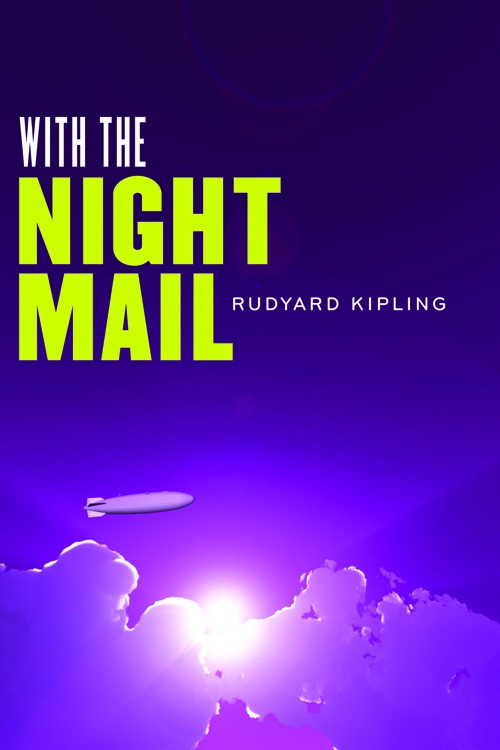
With the Night Mail by Rudyard Kipling (Hilobooks)

With The Night Mail

In 2012, Hilobooks will issue three classics of Radium Age science fiction including Rudyard Kipling’s With The Night Mail and As Easy as A.B.C., for which I have written the introduction.
With the Night Mail by Rudyard Kipling (Hilobooks)

On June 12
With the Night Mail, A Story of 2000 A.D. and “As Easy As A.B.C.”: Two Yarns About the Aerial Board of Control
By Rudyard Kipling
[978-1-935869-52-8]
By 2000 A.D, airships have replaced aircraft for freight and human travel. Kipling’s novella follows the exploits of an intercontinental mail dirigible battling foul weather, while detailing a planet-wide Aerial Board of Control (A.B.C.), which enforces a rigid system of command and control not only in the skies but in world affairs too; they outlaw war in 1967. Kipling got so excited by his own utopian vision that the story was accompanied by phony advertisements and other ersatz magazine clippings.

In Kipling’s 1912 followup story, “As Easy As A.B.C.,” set 65 years later, we learn just how complete the A.B.C.’s control is over the social and economic affairs of every nation. When a mob of disgruntled ‘Serviles’ in the District of Northern Illinois demands the return of democracy, the A.B.C. sends a team of troubleshooters (from England, Russia, Japan, and Italy) and a fleet of 200 zeppelins to retake the skies.

2012 marks the centennial of the publication of “As Easy As A.B.C.” “It is a glittering essay in the sham-technical; and real imagination, together with a tremendous play of fancy, is shown in the invention of illustrative detail.” — Arnold Bennett (1917). “A most remarkable little story… It is rather a fascist picture which Kipling gives us.” — Norbert Weiner, The Human Use of Human Beings (1950)

‘Once there was The People — Terror gave it birth;
Once there was The People, and it made a hell of earth!’
(Then the stamp and pause):
‘Earth arose and crushed it. Listen, oh, ye slain!
Once there was The People—it shall never be again!’

The levellers thrust in savagely against the ruins as the song renewed itself again, again and again, louder than the crash of the melting walls.

De Forest frowned.

‘I don’t like that,’ he said. ‘They’ve broken back to the Old Days! They’ll be killing somebody soon. I think we’d better divert ‘em, Arnott.’

‘Ay, ay, sir.’ Arnott’s hand went to his cap, and we heard the hull of the Victor Pirolo ring to the command: ‘Lamps! Both watches stand by! Lamps! Lamps! Lamps!’

‘Keep still!’ Takahira whispered to me. ‘Blinkers, please, quartermaster.’

‘It’s all right–all right!’ said Pirolo from behind, and to my horror slipped over my head some sort of rubber helmet that locked with a snap. I could feel thick colloid bosses before my eyes, but I stood in absolute darkness.

Introduction by Matthew De Abaitua, author of the science fiction novel The Red Men.

More at Hilobrow

The Art of Camping

My new book The Art of Camping: The History and Practice of Sleeping Under the Stars is published in paperback April 26th by Penguin. It explores the relationship between alternative culture and camping, from the radical idealism of woodcraft groups such as The Kindred of the Kibbo Kift to the progressive influence of the campfire. I have a separate all-camping site for the project, cathandmathcamping.com.

The Red Men by Matthew De Abaitua

Selected works

Piggy Banks for Significant Objects project

Significant Objects

My story Piggybank is part of the Significant Objects project and will be published in the Significant Objects anthology by Fantagraphics in 2011.
Piggy Banks for Significant Objects project
Significant Objects involved 100 writers creating stories about junk objects. The object and accompanying story were then sold on e-Bay, allowing the organisers to ascertain exactly how much value each story added to the object. My story went for about eleven dollars, I think. In the words of the press release, Significant Objects is “a bold online inquiry into the relationship between narrative and the value of everyday objects, [and] has been the subject of speculation by everyone from NPR to litbloggers to The New York Times’ Freakonomics crew.”

The Art of Camping cover by Matthew De Abaitua

The Art of Camping

I am hard at work writing a book about the history and characters of camping, to be published Summer 2011 by Hamish Hamilton and Penguin. It explores a left-hand trail through the woodcraft movements and into the counter-culture in search of what camping means and why we do it. The Art of Camping cover by Matthew De Abaitua