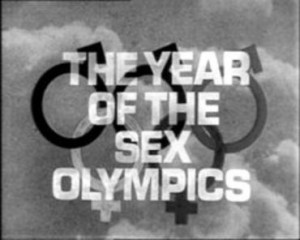
In the near-future, a media elite rule a dull-eyed society through television. The highpoint of their pacifying schedule is ‘The Year Of The Sex Olympics’, in which couples from around the country display their sexual prowess with the suburban smarm of ‘Come Dancing’ contestants.
Producers Nat Mender (Tony Vogel) and Lasar Opie (Brian Cox) lounge around the Sex Olympics studio, commenting on the skill of the performers while monitoring the reaction of their focus group, the aim being to keep them as docile as possible. The theory is that a glut of expertly-performed TV sex will act as a contraceptive against desire, curbing the numbers of the lumpen masses, or ‘lo-drive’ as they are called. Their hunger and rage is likewise satiated by ‘The Hungry Angry Show’, in which two half-naked fat men bellow and throw fish slop at one another.
Like ‘Castaway’ and ‘I’m A Celebrity Get Me Out Here’, the ‘Live Life Show’ entertains by exposing its pampered contestants to harsher, pre-modern ways of life
Penned by Nigel Kneale (‘Quatermass’) during the so-called sexual revolution, this BBC production aroused a similar controversy to those other landmark TV dramas of the decade, Cathy Come Home and The War Game. But The Year Of The Sex Olympics has had to wait until the 21st Century for its message to become truly pertinent.
Kneale’s vision of the future is so prophetic it is uncanny. The way the producers instantly consult focus groups anticipates both our ratings-obsessed TV culture, and the way in which the focus group has replaced democracy as the most influential expression of citizenship. Furthermore, the displacement of activity from ‘doing’ to ‘watching’ is the defining aesthetic of contemporary British television – cookery programmes for a country that no longer cooks, 24 hour TV shows you can watch instead of living.
An aspiring artist falls to his death. The focus group explodes into laughter
The final act of The Year Of The Sex Olympics is set within an around-the-clock reality TV show called the ‘Live Life Show’. Like ‘Castaway’ and ‘I’m A Celebrity Get Me Out Here’, the ‘Live Life Show’ entertains by exposing its pampered contestants to harsher, pre-modern ways of life. The three unfortunates are disillusioned TV exec Mender, his former lover and their young daughter. After spending their entire lives within a complex, they find the wind, the grass, and even the fire strange. With only a tape recording of instructions, they must survive in a cottage on a remote seemingly Scottish isle, their every act broadcast to a bovine nation.
Unfortunately for them, fellow executives Ugo Priest (Leonard Rossiter) and Opie have chanced upon a new way to entertain their audience: “fruit skin”. During a broadcast of clowns – which utterly fails to amuse their focus group – an aspiring artist falls to his death. The focus group explodes into laughter, and Priest remembers something from the old days, when people would laugh at things because it didn’t happen to them. The ambitious, amoral Opie decides to test this theory further, and he arranges for a murderer to visit Mender’s family.
Penned in a clipped argot (reflecting the debased language of an idiot box society), it takes a while for the audience (and the actors) to become comfortable with the futuristic language. Also there are those pesky BBC production values standing in the way of a whole-hearted suspension of disbelief. These glitches aside, the final act is as horrific as you would expect from a writer who gave us the shattering climax of ‘Quatermass And The Pit’ (“I saw a crowd fall upon a blind man. They tore him apart”) and Jane Asher’s descent into a cowled sacrificial ritual in The Stone Tape.
Matthew De Abaitua’s SF:UK feature on The Year Of The Sex Olympics and interview with Nigel Kneale can be watched here.


