Tag Archives: Matthew De Abaitua

“They only want you to do the wrong thing”

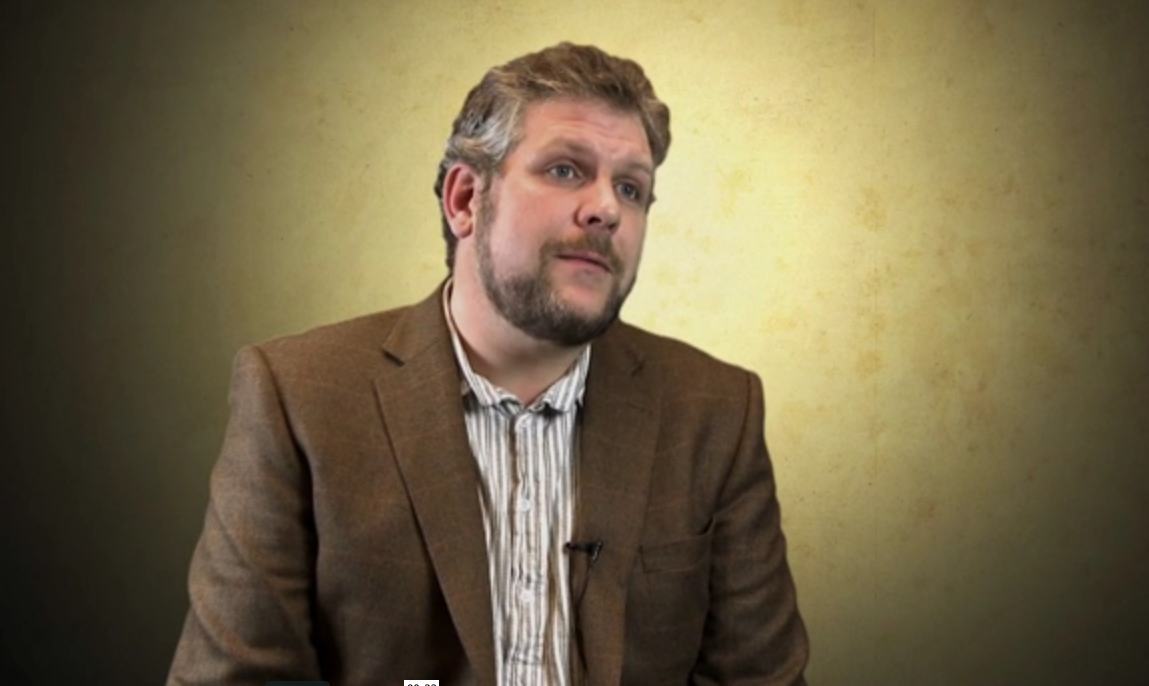
Jonathan Thornton visited me in Hackney for an interview he transcribed in its entirety for Fantasy Faction. I treated him to warm gozleme on Broadway Market and then coffee in the battered armchairs of Edgars. His transcription captures every molecule of caffeine in my brain. Our discussion ranged over my three SF novels and their connection to my book on camping. It can be read here.

Godforsaken – a short story

I wrote a new science fiction short story for Christmas. It’s called Godforsaken and it’s available for free at Barnes & Noble. It takes place in the same world as my science fiction novels.

Godforsaken

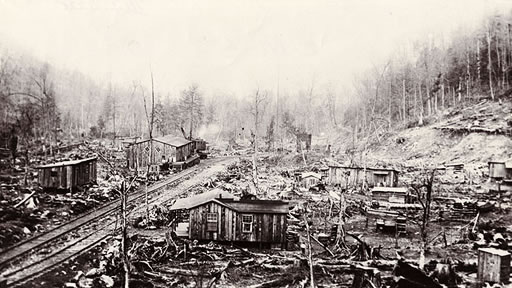
Of all the archive items the Institute has tagged for my inspection, the diaries and essays of Horace Emmons are the strongest candidate for entry into our shadow history of emergence. Particularly the entries covering the Christmas of 1921.

Emmons was – like myself – a librarian by trade. We share a certain loneliness too, as family men who have chosen to live apart from their families. My solitude, sequestered in the draughty rooms of the Institute, ought to be temporary. Emmons, after abandoning his wife and six children, was intent upon a permanent separation.

In the week before the Christmas of 1921, Emmons was struggling in the aftermath of an unspecified personal crisis. He had left the family home in October to undertake one of his habitual excursions into the Smoky Mountains then chosen not to return. In his diary, he avoids mention of his family. After spending Thanksgiving in the mountains, he notes only that the hunters arrived with leftover turkey in their sandwiches. Only in December does guilt encroach upon the margins of the diary. His day notes show resolve not to return to his family for Christmas Day. But the marginalia are shivering self-recriminations, scrawled and blotted under the dull glow of a campfire. I recognise the thought process, have felt it myself often enough.Nervous dyspepsia, as Emmons puts it. The towns and cities were dry with prohibition. Moonshine came from the stills hidden in the harsh country. The Mountain Dew. Emmons was a gentleman drunk and what he hymned as the call of the wild was, in my opinion, merely the holler of strong liquor.

To read on, click here.

Matthew De Abaitua reading IF THEN at Broadway Bookshop

IF THEN published in UK and US

My new novel IF THEN is out now, published by Angry Robot in the UK and US.

We launched the novel with signings at Forbidden Planet in London and Birmingham, and then a packed party in Broadway Books in Broadway Market, Hackney, just down the road from where I live.

Matthew De Abaitua, IF THEN, Phil Jourdan, Penny Reeve, Angry Robot

Me, editor Phil Jourdan and PR Penny Reeve from publisher Angry Robot

I’m keen to discover what readers make of IF THEN. To me, it represents a substantial advance in style, form and content over my debut novel The Red Men. There is a seven-year gap between the two novels. I’ve worked hard over the last four years in particular to improve my grasp of the various aspects of novel writing.

It may seem fussy to always set the title in upper case. But I prefer it that way as it reminds me of the software I used to write, from which the title is derived.

IF THEN has been listed by both I09 and Kirkus Reviews as being among the must-read science fiction and speculative fiction novels of autumn.

Early reviews have been positive.A round-up of them is below. I expect there will be more reviews to come.

“Matthew De Abaitua has written a novel about employment, about daily labour, about the dignity or otherwise of the working individual. IF THEN is a love story, the history of a marriage, a topical meditation on the end of capitalism; best of all, it is a bone-deep, blood-sweet British fantasy, naive and ingenious as William Morris and as warpedly nostalgic as Richard Jeffries’ After London. It is also the only intelligent book ever written about the technological singularity. As disturbingly hyperreal as any Pre-Raphaelite painting, IF THEN imagines what the end of history really will really look like, what’s really at stake, and maybe, just maybe, what we can do about it.” Simon Ings, author of Wolves.

‘Besides a surreal atmosphere, there is some perfectly executed and beautifully described weirdness in IF THEN. Every once in a while, just when things are starting to feel, if not normal, consistent, De Abaitua drops in reminders that the people of Lewes live in a manufactured reality, carefully controlled by something that can quantify, but not understand, humanity. I was drawn into James’ perceptions over and over just for us to be reminded that people and their actions were not genuine.’

I can’t recommend this book more highly. It’s slipstream fiction for polymaths. IF THEN flips off expectations of genre and leaves me feeling like I’m riding its shockwave into the future of literature.’

Karin Wellman, Boldly Read

‘IF THEN is personal and focused on small details, while at the same time addressing the big questions of life and what does it mean to be human. In a way it is an example of the personal made political, which is something that I really believe. Even if you think this isn’t a book for you, I’d urge you to take a chance on it, it really is a fascinating read.’ Susan Hated Literature

‘What follows is a meditation on violence and war. James finds himself working with Hector as a stretcher bearer in an artificial reconstruction of the Gallipoli campaign. Through James’s eyes we see the brutality and senselessness of war. We are forced to reflect on the way modern society normalises war and conflict for the many by concentrating the horror of it in a few. If Then asks us what value we place on people beyond their role as economic units, and whether we would rethink our actions if we were able to truly experience their consequences at first hand.’ Liwella, Astounding Yarns 

The Red Men by Matthew De Abaitua

The Red Men published by Gollancz

Gollancz  are delighted to be publishing an updated edition of Matthew De Abaitua’s Arthur C. Clarke Award-shortlisted debut novel The Red Men in eBook for the first time. The release will coincide with Film4’s worldwide digital release of Dr Easy, a short film based on The Red Men’s opening chapter, starring Tom Hollander and the voice of Geraldine James.

The Red Men by Matthew De Abaitua

Buy the ebook from Gollancz/Orion

Buy the ebook from Amazon UK

Buy the ebook from Amazon US

Marcus Gipps, editor at Gollancz, has acquired the UK and Commonwealth (ex Can) digital e-book rights to Matthew De Abaitua’s cult novel The Red Men from Sarah Such of Sarah Such Literary Agency, who has also recently sold The Red Men feature film rights to Warp Films, producers of This is England,Four Lions, and The Stone Roses: Made of Stone amongst many others.

Set in tomorrow’s Hackney, the novel’s ambitious executives and new technology satirise the modern workplace, where the Red Men of the title are an alluringly strange and prescient vision of the human cost of digital culture.

Dr Easy is written and directed by Shynola, multi-award-winning animators and directors of music videos for international bands including Coldplay, Radiohead, Beck and Blur. It is produced by Warp Films and shot by DOP Barry Ackroyd. It will premiere at Edinburgh International Film Festival 2013 the day before Film 4.0’s simultaneous worldwide online release on 21st June on film4.com and Vimeo, from where it can be embedded into other sites, with both platforms promoting its release heavily as part of a sustained digital marketing campaign to reach wider audiences.  Gollancz publish The Red Men (ebook) on 13 June 2013 at an introductory price of £2.99.

Marcus Gipps says: ‘We’re delighted to welcome Matthew to Gollancz, and thrilled that his remarkable novel will be available in eBook for the first time. With the forthcoming release of the very exciting short film Dr Easy, this is the perfect time to rediscover Matthew’s chilling vision of the near-future.’

Matthew De Abaitua says:  ‘It’s a great honour for me that The Red Men is appearing on the Gollancz imprint. I am always inspired by their SF Masterworks list, from Theodore Sturgeon’s More Than Human to Philip K Dick’s Ubik. And as the novel explores the outer possibilities of digital culture, I’m very pleased that Gollancz are making The Red Men available as an eBook for the first time.’

Buy the ebook from Gollancz/Orion

Buy the ebook from Amazon UK

Buy the ebook from Amazon US

Follow @MDeabaitua @Gollancz @SFGateway @SHYNOLAfilms  @WarpFilms @Film4  @SarahSuch

Hieroglyphic Monad of Dr John Dee painted outside Sainsbury's

Weird stuff happens to writers all the time

Like a lot of writers, I work in bed. The stolen time between dreaming and getting out of bed is vital for the compositional process. In this stolen time, I imagine the story, dream out what is to be written that day, and what will happen next. In dreams, I mine the rabbit hole and then just afterwards, I take a look at my haul and decide what to keep and what to throw back.
Our family life is busy and demanding, especially in the morning. I have to force myself to lie in bed throughout the various travails, pulling the duvet firmly over my head to screen out the sound of children arguing over cereal so that I can steal more time with dreamstate; extra time in bed can save me hours if not days of hacking away at the keyboard.
My wife is as understanding about this process as our circumstances allow. We play out variations upon the following conversation:
‘Are you going to get out of bed now?’
‘I’m working.’
Exasperation.
‘They are being sods.’
For the avoidance of doubt, “They” are the children.
‘But my characters live here.’
‘Under the duvet?’
‘In this moment. Please, I must return to them.’
‘Under the duvet.’
But they’ve gone. Chased away like fairies at the bottom of our garden.
There is no such thing as the unconscious. Dreams are random flushings that only become narrative at the moment of telling. I know all that. Still, writers continue to report peculiar phenomena when they are in the throes of a big fictional work. Books seem to fall open at just the right page. Overheard conversations supply exactly the right words. A road sign is suddenly pertinent. In a state of hyper-connectivity, everything pleads to be included in your creation. These are the times when it is necessary to go down the rabbit-hole. Slip the leash of control, let the imagination range around.
It was in such a mood, standing on Wilton Way in Hackney sometime in the previous decade, that I decided to incorporate into my novel The Red Men a vision of an enormous dosser on a park bench, a sozzled Gulliver attended to by numerous white-suited Lilliputians. In the novel, this giant figure is called Leto, a reference to the God Emperor of Dune, and he presides over an organisation called Dyad:  Dyad is about living in the land of do-as-you-please, the unbounded imagination, all the delights of the dreamstate and none of the horrors of breakfast.
The Red Men is a dialogue between the reality principle and the pleasure principle, between subordinating oneself to the will of others – as the narrator Nelson has done – or giving into the desire to dash one’s inner self all over the streets like so much terrible graffiti.  After writing the scene with the enormous drunken Leto, I decided to flick through the pages of a book and search therein for a portent as to whether The Red Men would ever find a publisher.
The book I chose for this task was Robert Anton Wilson’s Cosmic Trigger, as a good a resource as any for writers who have chosen to go headfirst down the rabbit hole.
I flicked through the pages of Cosmic Trigger, stopped at random, and jabbed my finger at a page.
The word I jabbed was ‘monad’.
This was peculiar because the name of Dyad’s rival company in the novel is Monad.
And monad is quite an unusual word. It crops up a bit in philosophy. According to Google’s Ngram, its peak usage was between 1895 and 1900, around the upsurge of Bergsonian philosophy, Theosophy, Vitalism, that kind of thing.
Nevertheless as portents go, it had – as they say in the corporate world – traction.
I’d already chosen the brand for Monad, taking it from the Hieroglyphic Monad of Dr John Dee, the Elizabethan wizard.

As I said, these kind of coincidences crop up a lot when you are writing. When you have your ear to the glass, and the glass is on the wall, and on the other side of that wall live the beings who stalk our imagination.

Alan Moore had warned me it would happen. I’m old enough not to dwell upon it.
Last week, after signing off the revised proofs of The Red Men for digital publication, I put my feet up to relax. My wife went to the shops and I had childcare to catch up on.
I thought back to the last time I had signed off proofs of the novel. I’d just sent them off to Shynola for them to read; they were deciding whether or not to go ahead and attempt to make the novel into a film when a minor character from the novel, a local figure I had drawn upon, knocked on their door.
They took it as a sign and decided to option the book.
This kind of thing happens all the time.
My wife returned from the shops.
‘Look at this,’ she said, holding out her phone. ‘I saw it scrawled outside Sainsbury’s.’
And this is what she saw. The Monad symbol in orange paint.
Happens all the time.

Hieroglyphic Monad of Dr John Dee painted outside Sainsbury's


father and son wearing trunks

Trunks

father and son wearing trunks

I have finally learnt to swim properly. For months, I have been gamefully thrashing away with a breaststroke undeveloped since the mid-1980s, keeping my head above water at all times and exiting the pool with a distinct pain in the neck. This style of breaststroke, in which the swimmer attempts to preserve their hairdo at all cost, served me well on the three or four occasions, in the previous twenty years, that I exercised.

Now that I am forty, and attempting to outswim death, a more efficient stroke is required; after an evening with Google, some terrible advice from a content farm (“Inhale when your face is in the water, and exhale when it is out” – thanks eHow). and the purchase of some goggles, I did it; I stopped swimming like an old lady.
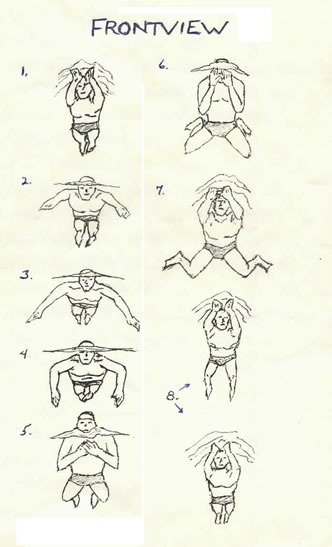
Directions on how to swim breaststroke

I glided alongside the proper swimmers in the grown-up lanes. Pausing for breath in the shallow end, I had a faint muscle memory. Something in my childhood to do with running with the big kids. No, not running. But something like running.

“The Frenchmen on the sun loungers were

hirsute and wore tiny speedos stuffed with

roadkill”

After changing, I sat in the leisure centre lounge sipping hot chocolate and the memory returned: boys cycling down Newlyn Avenue near to my family home, and me cycling to keep up with them. No, wait. Not cycling. I didn’t have a bike. Not then. I was five or six years old. The other boys were going so fast on their bikes and I was thrashing away trying to keep up, doing a kind of breaststroke. Surely not. How could they have been riding and I swimming?

To answer that question, we must inspect my trunks. I’ve been swimming four miles a week for five months and yet only last weekend did I buy a pair of goggles and – more crucially – a new pair of trunks. The elastic had withered on my old trunks and I was reduced to tying them in place with knotted boot laces. These old trunks had been purchased for a camping holiday twenty years earlier, pointlessly as it turned out, as the French swimming pools would not admit a man in boxer short-style trunks; the pool bouncer tutted his index finger at my big trunks and pointed approvingly at the various Frenchmen on the sun loungers; they were hirsute and wore tiny speedos stuffed with roadkill.

Manly swimming trunks

I had owned the trunks for so long and used them so infrequently that I forgot they were trunks at all. During a sweltering summer, I was talking to my girlfriend on the phone and observed that it was so hot that I had taken the risk of coming into the office – I worked at the Guardian at the time – in my shorts. “But you don’t own any shorts, Matthew,” said Cath. We used to call Cath the Truth because of the way she undercut our illusions. In this case, the illusion that the trunks were shorts and the further illusion that it would be acceptable to come to work at a national newspaper, even one as famously liberal as The Guardian, in them. I exited the office as briskly as my crouch permitted.

So we are stacking up questions here: why didn’t I own a proper pair of shorts? Why did it take me so long to replace a pair of twenty year-old trunks? If I am swimming five miles every week, why wait six months before buying a pair of goggles? And why did I have a muscle memory of doing the breaststroke down Newlyn Avenue when all the other boys were on their bikes?

I was raised to be frugal. My mother believes in making the best of what you’ve got and not needlessly expending resources on fripperies such as trunks or bikes. This was why, when the other boys pedalled their unnecessary bikes down Newlyn Avenue, I  luged alongside on a plastic turtle, its casters jiggling manically over the tarmac. The turtle was green. It could go at a fair clip, downhill. But it was never designed to be a mode of transport. The arm action required to power it was similar to the pushing down part of breaststroke, hence the muscle memory. Also there was something familiar in my desperation to keep up with the big boys despite being hopelessly under-equipped for the job.

When I got home after swimming, I told all this to Cath. She’s my wife now so she knows all about the turtle-that-was-not-a-bike.

“You’ve grown, though,” she said. “You can buy goggles now. You can recognise what needs to be done, and do it. You’ve learnt an important lesson for a forty-year-old man. Sometimes making do is not good enough. To preserve our dignity, sometimes we actually have to go to the shops.”

Turtle on wheels

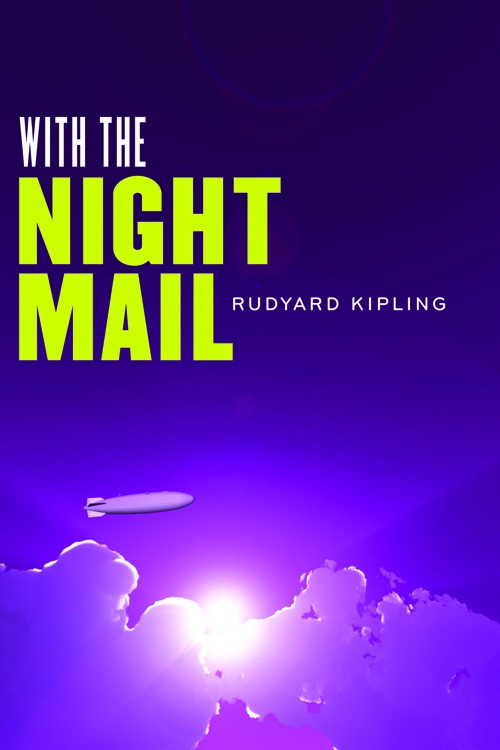
With the Night Mail by Rudyard Kipling (Hilobooks)

With The Night Mail

In 2012, Hilobooks will issue three classics of Radium Age science fiction including Rudyard Kipling’s With The Night Mail and As Easy as A.B.C., for which I have written the introduction.
With the Night Mail by Rudyard Kipling (Hilobooks)

On June 12
With the Night Mail, A Story of 2000 A.D. and “As Easy As A.B.C.”: Two Yarns About the Aerial Board of Control
By Rudyard Kipling
[978-1-935869-52-8]
By 2000 A.D, airships have replaced aircraft for freight and human travel. Kipling’s novella follows the exploits of an intercontinental mail dirigible battling foul weather, while detailing a planet-wide Aerial Board of Control (A.B.C.), which enforces a rigid system of command and control not only in the skies but in world affairs too; they outlaw war in 1967. Kipling got so excited by his own utopian vision that the story was accompanied by phony advertisements and other ersatz magazine clippings.

In Kipling’s 1912 followup story, “As Easy As A.B.C.,” set 65 years later, we learn just how complete the A.B.C.’s control is over the social and economic affairs of every nation. When a mob of disgruntled ‘Serviles’ in the District of Northern Illinois demands the return of democracy, the A.B.C. sends a team of troubleshooters (from England, Russia, Japan, and Italy) and a fleet of 200 zeppelins to retake the skies.

2012 marks the centennial of the publication of “As Easy As A.B.C.” “It is a glittering essay in the sham-technical; and real imagination, together with a tremendous play of fancy, is shown in the invention of illustrative detail.” — Arnold Bennett (1917). “A most remarkable little story… It is rather a fascist picture which Kipling gives us.” — Norbert Weiner, The Human Use of Human Beings (1950)

‘Once there was The People — Terror gave it birth;
Once there was The People, and it made a hell of earth!’
(Then the stamp and pause):
‘Earth arose and crushed it. Listen, oh, ye slain!
Once there was The People—it shall never be again!’

The levellers thrust in savagely against the ruins as the song renewed itself again, again and again, louder than the crash of the melting walls.

De Forest frowned.

‘I don’t like that,’ he said. ‘They’ve broken back to the Old Days! They’ll be killing somebody soon. I think we’d better divert ‘em, Arnott.’

‘Ay, ay, sir.’ Arnott’s hand went to his cap, and we heard the hull of the Victor Pirolo ring to the command: ‘Lamps! Both watches stand by! Lamps! Lamps! Lamps!’

‘Keep still!’ Takahira whispered to me. ‘Blinkers, please, quartermaster.’

‘It’s all right–all right!’ said Pirolo from behind, and to my horror slipped over my head some sort of rubber helmet that locked with a snap. I could feel thick colloid bosses before my eyes, but I stood in absolute darkness.

Introduction by Matthew De Abaitua, author of the science fiction novel The Red Men.

More at Hilobrow

The Art of Camping

My new book The Art of Camping: The History and Practice of Sleeping Under the Stars is published in paperback April 26th by Penguin. It explores the relationship between alternative culture and camping, from the radical idealism of woodcraft groups such as The Kindred of the Kibbo Kift to the progressive influence of the campfire. I have a separate all-camping site for the project, cathandmathcamping.com.