Tag Archives: science fiction

The Red Men by Matthew De Abaitua

The Red Men published by Gollancz

Gollancz  are delighted to be publishing an updated edition of Matthew De Abaitua’s Arthur C. Clarke Award-shortlisted debut novel The Red Men in eBook for the first time. The release will coincide with Film4’s worldwide digital release of Dr Easy, a short film based on The Red Men’s opening chapter, starring Tom Hollander and the voice of Geraldine James.

The Red Men by Matthew De Abaitua

Buy the ebook from Gollancz/Orion

Buy the ebook from Amazon UK

Buy the ebook from Amazon US

Marcus Gipps, editor at Gollancz, has acquired the UK and Commonwealth (ex Can) digital e-book rights to Matthew De Abaitua’s cult novel The Red Men from Sarah Such of Sarah Such Literary Agency, who has also recently sold The Red Men feature film rights to Warp Films, producers of This is England,Four Lions, and The Stone Roses: Made of Stone amongst many others.

Set in tomorrow’s Hackney, the novel’s ambitious executives and new technology satirise the modern workplace, where the Red Men of the title are an alluringly strange and prescient vision of the human cost of digital culture.

Dr Easy is written and directed by Shynola, multi-award-winning animators and directors of music videos for international bands including Coldplay, Radiohead, Beck and Blur. It is produced by Warp Films and shot by DOP Barry Ackroyd. It will premiere at Edinburgh International Film Festival 2013 the day before Film 4.0’s simultaneous worldwide online release on 21st June on film4.com and Vimeo, from where it can be embedded into other sites, with both platforms promoting its release heavily as part of a sustained digital marketing campaign to reach wider audiences.  Gollancz publish The Red Men (ebook) on 13 June 2013 at an introductory price of £2.99.

Marcus Gipps says: ‘We’re delighted to welcome Matthew to Gollancz, and thrilled that his remarkable novel will be available in eBook for the first time. With the forthcoming release of the very exciting short film Dr Easy, this is the perfect time to rediscover Matthew’s chilling vision of the near-future.’

Matthew De Abaitua says:  ‘It’s a great honour for me that The Red Men is appearing on the Gollancz imprint. I am always inspired by their SF Masterworks list, from Theodore Sturgeon’s More Than Human to Philip K Dick’s Ubik. And as the novel explores the outer possibilities of digital culture, I’m very pleased that Gollancz are making The Red Men available as an eBook for the first time.’

Buy the ebook from Gollancz/Orion

Buy the ebook from Amazon UK

Buy the ebook from Amazon US

Follow @MDeabaitua @Gollancz @SFGateway @SHYNOLAfilms  @WarpFilms @Film4  @SarahSuch

Apple in-store monolith

Science, magic and the iPhone

In The Red Men, the characters do not use computers, they use screens. These screens are pliable and can move around in response to haptic gestures or remote commands. They float on a cushion of air across the floor and can winnow out into a large landscape format or shrink down to fit into your palm.

“Gelatinous screens billowed out like spinnaker sails to catch the data pouring in.”

The novel was written just before the advent of the iTouch but I claim no special prophecy. Screen-based user interfaces were prevalent in SF and Bill Gates’ living room and appear in everything from Star Trek: Next Generation to Minority Report.

I made the screens soft. The prospect of a flexible quasi-organic screen fascinated me, and I visualised them as floating medusa jelly fish capable of exercising limited volition of their own. By the mid-section of the novel, robots wrap themselves in screens to project a different appearance. Characters are suffocated by these screens too.

Editing the novel this week in preparation for its digital publication, I‘ve been adding to the set of haptic gestures the characters use to operate the screens. With tablets we are accustomed to the swipe, the three-finger flick, the two-finger scroll. But why not a screen that sparks to life at the click of your fingers? Or a blown kiss? Or a beckoning index finger? When will I be able to stroke my screen and make it purr like a cat? Or whistle for it to come to me like a dog? Tomorrow presumably.

A useful repository of haptic gestures can be found in magic. The wave of a wand. The magic finger firing lightning bolts. ‘Open sesame’ combines voice recognition with security protocol.

Exploiting the potential of magic to conceptualise user interfaces is key to marketing the next generation of tech.

Apple already know this.
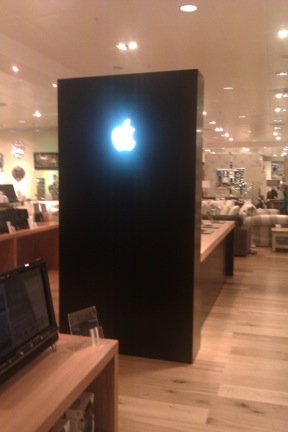
In-store Apple monolith
Uh, er…
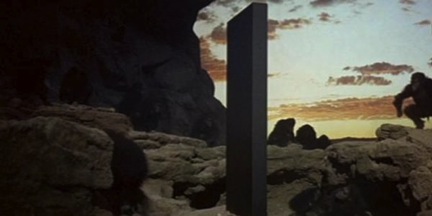
Monolith from 2001: A Space Odyssey

Apple took Arthur C Clarke’s line that, ‘Any sufficiently advanced technology is indistinguishable from magic’ as a guide for their design aesthetic. The copy for the iPad promised, “A magical and revolutionary product at an unbelievable price”. That’s three mystical promises in one sentence. People who are really into technology hate Apple because it promotes magical thinking and denies or conceals the reality of the tech.

The tablet or smartphone is anticipated by the black scrying mirror of Elizabethan magus Dr John Dee. In The Red Men, the futuristic company takes a sigil from John Dee as its logo. The title of Charlie Brooker’s science fiction TV series ‘Black Mirror’ closes the loop for us between tomorrow’s tech and magic.
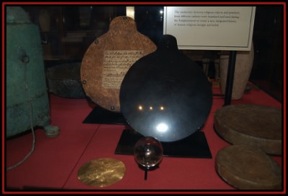
the black scrying mirror of Dr John Dee

Someone invented a nice screen for the first episode of the second series of Black Mirror. Notice the character is using it to paint and draw and not to code. You will increasingly see advanced technology sold with images of craft and finger-painting and suchlike. It’s the best way to make the tech appear homely and modelled around the individual.
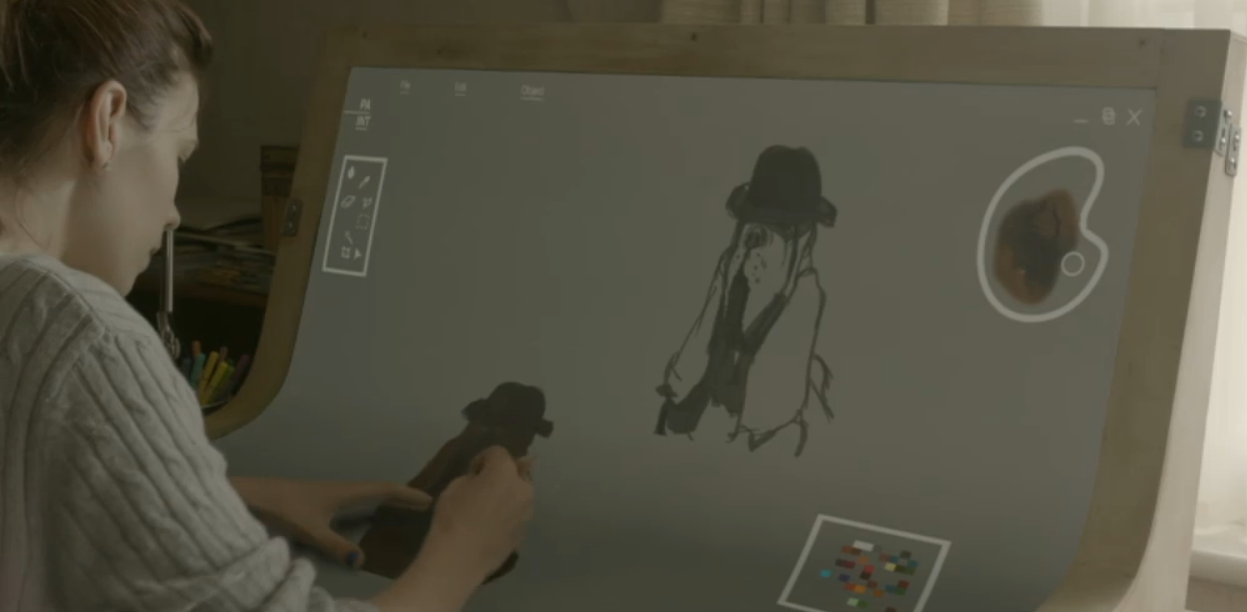
The screen from Charlie Brooker's Black Mirror
We will only recognise a technology as truly advanced only when it is wrapped and concealed with a layer of magic. No sooner had this thought coalesced than I was reminded of the copies of Harry Potter’s Book of Spells, an augmented reality Playstation game. Sell technology that helps you imagine yourself as a wizard.

Richard Matheson’s classic horror SF novel I Am Legend devises scientific explanations for the supernatural phenomena of vampires. It digs around in medical textbooks for plausible physiological explanations for vampirism.   One of my favourite workshops with my science fiction students this term was asking them to devise scientific explanations for magical artefacts: I particularly enjoyed one student using quantum entanglement to explain how Voodoo dolls work. Superheroes mix up science gods and supernatural monsters; the co-existence of the magical with the scientific, of Iron Man and Thor, is a quirky paradox that is creatively generative for the Marvel Universe.

We divide science fiction from fantasy because one features magic and the other features technology that behaves like magic. Here’s Adam Roberts from his History of Science Fiction:
‘Science fiction, in contemporary publishing and bookselling practice, is distinguished from “Fantasy”, the latter involving fantastic or non-realistic form in which the mechanism for fantasy is magic rather than technology.’

Lord of the Rings revolves around a magical ring. The magic sword of Excalibur. Aladdin’s magic lamp. The next generation of digital accessories, that is, Google’s glasses, Apple’s watch, Microsoft’s handbag with a portable hole in it, will be magical implements.

Adam Roberts’ history of science fiction is founded upon ‘a historicised definition of SF as that form of fantastic romance in which magic has been replaced by the materialist discourses of science.’

One of the crucial decisions I made when writing The Red Man was whether to give in to the imaginative allure of magic which, in the late 1990s, roved around an axis of techno-narco-mysticism. In the novel, I used gnosticism as a cover for zealotry in the American power structure, whether it was the Christian fundamentalism of George W Bush or the anarcho-libertarianism of the tech gurus. That Gnosticism has a strong connection to science fiction through Phillip K Dick’s Valis experience only pushed me further down that path. In The Red Men, the artificial intelligence Ezekiel Cantor is understood by the Monad management in terms of their gnostic beliefs. The original inspiration for The Red Men was Kurzweil’s The Physics of Immortality, as succinct an expression of our desire to see, in the future of science, a way of fulfilling our mystical yearnings. The title of William Gibson’s Neuromancer makes the same point.

The Red Men is built around a dialectic of technology and mysticism, expressed in the rival yet inter-dependent companies of Monad and Dyad, two sides of one artificial intelligence. Looking back at my decision all those years ago to push the novel out into mysticism, I regard it now as a florid but permissible response to an abiding cultural dialectic, and not merely an unwarranted or ill-disciplined diversion.

Also, screens have moved on. And soon they will be moving on of their own volition.
Sun Ra

HiLobrow hero: Sun Ra

My brief appreciation of Sun Ra is at HiLobrow.

To write of SUN RA (1914–93) is to balance Saturn upon an egg cup. He was born Herman Poole Blount in Birmingham, Alabama, a fact he obscured. An unearthly child prodigy, Herman went on to found a swing band and meet with Duke Ellington. Pouring over the Duke’s sheet music, he was emboldened when he discovered that the Duke used dissonance in his rhythms in a way that corresponded to Herman’s own theory of music.

With the onset of the draft for World War II, Herman was briefly imprisoned for conscientious objection. An intellectual, he conducted his own impassioned legal defense but to no avail. Prison brought the unworldly Herman to the edge of suicide. He was afraid of the violence of normal people, and their self-destructiveness, and wrote in his diary that he was indifferent to sex: “My orchestra and the management of it, the arranging and composing, the rehearsing, the developing of potential talent, that is my work and the only earthly pleasure I love.” Total immersion in the imagination demands self-reinvention. He renamed himself Sun Ra and sought out a group of musicians who were equally devoted to their art.

The Sun Ra of popular culture is a high watermark of the far-out. In the film Space Is The Place, Sun Ra quietly mocks the tendency of white counter-culture to project druggy transcendentalism upon his art. Space, he points out, is not just high. It is also as low as a bottomless pit. His incantations are calls to arms — “Space Is The Place,” “Rocket Number Nine Take Off For The Planet Venus” — that sound lonely and desolate. When June Tyson sings “We Travel The Spaceways,” you imagine a massive spaceship with only one passenger.

HiLobrow hero: Russell T Davies

My brief appreciation of Russell T Davies, the man who revived Doctor Who, is here at HiLobrow.com.

I could have written at much greater length about his work on Doctor Who. The show obsesses my family. I have three children ranging from two to eight years old. Across her repeated viewings, my eldest child Alice has noticed things that I have missed – are the shadows that kill the parents of the narrator of Love & Monsters the Vashta Nerada that appear in Silence of the Library, she wonders? Last week she declared Jon Pertwee’s Planet of the Spiders to be the scariest episode, and explained to me the similarity between the spiders that squat invisibly upon the backs of their victims, and the fate changing beetle that besets Donna in Doctor Who (my portrait of Russell T Davies appreciates his creative looting).
Every time I watch Doctor Who I do so in the company of children: I see what excites them, what annoys or bores them, and their reactions are mostly the same as mine – it’s very rare they will like something I do not. There is a universal appeal. What I think Russell T Davies did, that other great science fiction revivals have avoided or failed to do, is engage the family, and that’s not an achievement to be treated sniffily.

Hilobrow – John Carpenter

John Carpenter on the set of Ghosts of Mars with Ice Cube

John Carpenter on the set of Ghosts of Mars with Ice Cube

Few cultural scraps are as redolent of lo-fi VHS genre pleasures than a movie trailer with JOHN CARPENTER’s (born 1948) name above the title and his own analog synth score. Carpenter’s breakthrough was Dark Star (1974), a wiseass repudiation of 2001: A Space Odyssey’s intergalactic awe. Bits of the movie’s code can be discerned in the DNA of Douglas Adams’ Hitchhiker’s Guide to the Galaxy (chirpy talking bombs and planet-destroying contractors); the SF:UK comedy series Red Dwarf (opening credits featuring a Country & Western number playing over a shot of a sauntering space ship); and — via Dan O’Bannon, who co-wrote both — Ridley Scott’s Alien.

Read the full article at Hilobrow.com

Here is a highly misleading Dark Star trailer that makes no mention of comedy

Jonny Mugwump’s Weird Tales For Winter

Starting on midnight of the 25th January, Resonance FM will be broadcasting a series of specially-commissioned collaborations between writers and musicians, Weird Tales For Winter, curated by the incomparable Jonny Mugwump.

The Dinner Party Wars by Matthew De Abaitua and West Norwood Cassette Library

The Dinner Party Wars by Matthew De Abaitua and West Norwood Cassette Library

The first story sees Moon Wiring Club work on a short piece by the late Nigel Kneale, author of Quatermass, The Stone Tape and The Year of the Sex Olympics. I had the honour of interviewing Nigel Kneale for my TV show SF:UK, which you can watch here.
The second Weird Tale for Winter is my own The Dinner Party Wars, a story I rewrote and performed after the death of JG Ballard, as my own modest tribute to the great prophet of futuristic psychopathy. The West Norwood Cassette Library have done a fantastic job in hewing, smoothing and varnishing my raw recording, adding a rumbling bassline and various sonic constructs that any writer would be pleased to find himself within.

The Stone Tape

It’s hard for 21st Century whippersnappers to appreciate the impact Nigel Kneale’s 1950s Quatermass serial had on the nation. Back when there was only one channel, and the programmes all went out live, a writer could step out of Alexandria Palace, look out across the TV aerials rigging the dark London skyline and know that everyone with a set had just been watching his show.

stone tape title card

The Stone Tape

Pubs emptied for Quatermass, especially the second series, Quatermass And The Pit, a landmark in sci-fi horror later remade by Hammer. That’s why the BBC – when faced with filling the Christmas Day schedule in 1972 – turned to Kneale, commissioning a ninety minute ghost story to follow the traditional Morecambe And Wise special. The Stone Tape was the result.

A group of computer experts (think ZX Spectrum guru Clive Sinclair and his Open University mates) hole up at a stately home to invent a data storage medium that will restore Britain to the forefront of the information revolution and, as their leader Peter Brock (Michael Bryant) says, “put the boot in old Nippon”. But while clearing out a room in which to store their anachronistically immense computers, they disturb ghosts. Being scientists, the researchers decide to knuckle down and study the ghosts, discovering that the shades appear to be unthinking recordings of old presences, imprinted upon the stone walls, rather than self-aware phantoms. Could this stone be the storage medium they are looking for?

The performances have the exaggerated, stagey quality typical of the era, particularly Bryant’s philandering team leader, who fills out his beige slacks with thrusting actorly presence. Jane Asher is both heroic and disturbed as his mistress, doing some decent work before her career went into a period of doily purdah. Aside from the script, the best work here is done by the BBC Radiophonic Orchestra – their avant garde electronica burbles sinisterly in the background; the robotic death-fantasies of physics teachers.

Made on the cusp of the peak year in British horror (Don’t Look Now and The Wicker Man were just around the corner) The Stone Tape is profoundly disturbing, especially at the climax, which taps into deep evil.